The U.S. Navy just fired its first shots in a blockade that could strangle Iran’s economy and ignite a regional war that makes every previous Middle East conflict look like a skirmish.
Story Snapshot
- U.S. forces seized the Iranian cargo vessel Touska after a six-hour standoff in the Gulf of Oman, marking the first use of force in a week-old naval blockade that has already turned back 25 ships.
- The seizure threatens a fragile ceasefire between the U.S., Israel, and Iran set to expire this week, with Iran condemning the action as “maritime armed robbery” and threatening drone retaliation.
- President Trump issued stark warnings to Iran’s leadership, threatening strikes on energy infrastructure and bridges if Tehran refuses to negotiate, while dispatching diplomats to Pakistan-mediated peace talks.
- Despite headlines claiming otherwise, Iran has not fully closed the Strait of Hormuz, though Tehran maintains significant control over the waterway that channels roughly 20 percent of global oil supplies.
Six Hours of Warnings Before the First Shot
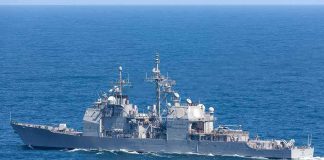
The USS Spruance, a guided missile destroyer, shadowed the Iranian-flagged Touska for six hours Sunday as the cargo vessel steamed toward Bandar Abbas. Verbal warnings crackled across maritime channels repeatedly. The destroyer’s crew gave the Iranians every opportunity to turn around. When the Touska’s captain refused to comply, U.S. forces fired disabling shots into the vessel’s engine room. Marines then boarded and seized control. CENTCOM released video footage showing the entire sequence, a deliberate move to establish an unambiguous public record of Iranian defiance and measured American response.
This seizure represents the first time the week-old blockade has escalated beyond peaceful turnbacks. Twenty-five other vessels heeded warnings and reversed course without incident. The Touska’s owners, tied directly to the sanctioned Iranian government, apparently calculated that Trump was bluffing. They miscalculated badly. The vessel now sits in U.S. custody despite Iranian claims that their forces repelled the Americans, a narrative contradicted by video evidence and multiple independent reports from allied naval observers in the region.
A Ceasefire Already on Life Support
The timing couldn’t be worse for diplomacy. A ceasefire agreement involving the United States, Israel, and Iran was already strained by mutual accusations of violations before Sunday’s naval confrontation. Both sides claim the other fired first, launched unauthorized strikes, or otherwise breached terms. The agreement expires within days, and the Touska incident gives hardliners in Tehran exactly the excuse they need to walk away from negotiations. Trump’s decision to send a delegation to Pakistan for mediation talks looks increasingly futile when warships are trading fire in international waters.
Iran’s foreign ministry branded the seizure illegal aggression and vowed consequences. Those threats aren’t empty bluster. Iranian forces have already deployed drones targeting U.S. assets in the region, according to military sources. The Pentagon has positioned over 50,000 troops across the Middle East, with more en route. The USS Gerald R. Ford carrier strike group is now operating in the Red Sea after transiting the Suez Canal, marking the longest continuous carrier deployment since Vietnam. This massive military buildup signals American resolve, but it also creates a powder keg where a single miscalculation could trigger full-scale war.
Trump’s Ultimatum and Iran’s Defiance
President Trump made his position brutally clear on social media following the seizure. He threatened direct strikes on Iran’s energy infrastructure and bridges if Tehran refuses to negotiate in good faith. “No more Mr. Nice Guy,” he declared, a phrase that would be almost comical if it weren’t attached to the world’s most powerful military. The threats represent classic Trump negotiating tactics: apply maximum pressure, then offer a deal. Whether Iran’s leadership will bend or double down on confrontation remains the critical question determining whether the region slides into open warfare or pulls back from the brink.
Iran’s government responded with characteristic defiance, announcing they would not participate in the Pakistan-mediated talks due to distrust exacerbated by the naval incident. This rejection strands American diplomats in Islamabad with no Iranian counterparts to negotiate with, leaving military action as the primary remaining lever. The Strait of Hormuz, that narrow chokepoint controlling a fifth of global oil transit, becomes the logical focal point for escalation. Iran maintains a firm grip on the waterway through coastal missile batteries, fast attack boats, and strategically positioned naval assets, even if they haven’t enacted a full closure as some reports erroneously suggested.
What Happens When the Ceasefire Expires
The next 72 hours will determine whether this confrontation freezes at current tensions or explodes into something far worse. If the ceasefire collapses without replacement, Israel will likely resume strikes against Iranian proxies in Lebanon and Syria. Iran will retaliate against U.S. naval forces and possibly Israeli territory. The blockade will tighten further, potentially provoking Iranian attempts to close the Strait of Hormuz entirely, which would send global oil prices soaring and force a military response from not just America but European allies dependent on Gulf energy supplies.
Former Trump National Security Advisor John Bolton called the seizure a significant escalation, while retired NATO commander Wesley Clark warned that control of the Strait of Hormuz represents the real strategic prize both sides are maneuvering to secure. Their analyses underscore a grim reality: this isn’t just about one cargo ship. The Touska seizure is a test case for whether the United States will enforce its blockade with lethal force if necessary, and whether Iran will accept economic strangulation or fight back with every asymmetric weapon in its arsenal. The cease-fire was always fragile, built on mutual exhaustion rather than genuine resolution. Now it appears ready to shatter completely, leaving the world to cope with consequences that could reshape energy markets, military alliances, and the balance of power across the entire Middle East for a generation.
Sources:
Trump seizes Iranian vessel – ceasefire winding down