
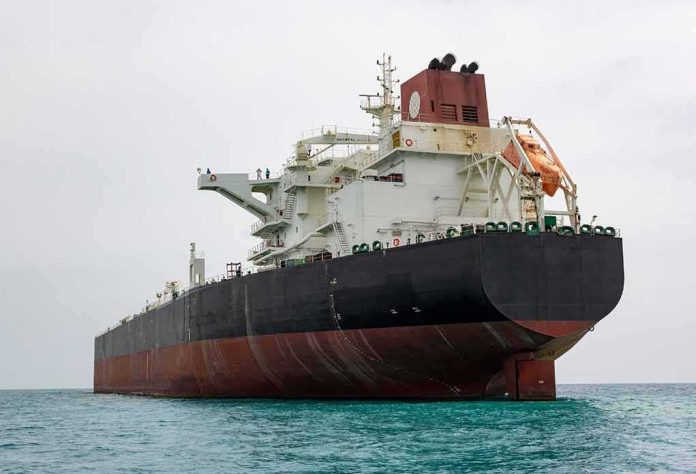
A fiery new warning from President Trump tells Iran that if it strangles the Strait of Hormuz, it risks losing the very country its regime is trying to control.
Story Snapshot
- Trump links Iran’s threats over the Strait of Hormuz to the survival of the regime in Tehran.
- The White House vows overwhelming force, from naval blockades to strikes on power plants, if oil flow is blocked.[9]
- Iran claims it can close the waterway and hints at attacks on U.S., Israeli, and Gulf energy targets in return.[8]
- The fight over this narrow waterway could decide global energy prices and America’s role as a superpower.[19]
Why the Strait of Hormuz Matters to Your Wallet and Western Freedom
The Strait of Hormuz is a narrow stretch of water off Iran’s coast, but it carries a huge share of the world’s traded oil.[20] When Iran tries to shut it down, gas prices spike, markets shake, and your family budget takes the hit. Experts describe it as a key chokepoint that can be used to squeeze the global economy and test American resolve.[21] That is why both Republican and Democrat administrations have treated any serious threat to close it as a red line.[18]
Today’s crisis did not start in a vacuum. After years of weak responses, appeasement deals, and cash flowing to Tehran under past globalist policies, Iran built up its missile forces, armed terror proxies, and grew bold in the Persian Gulf.[20] Under President Trump, Washington shifted to maximum economic and military pressure, hitting Iran’s nuclear sites and warning that any move to block the strait would be met with far greater force than before.[1] This is the clash we are now watching play out in real time.
Trump’s Ultimatums: Open the Strait or Face Devastating Force
President Trump has drawn a clear line: if Iran stops the flow of oil through the Strait of Hormuz, the United States will hit back “TWENTY TIMES HARDER” than before, with “Death, Fire, and Fury” that could make it “impossible for Iran to ever be built back, as a nation, again.”[1] In another ultimatum, he warned that if Iran does not fully open the strait within 48 hours, the United States will obliterate its major power plants, starting with the biggest one.[2][9]
These threats are not empty. The United States has already carried out large precision strikes on Iran’s nuclear facilities, which Trump says “totally obliterated” its enrichment capacity.[1] The Pentagon has surged Navy forces into the Gulf and is enforcing a naval blockade that has choked trade in and out of Iranian ports.[23] Analysts note that if Iran really tries to close the strait, the United States military would almost certainly succeed in reopening it, even if it takes significant time and cost.[18] For Trump, the message is simple: America will not let a terror regime hold the world hostage.
Iran’s Counter‑Threats and the Risk of Wider War
The Iranian regime is trying to flip the script and claim it is only “reacting” to U.S. and Israeli actions. State media and military statements have announced closures or tight control of the strait, demanding that Washington lift its naval blockade and ease pressure before traffic can flow freely again.[10][12][13] Iranian commanders talk about laying sea mines “across the entire Persian Gulf” and letting only ships with Revolutionary Guard approval pass.[12]
Tehran is not just talking about the waterway. Iranian officials threaten to attack U.S. bases, Israeli cities, Gulf ports, and energy infrastructure if America hits its power plants or keeps tightening the blockade.[8][23] This fits a long pattern where Iran uses the strait as leverage and mixes threats, proxy attacks, and media spin to spook global markets.[19] For everyday Americans, that means the price for weakness is paid at the pump and in a more dangerous world for our troops and allies.
Can Iran Really Shut the Strait — and What Would It Take to Stop Them?
Many viewers hear “closure of the Strait of Hormuz” and picture global shipping frozen for months. Military studies paint a more complex picture. Iran can harass, slow, and temporarily disrupt traffic with mines, fast boats, missiles, and drones, but its ability to fully stop oil flow for long is limited.[22] Tankers are tougher targets than most people think, and large minefields would likely damage fewer ships than pass through in a single day.[22]
Because of that, U.S. planners talk about a “war of endurance,” not a quick knockout punch.[19] Washington can “blockade the blockaders” by controlling access to Iranian ports and seizing forward bases and platforms used by Iran’s forces.[18] In past plans, American commanders even considered seizing certain Iranian islands and destroying offshore platforms to strip away Iran’s eyes and staging points in the Gulf.[18] That kind of operation would be serious and costly, but it underlines a key point: if the regime tries to shut the strait, it risks inviting the very ground and sea campaign that could break its grip on the country itself.
Sources:
[1] Web – Iran-US war latest: Trump warns Tehran ‘we will take over your …
[2] Web – President Donald Trump addresses nation after US strikes on Iran
[8] Web – President Trump called off air strikes against Iran, saying … – …
[9] Web – Iran Update Special Report, June 22, 2025, Evening Edition | ISW
[10] Web – CSIS | Center for Strategic and International Studies
[12] Web – 2026 Strait of Hormuz crisis – Wikipedia
[13] YouTube – Iran says its closing Strait of Hormuz again until US lifts …
[18] Web – U.S. DENIES IRAN’S CLAIM OF HORMUZ STRAIT CLOSURE U.S. …
[19] Web – [PDF] Iran’s Threat to the Strait of Hormuz – UM Carey Law
[20] Web – Iran’s Strait of Hormuz Gambit and the Limits of U.S. Military Power
[21] Web – Everything you need to know about the Strait of Hormuz – WBUR
[22] Web – “It has long been known that the Strait of Hormuz is a really …
[23] Web – Strait of Hormuz – Assessing the Threat – Strauss Center