
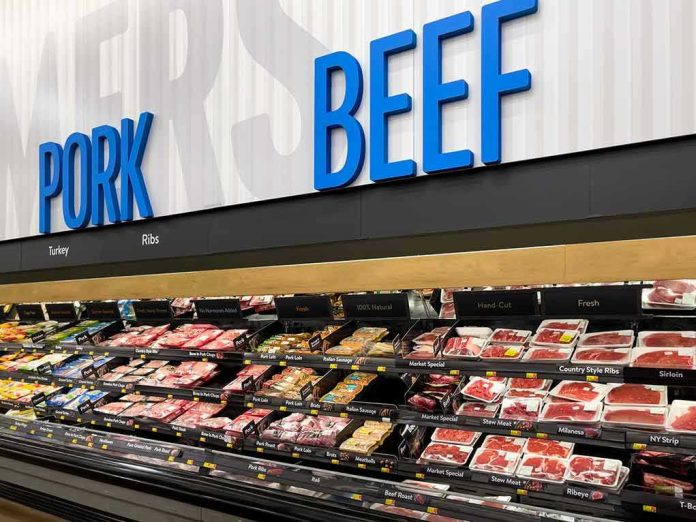
When governments try to cut everyday costs quickly, they reach for levers that act where voters feel pain most—at the grocery meat case, the fuel pump, and the household budget—yet those same levers collide with the deeper machinery of markets, law, and budget arithmetic. The tension between visible relief and durable economics is the through-line in the Trump administration’s recent consumer-focused moves.
The Short Version
- Three initiatives targeted salient prices: a temporary tariff waiver to expand ground-beef supply, floated restrictions on diesel exports, and a $5,000 per-adult “dividend.”
- Each was framed as direct consumer relief; each ran into resistance—from industry, Republicans in Congress, and administration allies—on feasibility and side effects.
- The beef measure is real but time-limited; its impact hinges on pass-through and scale, not the headline number.
- The diesel idea exposed a core trade-off in energy policy: local pump relief versus global supply chains and refinery economics.
- The $5,000 checks face the highest hurdles: cost, congressional approval, and inflation/fiscal risks.
What the administration actually put on the table
The White House announced a discrete, near-term beef intervention: up to 300,000 metric tons of product for ground beef could be imported over 90 days without out-of-quota tariffs, pitched as a way to push retail prices lower. Officials said the arrangement came with foreign sellers’ commitments to offer a 25% discount, to be passed through to consumers; the administration cast this as affordability policy, not arcane trade housekeeping. The pricing claim is specific, but the mechanics are not—counterparties were not named publicly, and enforcement of pass-through remains opaque. As a market mechanism, tariff relief lowers landed costs on imported trimmings; whether shoppers see cheaper patties depends on scale, duration, and how processors and retailers price at the shelf. Over 90 days, an incremental supply bump can soften spot prices; it cannot, by itself, undo structural supply tightness or concentration in processing.
On fuels, President Trump publicly backed a ban on diesel exports as a way to curb record prices, while Treasury signaled the idea was under examination for feasibility. Within days, reporting suggested the administration had cooled on the concept amid warnings it could backfire. Even in that brief window, the policy was treated as live—a reminder that in energy, signaling alone can move markets. Export curbs alter refinery run-mixes, regional balances, and international relationships; they are not simply a domestic price dial.
The most expansive promise was fiscal: a $5,000 payment to every American adult if Republicans held Congress, justified as both relief and a confidence play on the broader economy. The administration gestured at tariff revenue as a funding source, and President Trump argued the country could “easily” afford the roughly $1.2 trillion price tag. Here, the hard constraints are legal and budgetary. Such checks require congressional authorization, and independent tallies place the gross cost near $1.2 trillion before financing costs—numbers that immediately push the debate into deficits, inflation, and intergenerational trade-offs.
Mechanism versus message: how these levers actually work
Beef pricing is dominated by cattle supply cycles, processing capacity, and the price of imported lean trimmings blended with domestic fattier cuts to make ground beef. A temporary waiver on out-of-quota tariffs lowers the marginal cost of imported inputs; if wholesale prices fall and retailers compete, some of that discount flows through. But two frictions matter. First, scale: even a sizable-sounding import number is modest against annual U.S. beef consumption, which blunts retail impact over a short window. Second, pass-through: without contractual and competitive pressure at each step—packer, distributor, retailer—the promised 25% discount can be diluted before it reaches the register. That is why analysts often insist on post-hoc scanner data to verify effects rather than relying on announcement-day pledges.
Diesel is a global molecule. U.S. refineries optimize product slates across gasoline, diesel, and jet fuel based on margins here and abroad; exports are a release valve that keeps refineries running at efficient utilization. Curbing exports can, in theory, create a brief local glut and trim prices in certain regions. But the more likely sequelae—lower refinery runs, reduced gasoline and jet output, higher coastal prices, and strained allies who rely on U.S. diesel—arrive quickly, which is why energy officials and industry groups warned the cure could be worse than the disease. History and modeling agree on one point: export bans are blunt instruments in tightly integrated markets; they shift pressure rather than relieve it.
Direct cash transfers are administratively simple but fiscally large. A $5,000 universal payment is akin to an off-cycle stimulus—fast money, certain consumer impact, and equally certain budget impact. Tying it to tariff receipts is more narrative than ledger: tariff revenue is volatile, procyclical with trade volumes, and small relative to a trillion-dollar outlay. Congress must authorize both the appropriation and the mechanics; absent that, the promise is political intent, not executable policy. Lawmakers in the President’s own party raised concerns about inflationary impulse and debt levels—an immediate signal that votes would not be automatic.
Where the resistance is strongest—and why
Each measure drew opposition from the constituencies most exposed to its side effects. Ranchers and agricultural-state Republicans warned that cheap imports would undercut domestic producers and entrench large packers; industry groups expressed disappointment with the tariff pause. The critique is not that lower prices are undesirable, but that a short-term import surge can damage thin-margin producers already navigating high feed costs and herd-rebuilding cycles, with limited long-term consumer gain. On diesel, oil and refining leaders argued that export limits would reduce total fuel output and raise prices for gasoline and jet fuel, hurting the very families and businesses the policy aims to help; energy officials echoed the risk of higher coastal prices and tighter supplies for European allies. And on checks, Republican skepticism focused on inflation risk, fiscal stability, and the optics of contingent payments in an election cycle—obstacles that exist regardless of presidential conviction.
What durability looks like in consumer-price policy
Fast relief and durable reform rarely share the same tool kit. Temporary tariff waivers, even when well-targeted, are bridges, not destinations; their value rises when paired with transparent counterparties, verifiable pass-through, and published after-action data on retail prices. In food, that means committing to release scanner-based evidence on whether ground-beef discounts actually reached households in the 90-day window, not just claiming they would. In energy, price stability flows from capacity, resilient logistics, and predictable policy; export bans erode two of the three. More surgical steps—facilitating refinery maintenance, clearing bottlenecks, flexing seasonal specifications when safe, and coordinating with allies—deliver smaller headlines and steadier outcomes.
As for household transfers, the lesson of past stimulus rounds is straightforward: they work quickly but must be financed credibly and sized to macro conditions. A trillion-dollar universal payment demands either offsetting revenue, spending cuts, or higher borrowing; each path has distributional and inflation implications that deserve explicit scoring. The administration’s statement that tariff revenue can pay for it is not a financing plan; it is a political frame that Congress would translate into statutory numbers before a single check goes out.
How to judge success a year from now
Ignore the announcements and watch the outcomes. For beef: did retail ground-beef prices fall materially during the waiver period, and can the change be linked to the policy rather than seasonal effects? For diesel: did the administration ultimately issue export restrictions; if so, what happened to diesel, gasoline, and jet prices regionally within 60–90 days, and what were the ripple effects on allies? For checks: did legislation pass, what was the actual cost and funding mix, and how did inflation and deficits respond? The administration’s instinct—to attack salient prices directly—is politically rational. Whether it is economically successful depends on scale, pass-through, and governance far more than on the rhetoric that introduced the ideas.
Sources:
feedpress.me, nytimes.com, bbc.com, reuters.com, pbs.org, cnbc.com, cnn.com, abcnews.com, finance.yahoo.com, npr.org, abc.net.au, foxbusiness.com