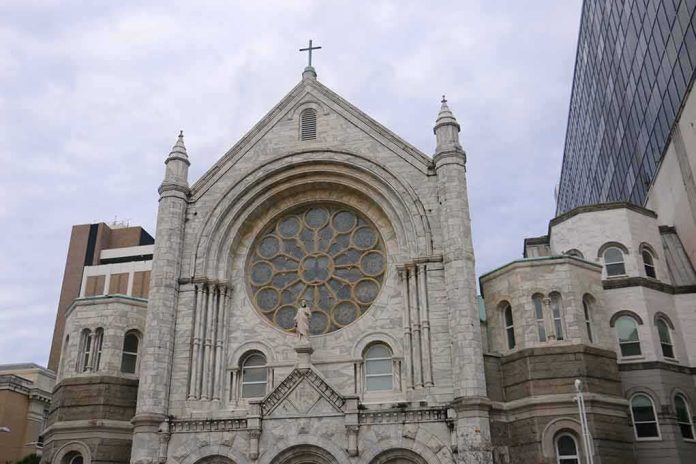
When a sacred place is violated, the Church’s response is not improvisation but law, prayer, and repair; that is why a French bishop’s decision to close a parish church and celebrate a Mass of reparation after teenagers blasted a rap glorifying terrorists inside was not symbolic theater but the required remedy to a real desecration.
The Short Version
- Diocesan authorities in France deemed a viral in-church rap performance praising Islamist terrorists a grave violation of sacred space and scheduled a Mass of reparation.
- Canon law instructs bishops to suspend worship in a desecrated church until a penitential rite “repairs” the offense; this is standard practice, not a one-off reaction.
- France has seen recurring attacks and profanations at Christian sites in recent years, shaping how bishops and officials interpret such incidents.
- Rites of reparation serve a dual purpose: restoring a church’s liturgical integrity and signaling pastoral solidarity with scandalized parishioners.
What Happened And Why The Bishop Acted
A video shared widely on French social media showed teenagers inside the church of Saint-Hilaire de Soullans in the Vendée, dancing and rapping to lyrics referencing Mohamed Merah, Salah Abdeslam, and the Bataclan massacre—figures and events synonymous with jihadist terror in France. Local diocesan leaders characterized the episode as a “grave” injury to a sacred space and announced the church’s closure followed by a Mass of reparation, the classic Catholic response when a church has been profaned. The point is not public relations. In the Catholic view, certain acts done in a consecrated building wound the very purpose to which the place is set apart, and they require a precise liturgical remedy before regular worship resumes.
The trigger here was not merely noise or trespass. The content celebrated perpetrators of atrocities that traumatized the French public; bringing such “apology of terrorism” into a sanctuary—near the altar where the Eucharist is offered—crosses from disorder into profanation in the judgment of the competent authority. In Catholic governance, that authority is the local ordinary (the diocesan bishop), who is charged with discerning both the gravity of the act and the appropriate penitential response.
The Canon-Law Mechanism: How Reparation Works
Catholic canon law codifies a straightforward sequence. Canon 1211 states that sacred places are “violated by gravely injurious actions done in them with scandal to the faithful,” and that, in the bishop’s judgment, when the injury is sufficiently grave and contrary to a church’s holiness, worship must cease “until the damage is repaired by a penitential rite” prescribed in the liturgical books. The specific rite varies with the nature of the profanation: it can range from a penitential liturgy to, in severe Eucharistic desecration, a more solemn act of reparation by the bishop or his delegate. A Mass of reparation, commonly celebrated with prayers such as the Miserere (Psalm 51) and appropriate propers, restores the church to public worship and addresses the scandal suffered by the faithful—scandal here meaning not gossip, but a spiritual stumbling block caused by sacrilege.
Because the logic is juridical and liturgical, not performative, closure of the building prior to the rite is more than a precaution; it is the visible expression of an interior claim: something is out of joint in this place until it is set right. Parishioners often experience the closure as a wound; the reparation rite is the medicine that closes it. This is why French bishops in other cases—after thefts from tabernacles, outrages at altars, or violent intrusions—have suspended worship and then presided over public reparation, sometimes with neighboring bishops concelebrating to underline ecclesial solidarity.
The French Context: Repeated Offenses, Established Playbook
To understand the quick diocesan response, place it against the French backdrop. France records hundreds of “anti-Christian acts” annually, most of them property crimes—vandalism, theft, and profanation—but a nontrivial share involves liturgical injury or sacrilege. The Ministry of the Interior tallied 857 anti-Christian acts in 2021, 923 in 2022, and 854 in 2023; Catholic analysts and journalists have tracked similar patterns since at least 2019, when the bishops’ conference counted 228 “violent anti-Christian acts” in just the first quarter. These numbers do not homogenize causes—some offenders are petty criminals or disturbed individuals; others act with ideological animus—but they do create a standing environment in which clerical leaders treat viral incidents inside churches as pastoral and canonical emergencies, not juvenile pranks.
In this environment, dioceses have developed a steady response: close the site if needed, cooperate with civil authorities, communicate clearly with the faithful, and schedule a penitential liturgy to repair the injury. Case archives from religious-freedom monitors and press accounts document repeated use of Masses of reparation across French dioceses after tabernacle desecrations, thefts of sacred vessels, and staged outrages at altars. The practice is neither politicized novelty nor media choreography; it is how the Church restores the conditions for the Eucharist to be celebrated reverently and unambiguously in a house of God.
Why A “Rap About Terrorists” Qualifies As Profanation
Canon law does not maintain a list of banned songs. It assesses whether an act, performed in a sacred place, is gravely injurious and scandalous—whether it contradicts the holiness of the space so starkly that worship cannot continue until repaired. In France, explicitly praising perpetrators of mass murder—on consecrated ground, near the altar—meets that threshold in a bishop’s prudent judgment. The standard is pastoral and juridical: would ordinary faithful, encountering that scene, reasonably conclude the sanctuary’s meaning had been violated? Here, the invocation of Merah, Abdeslam, and the Bataclan killing spree is not incidental background; it is the content that transforms a disrespectful intrusion into a sacrilegious event, therefore calling for reparation.
Importantly, the bishop’s discernment is not a criminal adjudication; civil authorities determine whether “apology of terrorism” constitutes an offense under French law. The ecclesial determination addresses a different good: safeguarding the integrity of worship and the conscience of the faithful. That is why a church can be closed and repaired liturgically independent of any court outcome, just as it would be after a theft from the tabernacle even if prosecutors never bring charges.
What The Rite Signals For The Future
Rites of reparation do three things at once. Liturgically, they restore the church’s status as a place of unambiguous worship. Pastorally, they console and strengthen a community that has suffered a shock in its most intimate space. Culturally, they assert that the sanctuary is not a stage for provocation—political, commercial, or nihilist—but a dedicated place, with boundaries that a pluralistic society can understand and respect. In a France where religious sites shoulder recurring indignities, that triple signal matters. Repair is not a retreat into nostalgia; it is the condition for a community to reopen its doors with confidence and without confusion about what, and whom, the church is for.
Sources:
washingtonpost.com, ground.news, wral.com, vaticannews.va, intoleranceagainstchristians.eu, ncregister.com, humanium.org, france24.com, rtrunews.com, catholicphilly.com, realclearinvestigations.com, x.com