
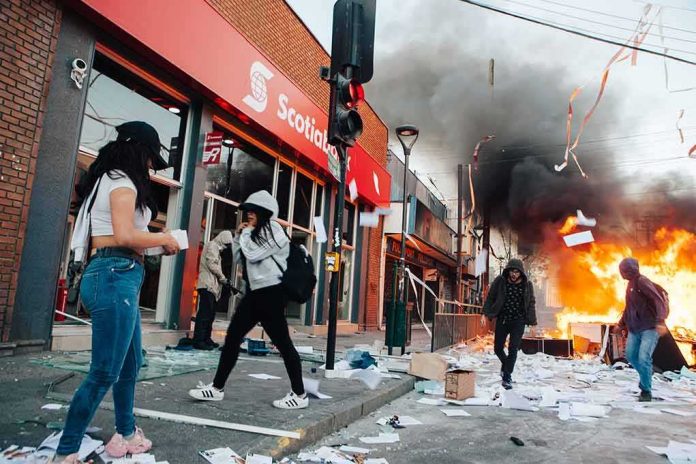
After days of street violence and hundreds of injuries, President Emmanuel Macron empowered local officials to ban public gatherings to restore order in parts of France.
Story Snapshot
- Macron authorized prefects and mayors to ban certain rallies to protect public safety.
- Police records cited mass arrests, injuries, arson, and looting across multiple cities.
- Marseille and parts of Paris imposed targeted bans and curfews amid fresh clashes.
- Marine Le Pen warned French democracy was “at risk,” sharpening the law-and-order debate.
What France’s Leaders Decided This Week
Macron told the nation that local authorities could ban some gatherings where needed to stop “unbridled violence” and protect cities, public buildings, and businesses. Prime Minister Sébastien Lecornu backed targeted, local curfews instead of a blanket one for Paris, calling his resolve to restore public order “absolute”. The government also said it would review any failures in intelligence or police readiness, while keeping order as the top priority.
Officials in Marseille barred protests and other gatherings during afternoon and evening hours, while Paris authorities issued partial bans and curfews in specific areas. These steps followed several nights of clashes that damaged shops and town halls, with fires and projectiles reported in multiple cities. The limited, place-based restrictions show the government chose a scalpel, not a hammer, to contain unrest while trying to keep daily life moving.
What The Numbers Say About Disorder
A Paris police order recorded 1,260 arrests and hundreds of injured officers after repeated use of mortars, projectiles, and arson against businesses and public property. Macron’s address described widespread looting and attacks on civic buildings, and he pledged to protect mayors, shop owners, and families facing “unprecedented violence”. Police data and the president’s remarks together signal a serious public-order crisis, not a routine protest wave.
At the same time, officials did not declare a nationwide state of emergency, and institutions kept running. Local bans and curfews came in select areas, not the whole country. This mix points to heavy strain on public order, while courts, ministers, and local governments continued to act. The line between crisis response and civil liberty remains in active debate as measures tighten in hotspots and remain looser elsewhere.
How The Politics Are Shifting
Right-leaning leader Marine Le Pen said democracy was “at risk” and accused Macron’s government of losing control, as she pushed a hard law-and-order message ahead of elections. Macron blamed ultra-left groups and criminal opportunists for much of the violence and said most demonstrators had legitimate concerns about daily life costs and public services. That contrast mirrors a long-running split in French politics: security first versus social causes first.
Macron also asked the government to convene students, teachers, lawmakers, unions, and business leaders to draft concrete proposals that address grievances fueling the unrest. The plan suggests a two-track response: punish looters and attackers, but also try to ease pressures that bring people to the streets. Whether these talks yield trusted fixes may decide if the unrest fades or returns in another form when tempers cool and policing eases.
Why This Matters Beyond France
France’s choices echo a wider test in Western democracies: can leaders keep streets safe without shrinking civic space? Targeted gathering bans and curfews can stop riots fast, but used too broadly or too long, they can chill peaceful protest. The French approach so far stays local and time-bound. Critics on the left and right will watch if the bans lift quickly and if promised reforms match the anger seen on the ground.
For Americans, the lesson is familiar. When disorder rises, governments often centralize decisions and expand police tools, while opposition parties frame the crisis to their advantage. Citizens across the spectrum worry that elites protect themselves first. Transparent data on arrests, injuries, and outcomes, plus clear end dates for bans, can check that fear. In France, those details—and whether daily life gets safer fast—will tell the real story of what comes next.
Sources:
telegraph.co.uk, afp.com, aol.co.uk, uk.news.yahoo.com, independent.co.uk, irishtimes.com, prefecturedepolice.interieur.gouv.fr