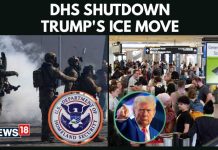
When TSA staffing collapses at the worst possible moment, the federal government’s fastest “spare parts” solution can look like a political statement—even when it’s meant as basic crowd management.
Story Snapshot
- ICE agents showed up at major airports during spring break disruptions after large TSA employee callouts snarled lines for hours.
- Tom Homan said ICE would handle simple, non-screening tasks like crowd control and exit monitoring so TSA could stay focused on screening.
- Sen. Cory Booker criticized the deployment as pointless, describing agents as “roaming around,” while DHS argued it would stabilize operations.
- Former TSA Administrator John Pistole suggested a visible federal presence can deter crime and threats, especially during heightened geopolitical tension.
Airports Became a Stress Test for Government Competence
Sunday’s callout numbers turned ordinary spring break travel into a national pressure cooker. Atlanta’s Hartsfield-Jackson reported 41% of TSA workers absent, and similar levels hit hubs like Houston, Baltimore, New York, and New Orleans. That kind of staffing gap doesn’t produce minor inconvenience; it forces checkpoint reductions and creates lines so long that travelers lose the one thing airports run on: predictability. By Monday, the White House chose an improvisation that guaranteed headlines.
ICE’s deployment landed in a public mood already primed for suspicion. Travelers stuck for four hours don’t separate agencies in their minds; they see uniforms and wonder what’s about to happen next. That’s why this story isn’t only about airport logistics. It’s about whether Americans can still expect the federal government to do two jobs at once—keep travel moving and keep security serious—without turning every operational decision into a partisan flare-up.
What Homan Actually Said ICE Would Do, and What They Wouldn’t
Tom Homan framed the mission as practical triage, not a new role for immigration enforcement. ICE agents, he said, would handle simpler tasks such as monitoring exits and helping with crowd control, explicitly drawing a line around specialized screening work. The logic is straightforward: every minute a TSA officer spends managing a crowd is a minute not spent screening bags and people. The weakness is also straightforward: “support” looks like “standing around” when nobody knows the assignment.
CNN’s on-the-ground observation from Houston captured the core credibility problem. Reporter Ed Lavandera described agents positioned around the edges, not visibly processing travelers through checkpoints. That doesn’t automatically mean ICE did nothing useful; perimeter presence, line management, and de-escalation can all matter. It does mean the public can’t easily verify the value in real time. When proof is invisible, politics rush in to fill the vacuum.
Booker’s “Roaming Around” Critique Versus the Reality of Crowd-Control Labor
Sen. Cory Booker’s criticism—that agents were merely “roaming around” without clear purpose—lands because it matches what frustrated travelers might see. From a common-sense standpoint, though, “not scanning boarding passes” does not equal “not helping.” Airports run on separation of duties: someone must keep flows moving, prevent bottlenecks, and respond quickly when tempers spike. Conservatives typically favor order, deterrence, and clear enforcement; the public also deserves clarity about what federal officers are doing and why.
The strongest version of Booker’s critique isn’t that ICE exists at airports; it’s that the deployment could become a stage prop—more about messaging than measurable relief. The strongest rebuttal is that a crisis demands surge capacity, and America already pays for trained federal personnel who can stabilize situations without being asked to do tasks outside their training. Homan’s stated boundary—no specialized screening—matters because it respects competence and reduces risk.
Why a Visible ICE Presence Changes the Temperature in a Terminal
Former TSA Administrator John Pistole offered a perspective many travelers never consider: conspicuous security can deter criminal activity and potential terrorism, particularly when wider events raise threat concerns. Airports are soft targets in the spaces before checkpoints, where crowds compress and anxiety amplifies. A visible law enforcement presence can reduce opportunistic crimes and help local airport police forces that get stretched thin during major disruptions. That benefit is real even if it doesn’t shorten the line by a single minute.
President Trump also acknowledged the uncomfortable overlap that critics keep pointing at: airports remain “fertile territory” for immigration enforcement, even if that’s not the stated purpose of the deployment. That overlap makes some travelers nervous and others relieved, depending on their view of immigration law and enforcement. Conservative values tend to prioritize the rule of law; the practical governance test is whether enforcement can stay lawful and targeted without turning travel chaos into a dragnet vibe.
The Precedent Question: Emergency Support or Mission Creep?
This is the loop the story leaves open: if ICE can surge into airports for “simple tasks” during TSA shortages, what’s the limiting principle for the next disruption? Support roles can be smart, but they should be bounded by written tasking, visible coordination, and objective measures of success. Otherwise, every future deployment becomes a Rorschach test—helpful public-safety presence to one side, intimidation theater to the other. Neither frame fixes the staffing problem that triggered the scramble.
TSA’s callout-driven breakdown suggests a deeper issue that extra uniforms can’t solve: workforce reliability and surge planning during predictable peak seasons. ICE agents can stand at exits, stabilize crowds, and deter crime, but they can’t backfill the screening function they are not trained to do. If the administration wants the argument to end, it needs results people can feel: shorter waits, fewer closed checkpoints, and fewer travelers sleeping on terminal floors.
Tom Homan Blasts Sen. Cory Booker for Fearmongering As ICE Is Deployed to Airports Across the US
https://t.co/iktsH5z302— Townhall Updates (@TownhallUpdates) March 24, 2026
The most grounded way to read Homan versus Booker is to separate symbolism from operations. Booker may score points by describing what cameras captured, but cameras don’t capture every task that prevents a mess from becoming a stampede. Homan may defend the deployment as common-sense support, but “trust us” fails when Americans watch lines not moving. The public wants the same thing it always wanted: competent staffing, clear authority, and security that doesn’t feel like a surprise.
Sources:
ICE agents are at airports to help TSA ease travel woes. Here’s what we know about their deployment