The federal government just approved the largest rebuild in the history of a major American airport, structured so that not a single dollar comes from the general taxpayer — and that financing architecture, more than the ribbon-cutting rhetoric around it, is the detail worth understanding.
Key Points
- President Trump and Transportation Secretary Sean Duffy unveiled a plan to rebuild Washington Dulles International Airport, with Reuters and the Department of Transportation placing the cost near $22 billion to $22.5 billion.
- The project replaces the aging C and D concourses, adds more than 5 million square feet of new or renovated space, and builds a 32,000-space parking garage described as potentially the largest in the world.
- Financing runs through airport-generated bonds, the Metropolitan Washington Airports Authority, and United Airlines — not direct federal appropriation.
- Construction is slated to begin in spring 2027, compressing what had been a decades-long phased modernization into a single accelerated build.
- The announcement circulated online under a mislabeled title referencing a nonexistent “Donald J. Trump International Airport,” a captioning error distinct from the substance of the Dulles plan itself.
What Was Actually Announced
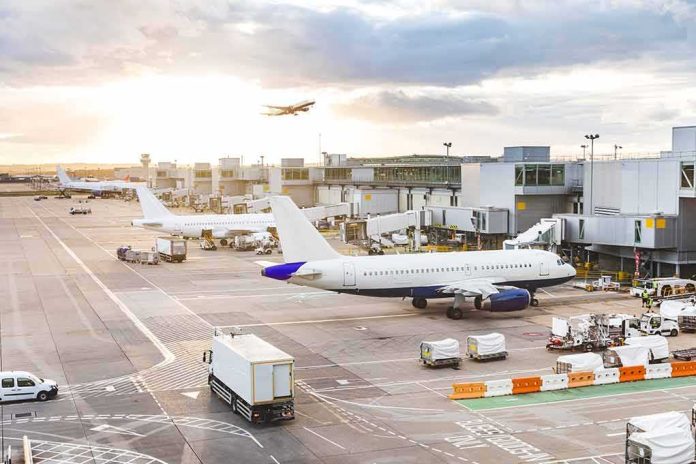
On July 29, 2026, Trump and Duffy stood with United Airlines and the Metropolitan Washington Airports Authority to unveil a reconstruction plan for Washington Dulles International Airport, the facility that has handled the Washington region’s long-haul and international traffic since 1962. The Department of Transportation’s own briefing confirms the lineup and the substance: a joint plan among USDOT, MWAA, and United to transform the airport’s terminal complex. Reuters reported the headline figure at roughly $22 billion, while the Associated Press and NBC News reported $22.5 billion, framed as a bonded investment rather than a line item in the federal budget.
The scope goes well beyond a facelift. Plans call for demolishing and replacing the C and D concourses, now more than four decades old, while preserving the original Eero Saarinen-designed main terminal — the swooping, winged structure that made Dulles an architectural landmark when it opened. The project adds upward of 5 million square feet of new or renovated space, eliminates the slow-moving people-mover trains passengers have complained about for years, and introduces a horseshoe-shaped train system with a central walking spine meant to cut gate-to-gate transit time dramatically.
How the Money Actually Works
The financing structure is the part most likely to get flattened into a single number in casual retelling, so it deserves precision. The administration’s framing is that the project requires “no federal dollars” — financed instead through airport-generated bonds and direct airline contributions, principally from United, which operates its largest domestic hub at Dulles. That claim traces to statements from Trump and Duffy rather than to a fully published bond prospectus, and the distinction between a total projected investment and a formally approved funding package matters. Washington Examiner reporting on a subsequent MWAA board vote describes an approved funding package of $19.9 billion — a figure below the $22 billion to $22.5 billion announced at the unveiling, consistent with the normal gap between an initial headline estimate and the financing instruments a board actually ratifies.
That gap is not evidence of a broken promise; it reflects how large infrastructure financing typically proceeds. Bond authorizations, airline use-and-lease agreements, and capital improvement programs are negotiated and formalized in stages, and the dollar figure attached to a political announcement is almost always a planning estimate rather than a closed financial instrument. Readers tracking this project over the coming years should expect the number to be refined — upward or downward — as design work, environmental review, and procurement proceed.
Why Dulles Needed This
The urgency behind the announcement rests on a widely cited ranking: J.D. Power’s 2025 airport satisfaction survey placed Dulles 23rd among 27 large U.S. airports, a result Trump and Duffy both invoked in describing the facility as among “the worst airports anywhere in the world.” Secretary Duffy’s own characterization — dark, dated, and overdue for replacement — tracks with United CEO Scott Kirby’s public remarks that the current terminal, built 45 years ago, was always intended as a temporary structure. MWAA CEO Jack Potter has noted that Dulles was the fastest-growing large U.S. airport in 2024 and 2025, a growth trajectory that strains a terminal complex designed for a smaller, slower-moving era of air travel.
The accelerated timeline is itself notable. MWAA had previously mapped out a sixty-year phased modernization; the new plan compresses major construction into a window beginning spring 2027, with officials projecting substantial completion within a few years rather than generations. Large airport megaprojects have a documented history of slipping that kind of schedule — Denver International Airport’s 1995 build ran roughly 200 percent over its original cost estimate, and industry research attributes the large majority of megaprojects worldwide to some combination of cost and schedule overrun. That base rate doesn’t indict the Dulles plan, but it is the honest backdrop against which any accelerated infrastructure timeline should be read.
WATCH LIVE: Trump gives remarks at Donald J. Trump International Airport
https://t.co/uOufBb742v— Fox News (@FoxNews) November 8, 2026
A Labeling Problem, Not a Factual One
Clips of the announcement spread across social platforms under titles referencing remarks at a “Donald J. Trump International Airport” — a facility that does not correspond to the Dulles event or to any airport under that name. The underlying footage and substance match the White House announcement on Dulles; the caption was simply wrong, an artifact of how quickly livestream clips get re-titled and reposted across platforms before a label is corrected. It is a captioning error, not a dispute over what was said or what was decided, and it does not change the substance of the plan or the financing arrangement behind it.
What Comes Next
The real test of this announcement will arrive in stages most viewers will never see broadcast live: MWAA board resolutions, bond issuances, environmental permitting, and the procurement contracts that turn renderings into steel and concrete. Those documents, not the unveiling itself, will settle the remaining open questions — how the bonded $22-billion-range estimate converges with the approved $19.9 billion funding package, whether the spring 2027 groundbreaking holds, and whether Dulles emerges from this decade looking like the airport its designers and its newest patrons were promised.
Sources:
facebook.com, reuters.com, pbs.org, washingtonexaminer.com, northstarmeetingsgroup.com