
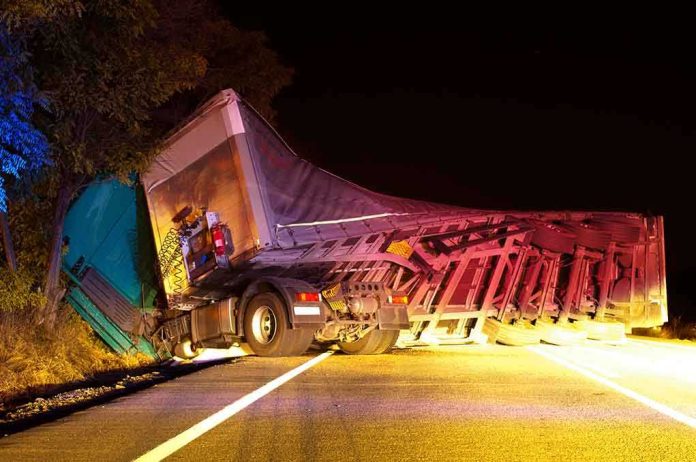
The deadliest migrant-smuggling disaster in U.S. history was not a freak accident but the predictable outcome of a commercial network that treated human cargo like freight—sealed in a sweltering trailer, routed by phone, and discarded when things went wrong. Prosecutors have since used that reality to indict, extradite, and now secure long prison terms against key participants whose choices led to 53 deaths and 11 serious injuries in San Antonio in June 2022.
The Short Version
- Federal prosecutors tied a cross-border smuggling network to the 2022 San Antonio tractor‑trailer deaths, securing a 30‑year sentence for Guatemalan coordinator Rigoberto Ramon Miranda‑Orozco after guilty pleas.
- A federal grand jury indictment laid out migrant‑smuggling offenses resulting in death and serious bodily injury; multiple defendants across the network have been charged or sentenced.
- The case shows how decentralized smuggling markets use compartmentalized roles—recruiters, guides, drivers, coordinators—yet converge on reckless transport practices that are foreseeably lethal in heat.
- The San Antonio event sits within a global pattern: when legal mobility is restricted, smuggling markets flourish, and containerized transport becomes a recurrent mechanism of mass fatalities.
What prosecutors proved: roles, routes, and responsibility
Federal charging documents and plea agreements establish the spine of the case: a network operating from Guatemala through Mexico into Texas arranged clandestine transport for dozens of migrants in a single tractor‑trailer during extreme heat. The vehicle was abandoned on San Antonio’s south side; 53 people—50 adults and three minors—died of heat-related causes, and 11 others survived with serious injuries. A grand jury returned an indictment for migrant‑smuggling offenses resulting in death and serious bodily injury, reflecting statutes that escalate penalties when fatalities occur in the course of smuggling. The United States later secured the extradition of Guatemalan national Rigoberto Ramon Miranda‑Orozco; he pleaded guilty and received a 30‑year federal sentence tied to his coordinating role and to the deaths of two of his own clients inside the trailer.
The government’s theory, ultimately accepted through plea and sentencing, is straightforward: the defendants knowingly joined a profit-driven conspiracy that used inherently dangerous transport methods—overcrowded, unventilated, containerized movement—under circumstances where death was a foreseeable outcome. The sentence reflects both the scale of harm and the culpable choices after knowledge of risk. According to the Justice Department, Miranda‑Orozco continued arranging crossings even after learning of the mass fatalities, behavior that goes to consciousness of guilt and indifference to life, and that weighed at sentencing.
How the network functioned: a market, not a cartel
This was not a single, vertically integrated “cartel operation” in the cinematic sense. Smuggling markets tend to be modular: local recruiters connect to guides and stash house operators; transport coordinators contract drivers; document handlers and money movers complete the chain. Each actor manages a segment, often with plausible deniability about the whole, but their actions aggregate into a lethal journey when containerized transport is used in heat. Research on smuggling market structure consistently finds decentralized, service‑based arrangements that thrive where migration demand meets scarce legal pathways; that description fits the array of defendants in Texas and Guatemala and their segmented roles across borders.
The legal challenge for prosecutors in such markets is linking specific individuals to the foreseeability of harm, not merely to the existence of a conspiracy. In the San Antonio case, the volume of victims in a sealed trailer, the Texas summer temperatures, and the documented coordination of routes and pickups supplied that link. Extradition cooperation from Guatemalan authorities—part of a broader Homeland Security and Justice Department push—helped pull higher‑level coordinators into U.S. courtrooms rather than leaving only drivers to bear the consequences.
Why containerized smuggling kills: mechanism and inevitability
Containerized transport—box trucks, tractor‑trailers, shipping containers—offers concealment from detection and economies of scale to smugglers. It also creates a closed heat sink when ventilation is limited and bodies are packed tightly, driving hyperthermia and hypoxia within minutes to hours. Global datasets catalog recurring mass‑fatality events with identical signatures: locked compartments, desperate attempts to claw through walls, and multiple deaths before any rescue can arrive. The San Antonio incident follows this known mechanism and is part of a documented pattern of container smuggling deaths on multiple routes worldwide.
Legally, this mechanism matters: when a trafficking method is widely known to be deadly in specific conditions, continued use evidences recklessness. That is why the federal sentencing guidelines escalate sharply when smuggling results in death, and why the Texas case produced severe penalties commensurate with the scale of loss. The 30‑year sentence against a coordinator rather than only a driver signals a prosecutorial view that those who assemble the transport chain bear responsibility for the transport’s risks—not just the last link behind the wheel.
How this case fits the global picture
As grim as San Antonio was, it is not an outlier in kind. Comparative research and international monitoring show that when enforcement tightens and legal channels remain limited, demand for irregular movement persists, and smuggling adapts—often by pushing migrants into more covert and more dangerous modalities. Containerized smuggling recurs because it masks movement and reduces per‑person logistics, enabling coordinators to spread fixed costs across large groups. That is a rational business response inside an illicit market; its human cost appears in periodic mass‑casualty events from North America to Europe and beyond.
For policy designers, the point is not abstract. Markets respond to constraints. Where pathways are scarce and detection risk is high, smugglers monetize concealment and scale. The resulting harms are borne entirely by migrants, who pay up front and carry all the risk. Criminal enforcement matters—extraditions and long sentences do alter the cost calculus for organizers—but the market-level incentive structure still favors concealment unless demand is redirected through safer, lawful channels. The San Antonio case demonstrates how much damage can accrue in a single trip when that structure holds.
#LocalNews #Austin TX
Guatemalan man sentenced for role in deadly 2022 migrant smuggling tragedyhttps://t.co/VLFvn4t83V
22 Oct 2026
(Rigoberto Miranda-Orozco) pleaded guilty .. led to 53 deaths and 11 injuries.
.. charging families ($12K-$15K)#MAGA #BorderObserver qt-maga-10181— The Border Observer (@borderObserver) November 11, 2026
What accountability now looks like—and what it doesn’t
Accountability in this case has extended beyond the driver’s seat. Multiple defendants have been indicted, arrested, or sentenced across jurisdictions, with Miranda‑Orozco’s 30‑year term the clearest marker that U.S. authorities will pursue coordinators wherever they operate. Homeland Security Investigations and the Justice Department have highlighted joint operations with Guatemalan counterparts; extradition and guilty pleas followed, underscoring that organizers who think borders shield them from liability are misreading the present enforcement landscape.
At the same time, the structure of smuggling markets cautions against assuming uniform knowledge across every participant. Some roles are transactional and localized, and not every facilitator knows of, or controls, the final transport method. That is why prosecutors tend to center charges on those who aggregate people into the final leg and choose the method of concealment—precisely the decisions that determine whether a truck becomes a death trap. The San Antonio prosecutions, anchored by the indictment for offenses resulting in death and the subsequent 30‑year sentence, reflect that logic: liability tracks the choices that made the deaths foreseeable.
What this means going forward
Three practical conclusions follow. First, containerized mass transports during heat are predictably lethal; investigative focus on coordinators who assemble such loads is not only justified but essential to prevention. Second, cross‑border enforcement partnerships can pull high‑leverage actors into court—extraditions and long sentences change incentives more than sporadic arrests of drivers do. Third, without legal channels that reduce demand for clandestine movement at scale, smuggling markets will continue to search for concealment and volume, with periodic tragedies the foreseeable result. The San Antonio convictions are accountability after the fact. The harder policy work is making the next mass‑fatality load less likely to form in the first place.
Sources:
justice.gov, miamiherald.com, ice.gov, uscis.gov, ksat.com