
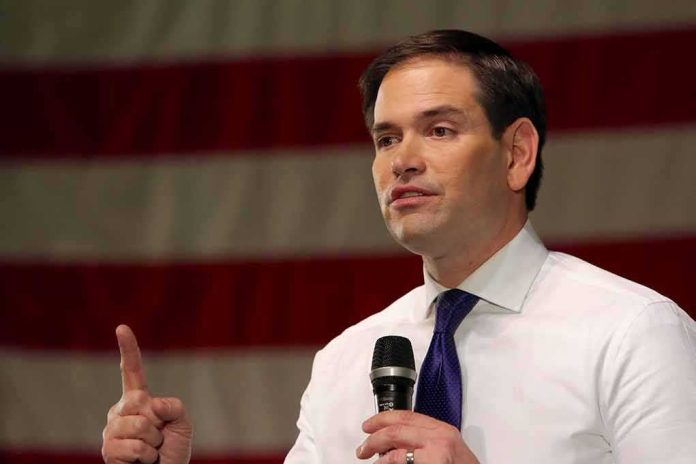
A small, human moment can reveal how public life really works: when President Trump introduced NASA astronaut Frank Rubio and quipped about the shared Rubio surname with Secretary of State Marco Rubio, he tapped a familiar register of informal banter that thrives at ceremonial events and then accelerates online once clipped from its setting.
At a Glance
- President Trump introduced NASA astronaut Frank Rubio and joked about the shared “Rubio” surname with Secretary of State Marco Rubio.
- Frank Rubio’s standing as a NASA astronaut and his prior White House ceremonial appearances are well documented.
- Marco Rubio currently serves as Secretary of State, making any Rubio reference politically salient by default.
- Short political clips often draw outsized social engagement, especially when they invite identity or partisan readings.
What Happened: A surname joke in a ceremonial moment
The core exchange is straightforward: during a public introduction of NASA astronaut Frank Rubio, President Trump highlighted the Rubio surname and made a light joke about possible family connection. Nothing in the record suggests a policy announcement or genealogical claim; this was stagecraft in the minor key that presidents and principals often use to warm a room and bridge otherwise formal proceedings. The scene fits the genre of White House-adjacent ceremonial remarks where dignitaries, service members, or astronauts are recognized and the tone briefly turns playful before returning to the program.
The identities at the center are uncontested. Frank Rubio is a NASA astronaut whose portfolio includes public-facing events; NASA has documented his participation in a White House Hispanic Heritage Month program alongside fellow astronaut Marcos Berrios, including photos that capture a relaxed, conversational atmosphere suitable for off-the-cuff humor. Marco Rubio, meanwhile, is the sitting Secretary of State, sworn in during the current administration; references to him carry immediate political resonance because of the office he holds.
How this kind of moment works: ceremony, rapport, and clip-ability
Presidential introductions balance two jobs: honor the subject and keep the room engaged. Humor—especially about a shared name or hometown—functions as social lubricant. It acknowledges the audience, nods to the newsmakers in the room, and signals ease. Astronaut recognition ceremonies, in particular, often blend reverence for technical achievement with casual asides that humanize the people behind the flight suits. The space program’s public interface is built on that duality: exacting expertise on the pad; relatability at the podium. When a principal recognizes an astronaut like Frank Rubio, the script typically includes the essentials—mission pedigree, service, education—punctuated by a quip if the chemistry of the room allows it.
That same quip, once extracted into a few seconds of video, becomes legible to millions who did not see the room, the preceding remarks, or the response. The effect is predictable: the micro-joke becomes macro-content. Researchers examining political behavior online consistently find that posts that cue partisan identity or moral emotion attract disproportionate engagement, a structural reality of social platforms rather than a property of any single speech.
The people behind the name: astronaut and statesman
Frank Rubio’s résumé is the opposite of a punch line. A U.S. Army physician and helicopter pilot before joining NASA, he represents the modern astronaut archetype: technically fluent, operationally seasoned, and skilled in public communication. NASA’s documentation of his appearances at the White House underscores the agency’s long-standing practice of placing astronauts in civic moments that inspire students, salute service, and connect the space program to national life. Those settings reward a touch of levity precisely because the underlying work is so serious.
Marco Rubio, as Secretary of State, occupies an office where every aside can be freighted with diplomatic meaning. That is why a benign surname joke acquires political coloration once the audience is reminded—explicitly or implicitly—that the other Rubio now runs American diplomacy. Cabinet-level prominence ensures that even whimsical references are interpreted through a policy frame by some viewers, regardless of the speaker’s intent or the event’s purpose.
Why clips like this travel: from room tone to timeline dynamics
If you watched the full introduction, you likely experienced a conventional ceremonial beat—recognition, a laugh, transition back to the program. On social platforms, the same few seconds can read differently: a wink about power, a signal about insider status, or fodder for partisan rivalry. The reason is mechanical as much as cultural. Studies show that content which primes confrontation or moral-emotional language reliably earns more clicks and shares, training both users and algorithms to amplify it. Even without overt outrage, the mere invocation of a high-profile political surname in a non-political setting is enough to trigger that engagement engine.
This is why low-stakes humor so often becomes a high-engagement artifact. The clip compresses context: it keeps the line and loses the room. Viewers project backstory onto the void. Supporters see conviviality and confidence; opponents may see casualness verging on flippancy. Both readings can thrive because the underlying moment is small and pliable; it accommodates competing interpretations without breaking.
Reading the moment for what it is
It helps to separate the domains. In the spaceflight domain, this was a standard ceremonial nod to a decorated astronaut—whose work, training, and risk profile have nothing to do with cabinet politics. In the diplomatic domain, the Secretary’s surname simply lent the joke a second layer that makes for a stickier clip. The two intersect in the moment but do not redefine one another. Treating a surname aside as political substance misunderstands how public ceremonies function; treating it as pure fluff ignores why such asides endure. They are a low-cost way to establish warmth, remind audiences of shared cultural references, and humanize both speaker and honoree.
So the take-away is uncomplicated. President Trump introduced NASA astronaut Frank Rubio, played off the shared last name with Secretary of State Marco Rubio, and moved on. The astronaut’s presence and prior White House visibility are a matter of record. The Secretary’s portfolio guarantees that even a brief mention resonates beyond the room. And the clip’s afterlife illustrates a durable reality of modern media: small moments scale when they touch a political nerve, or even just a political name.
Trump sees two people named Rubio and his big joke is "shake his hand just in case you are relatives"?
This is the President of the United States, at NASA, at a serious event with astronauts, and his best joke is about last names?
No policy, no vision, no respect for the…
— Dr. (@DrAkuamaka) November 7, 2026
Bottom line
In the room, a surname joke is a courtesy laugh on the way to the main event. Online, it is a portable shard of political entertainment. Both can be true at once, and knowing the difference is part of being a savvy consumer of public life.
Sources:
abcnews.com, svs.gsfc.nasa.gov, plus.nasa.gov