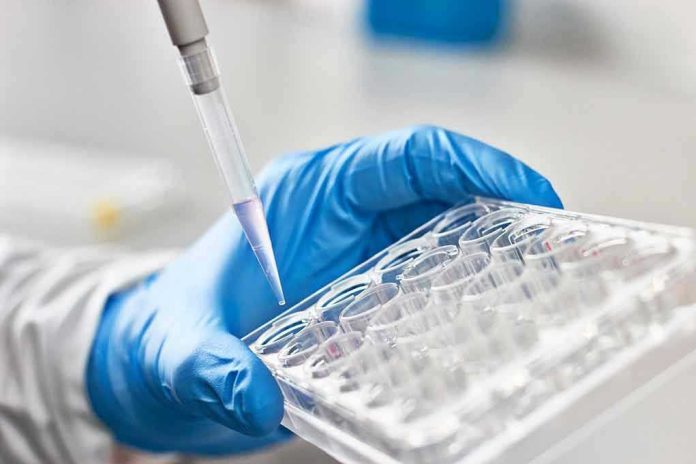
A new $4 tongue swab test that can spot tuberculosis in under an hour is being hailed as a game‑changer for poor countries—yet it also exposes how badly global health bureaucrats have failed to deliver simple, affordable tools for the world’s deadliest infectious killer.
Story Snapshot
- A low‑cost tongue swab test can detect active tuberculosis in about 30–45 minutes, using a simple, portable device.[2][3]
- Studies show tongue‑swab molecular tests reach roughly 71–83% sensitivity and around 95–100% specificity, making them a strong option when patients cannot produce sputum.[2][4]
- The World Health Organization (WHO) now allows tongue swabs with low‑complexity automated tests as an initial option only when standard respiratory samples are not available.
- Experts stress that tongue swab tests are a supplementary tool, not yet a full replacement for more sensitive sputum‑based tuberculosis diagnostics.[2]
A New $4 Test Targets Tuberculosis with a Simple Tongue Swab
Researchers and diagnostic companies are rolling out a **low‑cost tongue swab tuberculosis test** that aims to deliver results at or near the point of care, often in under an hour.[2][3] One leading system, the MiniDock molecular test, uses a tongue swab and a small battery‑powered device to detect tuberculosis DNA with a reported sensitivity of about 80% and specificity of about 95% compared with standard sputum molecular testing.[2] Another approach pairs tongue swabs with rapid polymerase chain reaction (PCR), targeting similar quick turnaround.
Tulane University scientists developed a CRISPR‑based tongue swab tuberculosis test that works like a simplified at‑home COVID test, using a single “one‑pot” tube and a lateral‑flow strip for visual readout in roughly 45 minutes.[3] In clinical trials, this test showed higher detection rates than some traditional methods, especially in patients who struggle to produce sputum, including children and people living with human immunodeficiency virus.[3] These platforms are designed to cost only a few dollars per test, making routine screening financially realistic in low‑income communities.[2][3]
How Accurate Are Tongue Swab Tuberculosis Tests Compared with Sputum?
Clinical studies paint a picture of **good but not perfect accuracy** when tongue swabs are used instead of sputum. A large study of the MiniDock tongue swab assay reported approximately 80% sensitivity and about 95% specificity compared with a standard sputum molecular test.[2] Other research on high‑sensitivity detection of Mycobacterium tuberculosis DNA using foam tongue swabs found roughly 83% sensitivity and 100% specificity in a South African cohort, suggesting that, when optimized, oral sampling can approach laboratory‑grade performance.[4]
Broader evaluations across multiple platforms led the World Health Organization to estimate that low‑complexity automated tests on tongue swabs achieve a pooled sensitivity of about 71% and pooled specificity near 98%. By comparison, sputum‑based molecular tests typically show higher sensitivity, often in the mid‑90% range or better in many studies.[2] One analysis directly comparing oral swabs and more invasive sampling found that while specificity exceeded 98%, sensitivity remained meaningfully lower than sputum testing, reinforcing the idea that tongue swabs are an important alternative but not yet a full replacement.
WHO Endorses Tongue Swabs—but Only as a Conditional Fallback Option
The World Health Organization (WHO) now officially recommends **tongue swab samples with near‑point‑of‑care or low‑complexity automated tests** as an initial diagnostic option for adults and adolescents who show signs of pulmonary tuberculosis but cannot provide sputum. WHO describes this as a conditional recommendation with low certainty of evidence, keeping sputum or other respiratory samples as the preferred first‑line specimens whenever they can be obtained. The guidance explicitly links tongue swabs to scenarios where access or sample collection is difficult.
Portable Tongue‑Swab TB Test Shows High Accuracy in India, Could Speed Up Diagnosishttps://t.co/zUM4dte7Sp
— Health and Family (@Healthandfamili) May 26, 2026
WHO and independent researchers both warn that the lower sensitivity of tongue swab testing means some active cases will still be missed if it is used alone. That trade‑off is why WHO stops short of endorsing these methods as a general replacement for standard sputum‑based diagnostics, especially in higher‑risk clinical settings. Instead, experts frame tongue swabs as a practical, patient‑friendly option to expand testing coverage in the field, particularly where healthcare infrastructure is weak or where patients, such as children, cannot reliably produce sputum.[3]
Why This Matters for Global Health, Fiscal Responsibility, and American Leadership
The emergence of a roughly **$4, rapid tongue swab test** underscores how simpler tools can address long‑standing gaps in tuberculosis care without massive, wasteful global programs.[2][3] More than 10 million people develop tuberculosis each year, and an estimated 40% of cases go undiagnosed, leaving families and communities exposed to a preventable killer.[3] Affordable point‑of‑care tests that do not require expensive laboratories or complex machinery match long‑standing conservative calls for targeted, cost‑effective solutions instead of bloated bureaucratic schemes.
American universities and innovators, including teams at Tulane University and other research groups working on tongue swab PCR methods, are helping drive this shift toward practical diagnostics that can be deployed in small clinics, community settings, and resource‑limited regions.[3][4] By pairing United States scientific leadership with a focus on efficiency and local empowerment, these tongue swab tests offer a model of health innovation that respects budgets, cuts red tape, and prioritizes real‑world results over grandstanding global health campaigns.[3]
Sources:
[2] Web – Diagnostic accuracy of a novel point-of-care tongue swab assay for …
[3] Web – Tulane Researchers Develop Rapid TB Test Using Tongue Swabs
[4] Web – Tongue swab testing on two automated tuberculosis diagnostic …