
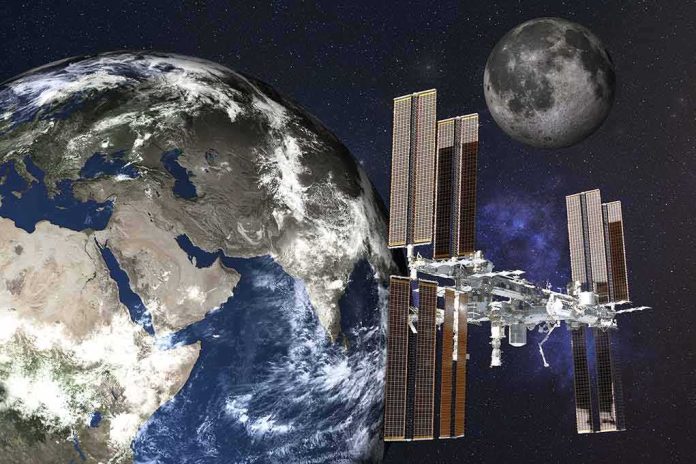
Northrop Grumman’s new Mission Robotic Vehicle is built to service satellites, but its two robotic arms have also raised obvious anti-satellite concerns.
Quick Take
- The Mission Robotic Vehicle, or MRV, launched with three Mission Extension Pods for in-space servicing.
- Northrop Grumman says the spacecraft can inspect, relocate, repair, upgrade, and extend satellite life.
- Critics say the same close-up tools could also be used to damage or disable another satellite.
- The debate reflects a larger space-policy problem: many orbital systems are useful for both repair and interference.
What Launched and Why It Matters
Northrop Grumman’s Mission Robotic Vehicle and three Mission Extension Pods launched successfully from Cape Canaveral on July 21, 2026. The company says the mission is meant to strengthen the resilience, mobility, and sustainability of satellites in orbit. Northrop Grumman also says the MRV is designed for on-orbit inspection, refueling support, relocation, repair, and upgrades. That makes it one of the most advanced satellite servicing systems ever flown.
The MRV is built around two robotic arms and a set of tools for rendezvous and proximity operations. Those arms let it grab a client satellite, attach Mission Extension Pods, and work in geosynchronous orbit, where many important communications satellites operate. The same design also requires very close contact with another spacecraft. That is why analysts see the vehicle as a dual-use system, even though its advertised purpose is service.
Why the Robotic Arms Worry Analysts
The concern is not that the MRV was announced as a weapon. Northrop Grumman presents it as a servicing craft, and its fact sheet says the main job is installing Mission Extension Pods and carrying out inspection and augmentation missions. The concern is that robotic arms built to grapple satellites can, in theory, be used to disturb them instead. The War Zone argued that the same arms could damage optics, solar panels, or other key parts, or even pull a satellite into a degrading orbit.
That kind of worry fits a long pattern in space policy. International and policy research often describes servicing, inspection, and grappling tools as dual-use because they can support both peaceful missions and more aggressive counterspace acts. The MRV case is striking because it is not a paper concept. It is a real spacecraft now in orbit, with a clear servicing role and a visible set of close-contact tools. That mix invites scrutiny from both security analysts and space operators.
What the Launch Says About Space Security
The launch shows how quickly the line between repair and interference can blur in space. Northrop Grumman and its partners say the MRV can extend satellite life and support commercial and government users. But the same hardware that can install a life-extension pod can also approach, hold, and move another satellite. That is why the MRV has become part of a wider debate over whether the United States and other space powers need clearer rules for dual-use orbital systems.
A SpaceX Falcon 9 rocket has successfully launched Northrop Grumman's Mission Robotic Vehicle (MRV) from Cape Canaveral, marking the debut of a first-of-its-kind commercial satellite-servicing mission. Built to operate in geostationary orbit (GEO), the MRV is equipped with two… pic.twitter.com/x6Nolu7qIi
— Stellarix (@Stellarixorine) July 23, 2026
The broader issue is not limited to one company or one mission. As space becomes more crowded, more valuable satellites will depend on robots that can dock, tow, inspect, and repair them. Those same skills can also create fear that a service craft could be repurposed in a crisis. For readers already frustrated by weak oversight, the MRV story is a reminder that the most useful technologies in orbit can also be the hardest to trust.
Sources:
realcleardefense.com, twz.com, satnews.com, vesti.ru, northropgrumman.com, space.com, doncio.navy.mil, spacenews.com, nextspaceflight.com, btlj.org, documents.unoda.org, escholarship.org, publications.jrc.ec.europa.eu, lawjournal.digital