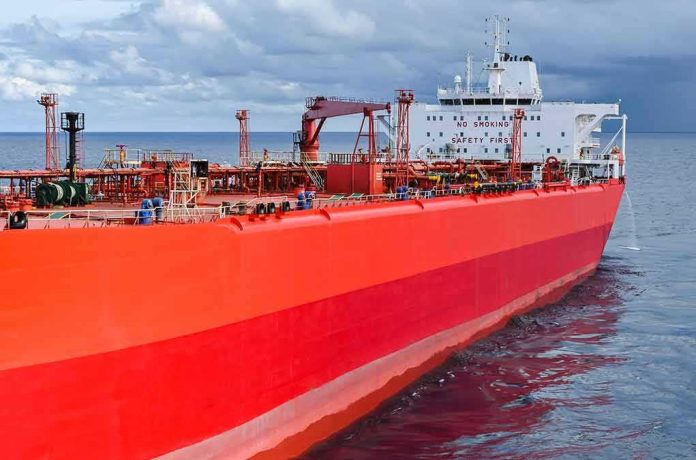
Iran is turning the Strait of Hormuz into a cash machine and a pressure point on global energy, testing international law and the Trump administration’s resolve.
Story Snapshot
- Iran is rebranding Strait of Hormuz tolls as “service fees” to claim billions from global shipping.
- International law experts say charging for simple passage through the strait clashes with treaty rules and trade norms.[1]
- Tehran insists the strait is under joint Iran–Oman sovereignty, not international waters, and says it will act “within international law.”[5][7]
- President Trump and US allies reject any tolls or fees on this vital chokepoint, warning of a dangerous precedent for global commerce.[3][6]
Iran’s New Plan: Fees, Not “Tolls,” on the World’s Oil Artery
Iranian leaders now say ships passing the Strait of Hormuz will not pay “tolls” but will be charged “maritime service fees” for things like navigation help, search and rescue, and environmental protection. Foreign Ministry spokesmen have stressed that Tehran “is not seeking to collect transit tolls” but will collect fees for services they claim to provide to commercial traffic. On paper, this is framed as cost recovery and safety. In practice, it is a way to monetize passage through the narrow waterway that carries a major share of the world’s traded oil.[1][4][5][12][16]
Reports from regional outlets and legal analysts say the charges can reach around $2 million per ship or the cryptocurrency equivalent of about $1 per barrel of oil, with estimates that a full regime could generate between $5 billion and $8 billion a year if widely applied. Iran has begun building out a formal structure, including a new authority to oversee traffic and collect payments, and routes coordinated with the Islamic Revolutionary Guard Corps. That combination of money, armed escorts, and paperwork gives Tehran new leverage over a chokepoint already known for geopolitical risk.[5][6][12][16]
The Legal Fight: International Straits vs. Sovereign Waters
Iran’s defense rests on two claims: that the Strait of Hormuz is entirely within the territorial seas of Iran and Oman, leaving no gap of “international waters,” and that Iran never ratified the United Nations Convention on the Law of the Sea (UNCLOS) and therefore is not bound by its transit passage rules. Iranian environmental officials have argued that because each state’s twelve-mile zone overlaps in the narrow strait, coastal sovereignty allows them to charge fees for transit services. Tehran also issued a declaration when signing UNCLOS, reserving the right to demand prior authorization for warships on “innocent passage.”[1][4][5]
Maritime law experts and many governments sharply dispute that reading. Analyses of UNCLOS and the older 1958 Geneva Convention explain that natural straits used for international navigation carry a non-suspendable right of passage, even where territorial seas overlap. Scholars note that coastal states can regulate safety, pollution, and traffic and can charge for specific optional services like pilotage or port use, but they cannot exact a fee simply for the right to pass. One study stresses that “since strait passage is a right the littoral state may not exact a charge for transit,” drawing a bright line between service fees tied to real services and any toll that functions as a tax on geography.[1][2][10][18]
Global Backlash and Risks for Energy Markets
International organizations and allied governments have reacted strongly to Tehran’s move. The International Maritime Organization has stated that no country has the right to block shipping or charge transit fees in the Strait of Hormuz, warning that such tolls would set a dangerous precedent for global trade if copied at other chokepoints. Legal commentators writing on access to Hormuz argue that Iran’s attempts to downgrade transit rights into a discretionary privilege, combined with fee collection, “seriously undermines” the freedom of navigation regime built into UNCLOS and supported by wider customary international law.[1][15]
🇮🇷🇴🇲 Who actually owns the Strait of Hormuz?
Legally, nobody. It's an international waterway under maritime law, open to all.
But control is a different story, and Iran has spent this war proving the gap between the two.
Tehran sits on one side of the strait, Oman on the… pic.twitter.com/DWj2q7IapD
— Mario Nawfal (@MarioNawfal) June 30, 2026
Studies of global trade risk show why this fight matters beyond the region. Research on maritime chokepoints finds the Strait of Hormuz among the highest-impact corridors, with disruption costs measured in billions of dollars per year as a share of world trade. Analysts reviewing recent practice point out that in the six major natural straits that are impossible to bypass — including Hormuz, Malacca, Bab al-Mandab, and Gibraltar — there has been no accepted practice since World War II of mandatory transit tolls just to pass through. Iran’s system, which ties transit to fees and security permissions, would be a sharp break from that post-1945 norm and could encourage other coastal states to start charging at will.[3][7][16]
Where the Trump Administration and Conservatives Stand
President Donald Trump and senior US officials have taken a clear public stance that the Strait of Hormuz is an international waterway and that “no country is allowed to charge tolls or fees” for simple transit. US-backed analyses emphasize that even non-parties to UNCLOS, like Iran and the United States, remain bound by customary rules protecting free navigation through international straits. Security-focused legal commentaries argue that Iran’s fee regime and threats to close or restrict the strait violate both the law of the sea and broader norms against using choke points as bargaining chips in conflicts.[3][6][8][10]
For conservative readers, the stakes are clear. If Iran can turn Hormuz into a toll road under the cover of “service fees,” energy costs and insurance premiums rise, global inflation risks grow, and hostile regimes gain new tools to squeeze the free world. Experts note that even friendly states like Türkiye only charge narrow, audited service fees under special treaties such as the Montreux Convention, not broad transit charges on all ships. That contrast strengthens the case for defending true freedom of navigation, keeping international straits open, untaxed, and beyond the reach of any one government’s revenue schemes.[1][12][18]
Sources:
[1] Web – Tehran Plans to Make Billions in Fees From Reopening Hormuz…
[2] Web – Access to the Straits of Hormuz, transit fees, and the International …
[3] YouTube – Iran deal allows Tehran to charge maritime service fees on Hormuz …
[4] Web – The Legal Question of Tolling Hormuz
[5] Web – Iran claims it has a legal right under international law to charge …
[6] Web – Iran’s foreign ministry says the country will charge maritime service …
[7] Web – The Closure of the Strait of Hormuz by Iran: Considerations over the …
[8] Web – Why Iran’s Transit Fees in the Strait of Hormuz Violate International …
[10] Web – Legal Perspectives on the Possibility of Imposing Tariffs and Fees in …
[12] Web – Iran has announced plans to introduce a formal service fee …
[15] Web – U.S. Proposes Port Fees on Chinese-Built Ships and Operators to …
[16] Web – The International Maritime Organization says no country can …
[18] Web – Can countries charge tolls on vessels passing critical straits? World …