Russia’s army is bleeding men and money for inches of land, yet the Kremlin still insists it is winning a war that most serious analysts say it cannot finish on its own terms.
Story Snapshot
- Russia’s advance in Ukraine has slowed to a crawl, making total victory take decades at current pace.
- Putin still believes he can win a long war of attrition, but key war goals remain unmet.
- Analysts say Russia can keep fighting and taking small bites of territory, but not force Ukraine to surrender.
- Both sides and many Western leaders now argue over talks, while ordinary people watch a stalemate the “elites” created.
Russia’s War Is Stuck, Not Won
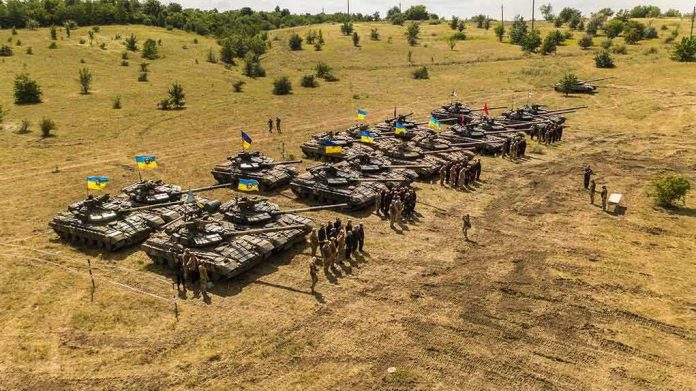
Four years into the full-scale invasion, Russia controls about one fifth of Ukraine, including a land bridge to Crimea, but has failed to seize major cities like Kyiv or fully occupy the Donbas region it claimed as a core war goal. Analysts at a leading European security institute note that Russia regained some tactical initiative at the front yet still “faces failure at the strategic level” because those main objectives remain unmet. The result is a grinding positional war where drones, artillery, and trenches replace rapid maneuvers, locking both armies into small, bloody gains.
Careful studies of Russian advances show just how slow the war has become. One international team estimates Russia would need more than four additional years to occupy the remaining parts of the four Ukrainian regions it only partly controls, at the cost of roughly another two million casualties if current trends hold. Another assessment finds Russia captured less than one percent of Ukraine in 2025 and would need until late this decade simply to finish taking all of Donetsk and nearby regions. At this rate, seizing all of Ukraine would take close to a century, far beyond any realistic plan.
Putin Thinks He Can Outlast Ukraine
Despite these numbers, Russia’s leadership does not act like a side that accepts defeat. A major Washington think tank reports that the Kremlin believes it is winning a war of attrition and can eventually overpower and outlast Ukraine by keeping pressure on the front and on cities. Another detailed study concludes that although Russia’s offensive has failed to reach its original goals, the operation has not collapsed, and the war remains sustainable for Moscow’s ruling circle in the near term. Russian president Vladimir Putin still talks about “battlefield realities” as proof that his forces are advancing, even though independent data shows those gains are modest and shrinking.
This gap between belief and reality is familiar to anyone who has watched Washington or Brussels ignore regular people while clinging to failed ideas. Academic research on long wars finds that clear, one-sided military victories rarely come after years of fighting; instead, elites on each side often reshape the story to claim some kind of “victory” even when the outcome is mixed. In Ukraine, both Russia and the West now talk about favorable endgames while the actual front barely moves, leaving soldiers and civilians to carry the cost of leaders’ stubbornness.
Can Russia Still Force Ukraine to Surrender?
The key question is not whether Russia can take more land, but whether it can take enough, fast enough, to break Ukraine’s will. A respected Dutch defense report estimates Russia has lost over one million troops killed or wounded and nearly 14,000 armored vehicles, yet still only occupies around 20 percent of Ukraine and advances very slowly. Another analysis notes that Russian forces now incur about 1,200 casualties a day for tiny territorial gains, a trade that would be hard to sustain for many more years without serious strain. These figures support the view that Russia can keep grinding forward, but at a price that offers no clear path to full victory.
Some military experts argue that Russia is already “losing” in deeper ways. Retired officers point out that Moscow is falling behind not just on the battlefield, but also in industrial, economic, and moral terms, as sanctions and isolation slowly erode its power. A Polish security study goes further, saying that victory over the current Russian regime is still possible if Ukraine and its backers hold firm, because Moscow has failed to achieve the key objectives it set at the start of the war. For readers frustrated with years of Washington’s failed wars, this sounds familiar: a big power can keep fighting and claiming progress while slowly losing its grip.
Why Talks Are So Controversial
As the stalemate hardens, more voices say negotiation is the only way out, yet they sharply disagree on when and on whose terms. One article that sparked debate argues that Russia cannot win in the sense of conquering Ukraine or forcing surrender, so Putin’s last real option is to negotiate before the terms get worse for him. Ukrainian officials also sometimes say Putin has only one real option left—losing the war—but refuse to accept any deal that locks in Russian gains over their territory. Western leaders split between those who want a quick deal and those who fear any compromise will reward aggression and invite more invasions.
ZELENSKYY MEETS EUROPEAN LEADERS IN PARIS TO SEEK MORE UKRAINE AID
Ukrainian President Volodymyr Zelenskyy will meet with two dozen European leaders in Paris today, to seek more help for fighting Russia. Ukraine's recent advances in drone technology, and its attacks on Russia's…
— Worldwide News Network (@WorldwideNNX) July 13, 2026
Major research groups warn against rushing into talks just because the front is stuck. The Institute for the Study of War argues that negotiations with Russia today would only pause the conflict, not end it, because the current Kremlin still aims to dominate Ukraine and rewrite borders. They say Ukraine’s position has improved since early 2022 but is not yet strong enough to produce a durable peace deal. At the same time, other studies say winning the war against Russia is still possible if the West keeps supporting Ukraine instead of chasing easy-sounding deals or cutting aid to please domestic voters. Caught between elite narratives, ordinary Americans see another distant war where the human cost falls on someone else while leaders argue over theory and spin.
Sources:
19fortyfive.com, csis.org, rusi.org, understandingwar.org, factually.co, bbc.com, nytimes.com, aljazeera.com