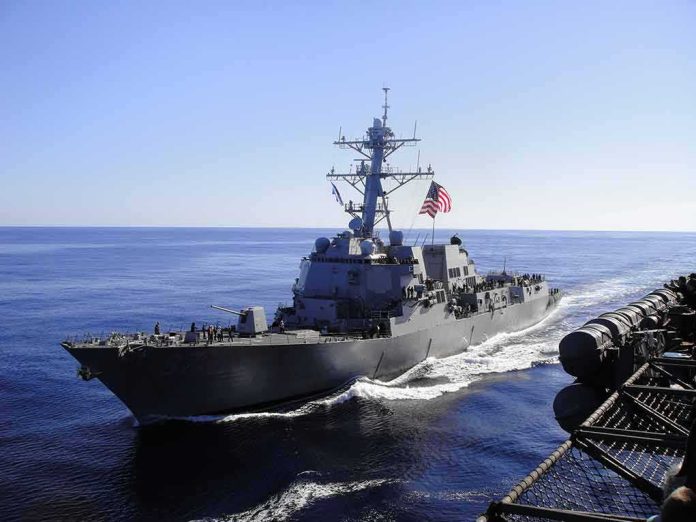
As U.S. warplanes pound targets deeper inside Iran for yet another night, both sides now claim they are “defending” civilians while millions of Americans see a distant war run by elites that never seems to end.
Story Snapshot
- The U.S. says new overnight strikes on Iran aim to protect commercial ships and civilian mariners in the Strait of Hormuz.
- American forces have hit hundreds of Iranian military targets over multiple nights, including air defenses, missile and drone sites, and small boats.
- The campaign now reaches further inside Iran, raising sharp questions about sovereignty, civilian risk, and long-term blowback.
- Both Washington and Tehran frame their actions as “self-defense,” leaving regular people trapped in a cycle of escalation with little transparency or accountability.
What the Latest U.S. Strikes Actually Hit
The United States Central Command says its newest round of overnight strikes hit more than 80 Iranian targets, including air defense systems, command networks, coastal radar, anti-ship missiles, and over 60 small boats in and near the Strait of Hormuz. Earlier waves this week struck about 90 sites one night and 140 the next, from missile and drone facilities to naval capabilities and ammunition depots. In just three nights, U.S. forces hit more than 300 targets, showing this is no small “limited” action but a large and sustained air campaign.
U.S. officials say these targets are all military and tied to Iran’s ability to attack commercial shipping. Central Command’s statements repeatedly stress that the goal is to “degrade Iran’s ability to attack commercial shipping and innocent civilian mariners in the Strait of Hormuz.” The strikes have focused on Iran’s coastline and key port areas, including locations near Bandar Abbas and other coastal cities, where Iranian radar, surveillance, and missile sites watch the busy shipping lanes. This mix of coastal military sites and nearby civilian hubs is what worries many observers most.
Why Washington Says the Strikes Are Necessary
U.S. leaders frame the operations as direct answers to Iranian attacks on cargo ships and tankers moving through the Strait of Hormuz. Central Command has linked several strike rounds to specific incidents, including a drone attack on a cargo ship that broke a fragile ceasefire and other alleged Iranian hits on commercial vessels. Officials argue that if Iran can mine waters, fire missiles at ships, or threaten crews with swarms of small boats, then America must act to keep global trade and energy flows moving. For many Americans, though, this sounds like another faraway war justified in the name of “commerce” while problems at home go unresolved.
President Trump and Pentagon briefers also connect these newer strikes to a longer pattern, including the 2025 “Operation Midnight Hammer” attacks on three Iranian nuclear sites. In that earlier operation, U.S. forces used bombers and missiles to hit Fordow, Natanz, and Isfahan, claiming they “obliterated” key enrichment facilities and slowed Iran’s nuclear ambitions. Now, officials present the ongoing 2026 strikes as part of a broader effort to limit both Iran’s nuclear program and its leverage over world shipping. Supporters see strength and deterrence; critics on both left and right see a permanent war footing that never seems to bring peace.
Iran’s Response and the Sovereignty Question
Iran answers these strikes with its own attacks on U.S. bases and allies around the Gulf, claiming it is retaliating against U.S. hits on bridges, ports, and other infrastructure on its soil. Reporting notes that some U.S. strikes destroyed bridges in Hormozgan province and a maritime control tower in the port of Chabahar, both inside Iran. That gives Tehran a concrete basis to argue that America is not just protecting ships at sea but also bombing Iranian territory and key transport routes. The more targets shift inland, the louder the sovereignty debate becomes, especially for people who already distrust Washington and talk of “limited” wars.
At the same time, Iran has not provided detailed public evidence that U.S. attacks are hitting purely civilian sites or causing large unlawful casualties. U.S. statements are very specific about hitting command centers, missile depots, and drone storage, while Iran’s counter-claims focus more on aggression and violation of territory than on site-by-site proof. There is also no neutral damage report yet that lists exactly what was destroyed, who was hurt, and whether each target was strictly military or “dual use,” like bridges and power stations. In this information gap, each government pushes its own story, and regular citizens are left to guess what is true.
What This Escalation Means for Ordinary Americans
For many Americans, especially older conservatives and liberals who both feel let down by Washington, this Iran war fits a familiar and troubling pattern. Leaders talk about “freedom of navigation” and “holding Iran accountable,” yet the strikes stretch on night after night, with growing risks to U.S. troops and foreign civilians. People watch their own costs rise at home, worry about unstable borders, and see more tax dollars and attention go toward another Middle East conflict. They wonder if anyone in power is focused on fixing life for working families rather than managing endless wars.
4 AM Top-of-the-Hour News
THE U-S HAS CONCLUDED AN EIGHTH ROUND OF STRIKES AGAINST IRAN President Trump ordered U-S CENTCOM to "open the gates of hell" upon Iran after two U-S service members were killed in Jordan. The latest attacks concluded late Saturday, Eastern time News… pic.twitter.com/bFpiIn4fBu
— Worldwide News Network (@WorldwideNNX) July 19, 2026
The Strait of Hormuz has long been a gray zone, where countries test each other with drones, coastal patrols, and small-boat harassment below the level of full naval war. Now that pattern has burst into open, repeated airstrikes by a superpower on another nation’s soil. Both Washington and Tehran claim “self-defense,” but neither side offers the kind of transparent, independent evidence that would reassure a skeptical public. Until citizens see clear answers on necessity, civilian harm, and end goals, this conflict is likely to deepen the shared belief across left and right that the federal government serves distant interests first and the American people last.
Sources:
facebook.com, reuters.com, nytimes.com, centcom.mil, aljazeera.com, bbc.com, cbsnews.com, youtube.com, cbc.ca