
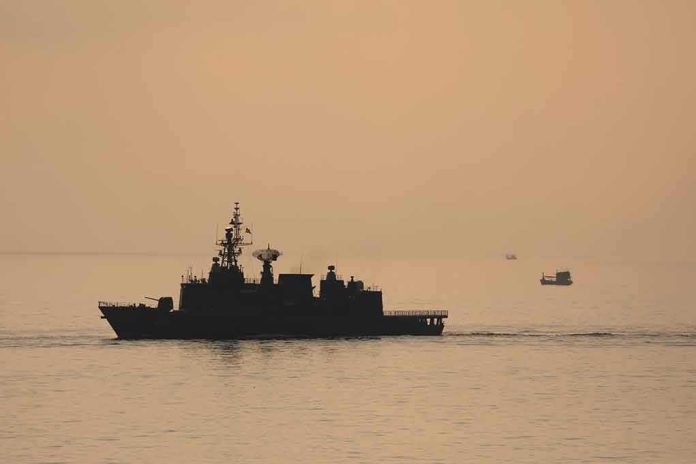
After a surprise attack on ships near the Strait of Hormuz, the United States has answered with nearly two weeks of steady strikes on Iran’s military — raising new questions about war powers, global trade, and who really benefits when conflicts spiral.
Story Snapshot
- The U.S. military says its strikes on Iran are a “powerful” self-defense response to attacks on commercial shipping and American forces.
- U.S. Central Command reports 13 straight nights of precision attacks on Iranian command centers, air defenses, drones, and coastal surveillance sites.
- Officials say the main goal is to keep the Strait of Hormuz open to global oil and goods traffic and protect civilian mariners.
- Critics warn that long, open-ended campaigns without clear legal and political checks feed the sense that Washington’s “deep state” chooses war over accountability.
What Triggered the New U.S. Strikes on Iran
U.S. Central Command says this latest wave of strikes started after Iranian forces attacked commercial ships moving through the Strait of Hormuz, one of the world’s key energy lanes. Military officials told reporters the United States was answering what they described as Iranian attacks on three commercial vessels. Earlier in the crisis, Central Command also tied other strikes to Iran’s downing of a U.S. Army Apache helicopter and missile and drone threats against U.S. bases. In public briefings, commanders have repeatedly framed these actions as self-defense meant to stop further attacks and protect regional shipping.
For many Americans, these explanations sound familiar. They have heard similar language used to justify past wars and interventions that dragged on for years and cost trillions of dollars, while problems at home went unresolved. Conservatives who backed tough responses to terrorism now worry about never-ending missions and the strain on troops. Liberals who opposed “forever wars” see another example of Washington choosing force first and accountability later. Both sides suspect that unelected security officials hold more real power than voters.
How the Strike Campaign Has Unfolded Night After Night
Central Command and major news outlets report that the United States has hit Iranian targets night after night, turning this response into a sustained air and sea campaign. Reports from National Public Radio, CNN, the Associated Press, and others describe repeated U.S. strike waves that soon reached 11 straight nights and then a 13th night of attacks. On July 23, Central Command said the latest round had lasted over two hours and focused on military sites tied to Iran’s ability to threaten shipping and nearby U.S. and allied forces. This scale and tempo show an operation that looks less like a one-time warning shot and more like a rolling attempt to reshape Iran’s military posture around the Strait.
Central Command’s own releases list a wide range of targets. They include Iranian command centers, air defense systems, missile and drone launch and storage sites, coastal surveillance radars, military logistics hubs, and maritime assets such as small boats used to menace commercial ships. U.S. officials emphasize that these are military objectives, not broad civilian infrastructure, and that they are chosen to reduce Iran’s ability to threaten global trade routes. At the same time, outside reporting says Iran has answered with attacks on U.S. bases and Gulf Arab states, and with its own strikes on tankers, deepening the sense that the region is sliding into a wider confrontation. Ordinary Americans watching this see another complex conflict that could easily grow, with little say from them about where it stops.
Freedom of Navigation, Energy Prices, and the Global Economy
U.S. officials say the heart of this campaign is the Strait of Hormuz, a narrow waterway where much of the world’s oil and gas flows. Central Command and Reuters both report that the strikes aim to “keep the Strait of Hormuz open to shipping” by hitting units and equipment Iran uses to target commercial vessels. Commanders claim Iran has attacked more than 30 commercial ships in recent weeks, endangering hundreds of civilian mariners and undermining freedom of navigation that global trade depends on. For families back home, those words translate into worries about higher energy prices, supply chain shocks, and another hit to an economy many already see as stacked against workers and small businesses. They hear that U.S. forces must defend world markets, but they wonder why the system rarely seems to defend them.
The US military has carried out a “heavy wave of strikes” against Iran in retaliation for Tehran’s missile attacks on American bases in Jordan, marking a sharp escalation after a nearly week-long pause in fighting.https://t.co/SYfzdL87GI#USmilitary #MiddleEast #american… pic.twitter.com/miBY50JkHe
— The Diplomatic Insight (@DiplomaticIns) July 30, 2026
At the same time, legal and academic experts are split over whether these strikes fit international law rules for self-defense. U.S. government lawyers point to Iran’s pattern of attacks and argue this is collective self-defense for both the United States and allies like Israel. Critics answer that Washington has not yet shared enough public proof of an “armed attack” that meets the United Nations Charter’s standard, or of careful checks on necessity and proportionality. Whatever people think of those legal arguments, they add to a feeling already strong on both left and right: the federal government makes huge decisions about war and peace in secret, and ordinary citizens are expected to accept the costs without seeing the full case.
War Powers, the ‘Deep State,’ and Public Trust
The way this campaign has unfolded feeds long-running worries about how America goes to war. Central Command’s statements and live cable news coverage shape most of the public narrative, while key documents like legal memos, rules of engagement, and full incident reports remain hidden. This one-sided flow of information lets military and intelligence officials frame events before Congress or the public can fully question them. That concerns conservatives who think unelected bureaucrats block America First priorities and liberals who fear security agencies ignore civil liberties and human costs. Both sides see a “deep state” that presents conflicts as technical operations, not democratic choices.
Many Americans also see a pattern: long overseas campaigns continue while core problems at home keep piling up. People wrestle with inflation, high energy costs, health care bills, and a shrinking middle class, yet Washington seems most unified when authorizing more strikes and deployments. The Iran campaign comes on top of decades of war in the broader Middle East, during which elites promised stability and prosperity that never fully reached average families. That history makes it harder for citizens to trust official claims that each new operation is limited, lawful, and aimed at protecting them. As this latest round of strikes continues, the central question for many is not only what happens next in the Strait of Hormuz, but whether the country’s leaders still place the American Dream ahead of the next war plan.
Sources:
townhall.com, centcom.mil, npr.org, aljazeera.com, cnn.com, reuters.com, apnews.com, youtube.com, justsecurity.org, theconversation.com