
President Trump told Senate Republicans that without the SAVE America Act, he may be the last Republican president — and he meant it as a deadline, not a metaphor.
Story Snapshot
- The bill requires documentary proof of United States citizenship to register for federal elections.
- The Senate opened debate by a 51-48 vote but later blocked the measure.
- Trump pressed leaders to keep the Senate in session until passage; party divisions stalled it.
- Opponents say noncitizen voting is rare and the bill would burden eligible voters.
What Trump Demanded, What the Bill Does
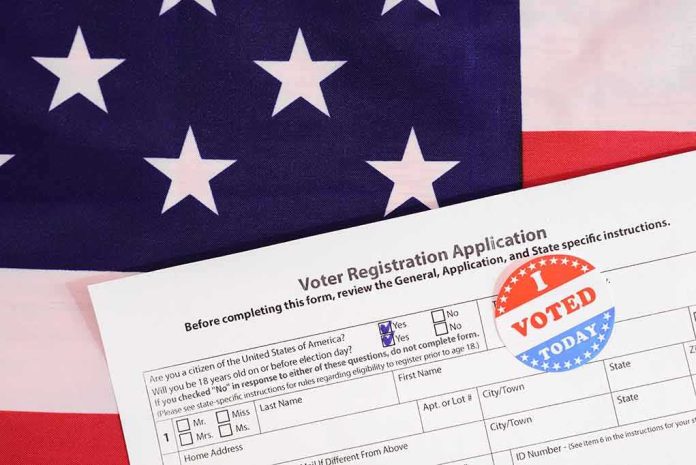
Trump set a clear line for Senate Republicans: pass the Safeguard American Voter Eligibility Act, or risk the party’s future in the White House. The bill amends the National Voter Registration Act to require documentary proof of United States citizenship for federal voter registration. It bars any state from accepting or processing a federal registration without that proof. The text lists acceptable documents and codifies the citizenship check nationwide. This is the heart of Trump’s case: election integrity starts at the registration desk.
Supporters say the rule is basic common sense: only citizens should vote in federal elections. They argue a uniform national standard ends loopholes and uneven state practices. That message resonated enough to clear an early Senate hurdle with a narrow 51-48 vote to begin debate. But the road got steep fast. The chamber’s filibuster rules require 60 votes for final passage, and Democrats held firm against it. A later push to attach the plan failed, marking a major setback.
Why It Stalled in the Senate
Senate Republicans split over tactics and timing. Some questioned whether budget reconciliation could carry a policy-heavy bill. Others saw no path to 60 votes and warned a talking filibuster could burn precious floor time with no win at the end. Four Republicans broke ranks on a modified attempt, signaling real resistance inside the party. Senate leadership kept expectations low, with aides even advising offices to downplay chances of passage. Trump’s pressure met a math problem the whip count could not solve.
Trump’s allies argue the stakes outweigh the risks. They point to a simple standard that treats every state the same and deters illegal registration before it happens. That is a platform built to match conservative values: clear rules, equal treatment, and respect for the vote. The counter from Democrats framed the bill as a voter suppression tool that would upend common registration methods and hand over sensitive voter data to the federal government. That message gave cover to moderates to say no, even as the House had earlier advanced its version.
The Core Dispute: Risk Versus Burden
The fiercest fight centers on scale. Backers say even one illegal vote cancels a legal one, so prevention is worth the paperwork. Critics cite studies and reviews showing noncitizen voting occurs in tiny numbers and rarely on purpose, then argue document hurdles will block far more eligible citizens than the fraud it stops. On pure numbers, the critics have a point about rarity. On principle, supporters have the cleaner line: citizenship is the bright line, so prove it at signup and move on.
Meet Dottie.
She helped to deliver Pennsylvania for President Trump & wants Senate Majority Leader Thune
to pass the SAVE America Act.
Dottie, thank you for helping to secure our nation’s future. pic.twitter.com/gv4AtMG5T7
— John f Kennedy jr ⏰ (@JohnJohnjr37795) September 1, 2026
The Supreme Court has upheld voter identification laws before, but the SAVE America Act goes further by requiring proof of citizenship at registration. That jump demands strong administration: easy access to documents, broad lists of acceptable records, and fail-safes for veterans, seniors, and rural voters. If the Senate ever revives this bill, Republican drafters should pair the mandate with friction cuts that match the burden claims point for point. Do both, and the fairness case gets stronger.
Trump’s Warning, The GOP’s Choice
Trump’s warning was not theater; it was leverage. He believes the party cannot rely on close margins while leaving registration checks to a patchwork of state rules. The Senate’s failed vote showed the political ceiling, not a lack of will at the base. A path remains: keep the standard, widen the document list, fund free records, and guarantee same-day cures for missing papers. That blueprint honors election integrity while avoiding friendly fire on lawful voters.
Republicans now face a simple test that every busy voter can understand. If only citizens can vote, the system should ask for proof — and make it simple to provide. If the Senate will not pass that standard this year, Republicans should run on it, earn the votes to clear 60, and do it right. The alternative is Trump’s line ringing in their ears. In politics, as in life, warnings like that tend to be less about fear and more about focus.
Sources:
thegatewaypundit.com, cnbc.com, cnn.com, congress.gov, usatoday.com, npr.org, en.wikipedia.org, axios.com, time.com, democracydocket.com, brennancenter.org