
Astronomers say a nearby dead star likely looks chartreuse to human eyes, a rare color explained by polluted starlight and hard data.
Story Snapshot
- Scientists identified white dwarf WD J1330+6435 as the first modeled green-looking star.
- Research links the color to sodium-rich pollution in a dense helium atmosphere that soaks up yellows and oranges.
- NASA highlighted the object in its Astronomy Picture of the Day with an educational illustration.
- The green color comes from measured spectra and human-vision models, not a telescope eyepiece view.
What Scientists Found And Why It Matters
Researchers published an analysis showing that the white dwarf WD J1330+6435 would appear distinctly green if our eyes could resolve its tiny disk. The team modeled human-visible colors from measured starlight and found a chartreuse hue, not the usual white. The object sits in the constellation Draco and lies a few hundred light-years away in our galaxy, according to reporting that cites the lead scientist, Mark Hollands of the University of Warwick.
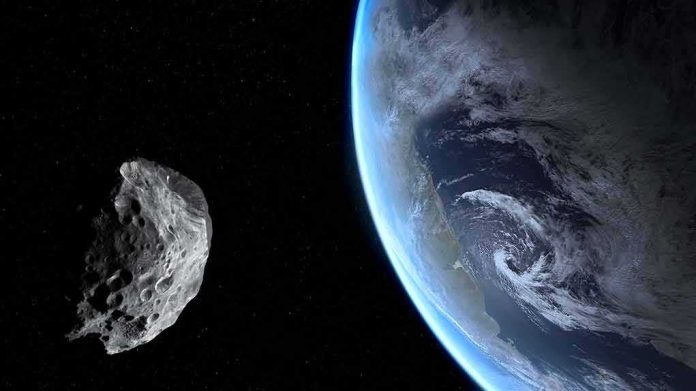
NASA’s Astronomy Picture of the Day featured the discovery on October 22, 2026. The entry described the object as a white dwarf and presented an illustration with a dusty ring and rocky debris. The image is a teaching aid, not a direct photograph of the system. NASA’s post helped push the story into wide view during a week of heavy news at home and abroad, where public trust often hinges on clear facts and plain language.
How A Dead Star Can Look Green
The research points to a simple cause with unusual physics. The star’s outer layers appear loaded with sodium, likely from former planets that fell in. In a very dense helium atmosphere, sodium atoms collide so often that they absorb a wide band of yellow, orange, and some red light instead of a thin orange line. That missing light shifts the star’s look toward green when modeled for human vision, the team reported in coverage of the study.
The color result comes from spectra, which are careful measurements of how much light arrives at each wavelength. The scientists then converted that spectrum into a predicted color that a person would see. Reports stress that nobody has looked through a backyard telescope and seen a green disk. The conclusion relies on tested models of human color response fed by real starlight data, not on a painted picture or guesswork.
Where This Fits In Astronomy
White dwarfs often show heavy elements in their atmospheres, which should sink out of sight fast. That signal is strong evidence that many such stars keep pulling in bits of old planets or moons. Studies over the years have found that a large fraction of white dwarfs are “polluted” this way, making WD J1330+6435 part of a well-known pattern. What is new here is the specific chemical mix and pressure effects that may push the color into green.
Basic details remain under study, as they often do with fresh results. Stories disagree on the exact distance, with numbers near 280 and near 326 light-years both in circulation. That gap may reflect different data releases or methods and does not change the key finding about color modeling. Astronomers can tighten those numbers using the latest parallax from space-based measurements and standard checks used across the field.
Why This Discovery Resonates Now
This find shows how careful measurements and open methods can still surprise us. During a time when many Americans feel let down by big institutions, clear science that explains both what we know and how we know it can earn trust. Here, the evidence rests on spectra, physics of atoms under pressure, and a transparent link to human color vision. NASA’s public post and the peer-reviewed paper give citizens a way to check the claims for themselves.
Astronomers have discovered something that, until now, seemed almost impossible: a genuinely green star. And the explanation is even more extraordinary than the discovery itself.
Scientists at the University of Warwick have identified a white dwarf called WD J1330+6435, whose… pic.twitter.com/oxjOejsWva
— Mark Lambert (@sitsio) October 20, 2026
The next steps are practical and testable. Independent teams can take new spectra, look for dusty debris, and compare models that vary sodium, calcium, and lithium. They can also report color coordinates and uncertainties so others can reproduce the result. That is how science should work: measure, model, repeat. If confirmed, WD J1330+6435 will stand as a rare green-looking star and a vivid marker of shattered worlds around a stellar remnant.
Sources:
science.nasa.gov, reuters.com, people.com, natureworldnews.com