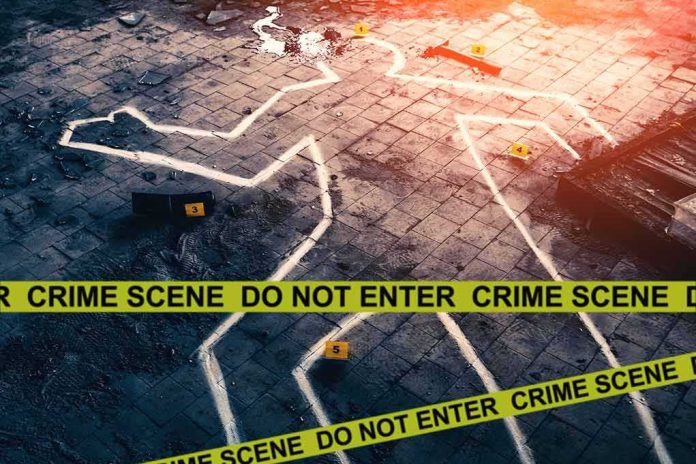
In intimate-partner homicides, the question is rarely whether the evidence is “direct” or “circumstantial”; it is whether the mosaic coheres. In the Caleb Flynn case, jurors concluded it did: motive anchored in a collapsing marriage, pre-offense messages mapping intent, digital records undercutting the alibi, and a scene they found was staged to mimic an intruder.
The Short Version
- A jury convicted Caleb Flynn on nine counts, including aggravated murder and tampering with evidence.
- Prosecutors tied motive to a looming divorce and an affair, supported by a 107,000-message archive.
- Electronic records and the lack of intruder forensics undermined Flynn’s claim he was asleep when his wife was shot.
- Defense arguments emphasized a missing murder weapon and the case’s circumstantial nature; the jury was unpersuaded.
What the jury decided and why it matters
Juries are not asked to choose between “direct” and “circumstantial” proof; they are asked whether all the admitted evidence, considered together, establishes guilt beyond a reasonable doubt. In Flynn’s trial, the panel returned guilty verdicts on all counts after a brief deliberation, a signal that the state’s theory—premeditation followed by crime-scene staging—held together under instruction and cross-examination. Multiple outlets reported the convictions included aggravated murder and three counts of tampering with evidence, reflecting not just a finding that Ashley Flynn was killed, but that the scene was manipulated to mislead investigators about how it happened.
That matters beyond this case. Domestic homicides often unfold without eyewitnesses; intent and identity are reconstructed from communications, timing, and post-offense conduct. Here, the verdict confirms that a carefully assembled digital and behavioral record can meet the standard even absent a recovered weapon.
The evidentiary spine: motive, messages, and a dismantled alibi
Prosecutors advanced a straightforward narrative of motive: a marriage collapsing under the weight of an affair and impending divorce. The state didn’t ask jurors to infer that motive from innuendo; it put on Flynn’s former mistress for two days and walked the jury through an enormous message archive—34 binders and 107,000 texts—linking emotion to action across time. Jurors heard lines that, in context, read as more than venting. One message attributed to Flynn was stark: “If I could literally kill her and not go to hell, I would do it in a heartbeat.” Another, hours before the 911 call, said, “I choose you. I’m free. Actions will come tomorrow,” which the witness understood as a declaration that decisive steps—divorce foremost—were imminent.
Digital forensics then did what it often does in modern homicide trials: it tested narrative against timestamps. Prosecutors said device records contradicted Flynn’s claim that he was asleep in a child’s room when the shots were fired, and they emphasized the absence of any forensic support for an intruder—no prints, no DNA, no trace that fit the break-in story. The jury’s acceptance of three separate tampering counts reinforces that they credited a staging theory, not an unknown assailant slipping in and out undetected.
The defense’s case—and its limits
Defense counsel leaned into two familiar lines. First, they argued prosecutors had proved an affair, not a murder, and stressed that no murder weapon was recovered. Second, they characterized the state’s case as circumstantial and warned against reading ugly messages as proof of homicidal action. These are not frivolous points; missing-weapons cases require clean chains of inference, and message caches can be emotionally inflammatory if not carefully contextualized. Flynn himself maintained his innocence to police and again in court, insisting he did not kill his wife.
But circumstantial is not synonymous with insufficient. American courts have long held that motive plus corroborated conduct plus post-crime behavior can satisfy the burden; indeed, many domestic killings are proven precisely this way. The jury’s quick verdict suggests they found the state’s web—motive texts, pre-incident declarations, alibi-fracturing device data, and a scene inconsistent with an outsider—more persuasive than the defense’s objections to missing physical items and the rhetoric of “all circumstantial”.
How staged-scene cases are investigated and proven
Crime-scene staging—altering evidence to masquerade a homicide as a burglary, a suicide, or a random attack—is well documented in intimate-partner homicides. It is not rare, and it is not new. The investigative response is equally well developed: treat the scene as data, not theater, and test claims against physical and temporal constraints. Analysts probe entry points from both sides of the threshold, trace damage patterns for directionality, and reconcile bloodstain and trajectory evidence with a hypothesized sequence of events. Investigators also now treat digital exhaust—phone movements, message cadence, wearable-device arousals—as part of the scene, because it fixes human behavior to the minute and often to the meter.
When jurors later hear that a defendant’s timeline collides with his device’s own telemetry or that a supposed break-in shows hallmarks of after-the-fact manipulation, they are not being asked to imagine new science; they are being asked to apply common sense to converging lines of proof. In cases like Flynn’s, the volume of messaging is not a spectacle; it is how prosecutors show continuity from grievance to plan to execution window.
🚨 BREAKING: PROSECUTOR CALLS CALEB FLYNN MURDER A “PLANNED AND CALCULATED EXECUTION” — ASKS FOR LIFE WITHOUT PAROLE
The prosecutor highlighted something especially disturbing: Flynn’s alleged attempts to coach his own daughters on what to tell police after their mother was… pic.twitter.com/d9IfcWbaXB
— Lindsay 🇺🇸 (@TheLinzerShow) October 5, 2026
Why the “circumstantial” label misleads lay readers
In everyday speech, circumstantial sounds like speculative. In law, it is not. A present-sense text about looming “actions,” a digital wake event on a watch that contradicts a claimed sleep period, a lack of third-party trace where one should exist if an intruder passed—all are circumstantial. Together, properly authenticated and admitted, they can be overwhelming. Appellate courts regularly uphold such mosaics in homicide cases because people reveal themselves in patterns: what they say to intimates, where their devices move, and how they behave when the spotlight turns on.
Put differently: demanding a single irrefutable object—a gun, an eyewitness—misunderstands how modern murders are investigated and proven. Forensic evidence is often strongest not when a single artifact appears, but when dozens of independent artifacts point in the same direction.
What this case teaches going forward
Three takeaways travel beyond this courtroom. First, digital life is evidentiary life. Message archives, location pings, sleep metrics, and application logs will continue to be central in reconstructing intent and opportunity in domestic killings. Second, staging theories live or die on professional scene work; when investigators treat every scratch, smear, and “broken” latch as data, juries can see through theatrics. Third, media framing around notoriety—celebrity tie-ins, religious standing—can distract from the analysis that actually decides cases: the chronology and the coherence of proof. Readers should prize the latter, not the headline hook.
In Flynn’s prosecution, the state advanced a coherent, corroborated narrative of premeditation and deception; the defense offered denials, highlighted what was missing, and urged restraint. Jurors chose the mosaic. That choice aligns with how intimate-partner homicides are typically solved and proven—and with a justice system that asks factfinders to weigh the whole picture, not a single piece.
Sources:
youtube.com, bbc.com, abcnews.com, nbcnews.com, cnn.com, cbsnews.com, abcnews4.com