
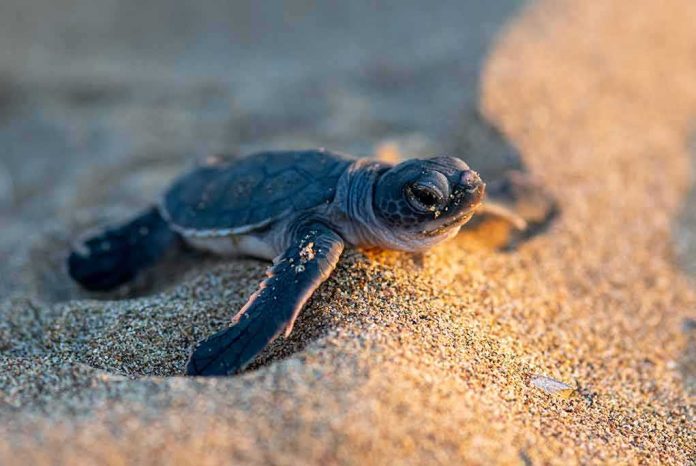
Southern California’s coastline has become, for the first time in recorded history, a nesting ground for a tropical sea turtle that has no business being there — and the reason traces back to an ocean current pattern that periodically rewires the map of where marine life can survive.
Key Points
- Two olive ridley sea turtles — a species that normally nests from Mexico to Panama — dug nests and laid eggs on Orange County beaches in September, the first confirmed natural sea-turtle nesting ever recorded on the U.S. West Coast.
- Federal agencies point to a combination of a lingering marine heat wave and an incoming strong El Niño as the likely drivers pushing warm water, and the animals that depend on it, hundreds of miles north of their usual range.
- The pattern extends well beyond turtles: hammerhead and whale sharks, yellow-bellied sea snakes, devil rays, and blue marlin have all turned up in Southern California waters during this warm phase.
- Marine scientists caution that while tropicalization during warm ocean cycles is a well-documented and repeatable phenomenon, no single sighting proves causation on its own — the broader multi-year data record is what confirms the trend.
- The same warm water driving these sightings is also stressing kelp forests and reshuffling the food web, meaning the “exotic visitor” story has a less charismatic flip side for resident species.
What actually happened on the beach
On September 16, 2026, an olive ridley sea turtle crawled ashore near Seal Beach National Wildlife Refuge in Orange County, dug a nest pit, and laid eggs. Three days later, a second olive ridley — possibly the same animal, though biologists could not confirm it — repeated the act near the Huntington Beach Pier. NOAA Fisheries called it the first-ever recorded nest for any sea turtle species on the entire U.S. West Coast, a designation later echoed by the U.S. Fish and Wildlife Service, which jointly documented the find. Lifeguards fenced off both sites, and biologists eventually excavated more than 200 eggs and relocated them to the Aquarium of the Pacific in Long Beach ahead of a damaging swell that threatened the nests directly.
Olive ridleys are an arribada species, famous for synchronized mass nestings on beaches in Mexico, Costa Rica, and India. Finding even one female attempting to nest 700 miles north of her typical range is, in the words of one researcher who spoke to the USA TODAY Network, something that “forces us to kind of redefine the distribution” of the species. NOAA’s own statement tied the event to a convergence of two separate warming forces: a marine heat wave that had already elevated sea-surface temperatures along the Southern California coast, layered on top of the onset of a strong El Niño.
How El Niño rearranges the ocean’s map
El Niño is a periodic warming of surface waters in the central and eastern tropical Pacific, part of a natural oscillation that also includes its cold-phase counterpart, La Niña. When it strengthens, the usual wind and current patterns that keep cold, nutrient-rich water upwelling along the California coast weaken, allowing warm tropical water to push northward instead. That shift doesn’t just raise a thermometer reading — it moves the entire habitat envelope that governs where heat-sensitive species can live, feed, and in rare cases, reproduce. Fisherwomen interviewed by Reuters described a season turned upside down: one crew landed roughly 5,000 yellowfin tuna this summer compared with just two the year before, alongside an unusual abundance of mahimahi, or dorado — both warm-water species that track the thermal boundary wherever it moves.
The same warm corridor has carried far stranger company. Yellow-bellied sea snakes, a highly venomous pelagic species normally confined to the tropical Pacific and Indian Oceans, have been documented in Southern California only a handful of times since 1972 — and scientists flagged the current super El Niño as a likely reason more could appear. Hammerhead and whale sharks, giant manta rays, and fin devil rays have also been spotted well north of their customary range, with one spearfisherman off Catalina Island calling a school of devil rays “stealth bombers of the sea” after only two or three such sightings in his 15 to 20 years on the water. Oceana has cataloged these as classic tropical and subtropical species that strong El Niño conditions are known to usher northward.
Why one nesting event isn’t the whole proof — but the pattern behind it is real
A single sea turtle choosing an unlikely beach is, strictly speaking, an anomaly — and marine biologists involved in the discovery have been careful to say exactly that: it is not fully known why these particular turtles nested where they did, only that the conditions made it far more plausible than it would otherwise have been. What elevates this from curiosity to pattern is the decades-long scientific record behind it. A 23-year biological archive of larval fish off Southern California found that the 2014–2016 Northeast Pacific marine heat wave brought measurable increases in southern, warm-affinity fish species alongside declines in cold-water natives. Separate case-study analysis of that same heat wave documented southern warm-water fish and invertebrates expanding their range northward while offshore species moved into shallower coastal habitat, with California’s market squid fishery shifting substantially as a result.
Researchers studying the California Current more broadly have identified dozens of discrete marine heat wave events over recent decades and linked their frequency and intensity directly to basin-scale climate modes, including El Niño, rather than treating any one event as a freak occurrence. That is the real mechanism at work: not that El Niño personally escorts a given turtle to a given beach, but that it reliably tilts the odds, year after documented year, toward exactly this kind of northward incursion. The 2026 event fits a template scientists have now watched repeat since at least the 1997-98 and 2014-16 episodes — strong warm phases correlating with tropical species appearing, and in this case nesting, at record latitudes.
The less photogenic consequences
Warm water that imports exotic visitors is the same warm water punishing species that belong on this coast. Educators at the Aquarium of the Pacific have observed whale-watching trips come up empty of the whales themselves, as cooler-water prey retreats north and forces predators to follow; kelp forests, which require cold water to thrive, have shown measurable stress under sustained warming. Coastal managers are also contending with compounding effects — thermal expansion contributing to sea-level rise, Kelvin waves, and storm systems arriving on top of an already elevated baseline, which together have intensified beach erosion in places like Long Beach and Balboa Island. The arrival of a nesting sea turtle makes for an undeniably good headline; the quieter disruption to the ecosystem underneath it is the part scientists are most focused on tracking.
What it means going forward
Expect this will not be the last time. Biologists managing the Orange County nests have said explicitly that this marks the beginning of active sea-turtle nest management on Southern California beaches, anticipating more attempts in future warm years rather than treating 2026 as a one-off. El Niño cycles are not getting rarer, and the baseline ocean temperature they warm from has been trending upward independent of any single event — meaning the thermal threshold tropical species need to cross to reach California is lower than it was a generation ago. The practical upshot for anyone who swims, fishes, or simply watches this coastline: unusual is becoming, gradually, the new usual.
Sources:
youtube.com, fisheries.noaa.gov, latimes.com, smithsonianmag.com, aquariumofpacific.org