
In modern airliners, a trickle in the wrong place can escalate into a flight-safety decision; that is why a leaking lavatory faucet led a Frontier crew to declare an emergency and divert, and why that choice makes technical sense.
At a Glance
- The pilots explicitly declared an emergency over a forward-lavatory sink leak and diverted to Chicago O’Hare.
- Frontier confirmed the faucet “sprung a leak,” water traveled along the cabin floor, and the flight landed safely with no injuries.
- Multiple outlets corroborate the Denver–Detroit route, the diversion to O’Hare, and passenger video showing water on the aisle.
- Concern about electronics is credible: FAA and NTSB records document how cabin and lavatory fluids can intrude on wiring and systems.
What Happened Onboard: A Minor System, A Major Decision
The operational facts are straightforward. En route from Denver to Detroit, the crew of a Frontier Airlines flight reported that the forward lavatory sink “sprung a leak,” with water spreading into the cabin. On air traffic control frequencies carried by local news, the pilot issued an emergency declaration and requested a diversion to Chicago O’Hare, citing concern about potential impact to aircraft electronics. The aircraft landed safely; Frontier stated there were no injuries among passengers or crew, and maintenance was initiated after arrival. These elements — leak in the forward lavatory, emergency call, diversion to O’Hare, and safe outcome — are consistent across NBC Chicago, ABC7 Chicago, and CBS Chicago reporting.
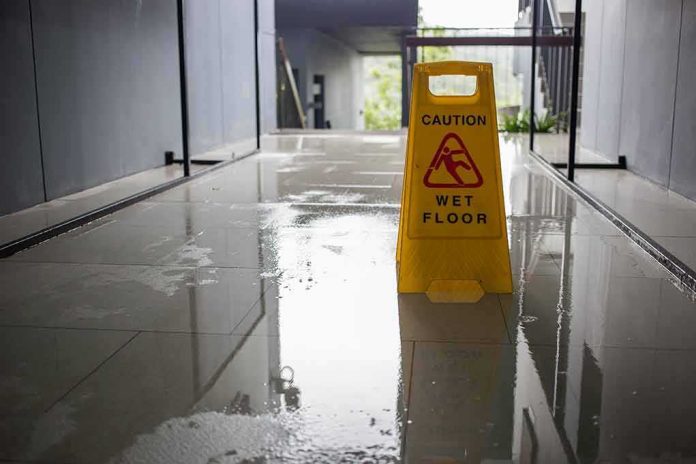
Eyewitness-style visual corroboration exists. ABC7 reported obtaining video that appears to show water pooling on the floor, and other outlets referenced passenger footage. The presence of visible water in the aisle moves the narrative beyond a single radio call and into the realm of observed cabin effects, even if the volume and exact origin within the faucet assembly were not established in public reporting.
Why A Leaky Faucet Can Justify A Diversion
To non-aviators, a plumbing issue may sound cosmetic. It is not. Commercial transports route potable-water, waste, and drain lines through confined spaces that often live above or adjacent to electrical harnesses, avionics bays, environmental-control ducting, and control-cable runs. Water follows gravity and structure; it wicks along insulation, seeps beneath floor panels, and can migrate far from the source. FAA guidance has, for decades, emphasized lavatory and galley leak prevention and secondary containment because leakage can create secondary hazards — electrical shorts, corrosion, or, at altitude, freezing that compromises systems or mobility of components.
The risk is not theoretical. NTSB investigations have documented events where lavatory or cabin fluids contaminated electrical connectors, leaving telltale “blue water” residue — the dye used in aircraft lavatory systems — and producing electrical malfunctions. In one case, contamination of connectors in the electronics compartment was associated with an uncommanded roll event attributed to electrical faults; maintenance and inspection gaps were part of the chain. The lesson translates cleanly: crews are trained to treat unexplained or uncontrolled cabin fluid leaks as a systems risk, not a housekeeping issue.
Inside The Crew’s Call: Risk Management In Real Time
Pilots make diversion decisions against a moving backdrop: location, weather, system status, workload, and the imperfect information available midflight. Here, the crew told controllers they were “worried about electronics,” then executed a direct diversion and expedited descent. That is textbook airmanship: identify a plausible hazard pathway (water migration), protect the aircraft’s electrical integrity before faults emerge, and move to the nearest suitable airport with robust maintenance and emergency response. The reporting also notes the crew said “so far all our systems are normal” during the descent in one recording — exactly the point: act before abnormal indications develop, not after.
Industry practice backs the caution. Wet wiring does not announce itself politely; it can present later as corrosion, intermittent connections, or nuisance faults that escalate during a critical phase. Even when leaks stay above the floor covering, pooling water can migrate with pitch and roll. The safest card to play is time and proximity to a field like O’Hare with parts, people, and pavement.
The Known, The Unknown, And What Matters
What’s well established: a forward-lavatory faucet leak occurred; the pilots declared an emergency and diverted; the airplane landed uneventfully; no injuries were reported; and video shows water on the cabin floor. What remains unreported in public sources is the precise failure mode — cracked fitting, failed seal, mis-rigged valve, or other component issue — and whether any electrical components were actually contacted or damaged. Those specifics live in maintenance discrepancy logs, fault histories, and post-landing inspections that airlines and the FAA do not routinely publish in real time. The absence of those minutiae does not change the flight-safety logic of the diversion; it only narrows our post hoc technical diagnosis.
There is also a clerical wrinkle: some coverage labeled the flight as 3566 while another outlet referenced 3655, a minor but real discrepancy in a story otherwise aligned in sequence and substance. Multiple reports, including the airline’s statement carried by local affiliates, identify 3566 on the Denver–Detroit routing; aligning identifiers is a task for dispatch records and airport logs, not a determinant of whether the event occurred.
Mechanics Of Lavatory Leaks: How A Drip Becomes A Hazard
Lavatory installations are engineered with primary seals, backup caps, and servicing procedures specifically to prevent in-flight leakage. FAA advisory material describes redundancies meant to mitigate leaks from valves and fittings; when those defenses are defeated — by component failure, improper servicing, or vibration-related loosening — fluids can escape and take the path of least resistance along floor structure and into compartments that were never designed to be wet. Investigations have tied prior events to servicing errors and to inadequate inspection intervals that missed developing corrosion or seepage. Some carriers revised procedures after incidents to ensure complete draining and proper sealing of waste tanks and lines to avoid overflow and migration.
In practice, crew options aloft are limited. They can command the water supply off, isolate the lavatory if able, and attempt to contain spread with absorbent materials, but if flow continues or the extent of migration is unclear, the correct next step is to reduce exposure time by landing.
#MAYDAY: Frontier Flight 3566 diverted to Chicago O’Hare after massive water leak from forward lav.
✈️ Aircraft: Airbus A321neo N688FR (MSN 13228, Mickey the Moose livery)
📍 Route: Denver (DEN) → Detroit (DTW)
🔢 233 souls on board, ~11,000 lbs fuel remainingPilot reported… pic.twitter.com/KnUdOP6BPI
— SLCScanner (@SLCScanner) November 11, 2026
Passenger Safety And Operational Aftermath
From the passenger’s perspective, the dominant risks in a cabin water event are slip hazards, the chance of water reaching carry-on electronics on the floor, and the cascading impacts of a diversion — delay, rebooking, and a maintenance hold. According to coverage citing the airline, no one was injured in this case, and the aircraft taxied to a gate for maintenance. That outcome reflects the layered safety net: alert crew, cooperative air traffic control, and a diversion airport built to absorb the unplanned.
What This Incident Teaches Frequent Flyers
First, treat water in the aisle as an operational, not cosmetic, issue; if crew cordon areas off or ask you to keep electronics off the floor, there is sound reasoning behind it. Second, understand that “emergency” in aviation parlance is a legal status that prioritizes a flight for landing; it does not imply impending catastrophe. Crews declare early for precisely this reason — to keep a manageable situation from turning into a technical one. Finally, recognize that the safest outcome often looks uneventful: a quick descent, an ordinary landing, and a maintenance team waiting at the gate.
Sources:
nypost.com, cbsnews.com, abc7chicago.com, meridian.news, viewfromthewing.com, faa.gov, data.ntsb.gov