
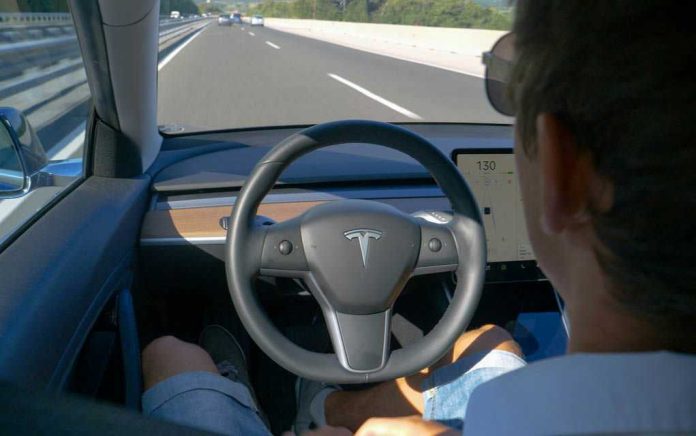
Robotaxis will only matter to the real economy if they do two hard things at once: prove driverless safety credibly and deliver cost-per-mile low enough to beat car ownership and human ride-hailing at scale; software leaps alone, however striking, are not the same as bankable economics.
At a Glance
- Software progress claims are necessary but insufficient; the economic case hinges on verified crash safety and unit costs, not internal multipliers.
- Intervention or disengagement rates lack standardization, making cross-company comparisons weak without transparent denominators and operating domains.
- Modeling work shows robotaxi competitiveness is dominated by utilization and annual mileage; labor and vehicle costs follow behind.
- Tesla’s “25x” critical-intervention claim for FSD v15 is notable but methodologically under-specified, so its implications for driverless robotaxi viability are indeterminate.
What “25x better” actually tells us—and what it doesn’t
Tesla’s FSD v15 release frames a step-change: a shared, upgraded vision encoder—trained on millions of internet videos—purportedly cuts “critical interventions” by a factor of 25 and “handles safety-critical cases” far better across the fleet. In autonomy development, tying a performance jump to a specific architectural change matters; it signals a mechanism rather than hand-waving. Yet for claims meant to support driverless service, a multiplier without a baseline obscures the absolute rate—miles per critical intervention, distribution by environment, weather, and road type—which is the figure that maps to crash risk and insurance modeling. Analysts across outlets have emphasized precisely these omissions: no published starting rate, no clear definition of “critical,” no exposure mileage, and no externally auditable dataset. As a result, the claim is interesting for engineering insiders but cannot be converted into a safety or economics conclusion by outsiders.
Context helps. Intervention and disengagement rates are a common internal yardstick, but reviews show the metric varies orders of magnitude across manufacturers and test regimes; without a shared denominator and taxonomy, it is not comparable and can mislead when generalized to safety-at-scale arguments. Even Tesla’s own framing concedes that gains may be “hard to notice on any individual drive” and only appear over millions of miles—exactly where transparent exposure accounting matters most.
Safety evidence that moves regulators and actuaries, not just enthusiasts
For a robotaxi network to run without safety operators, two questions must be answered with data regulators and insurers will accept: what is the crash rate by severity compared with human benchmarks, and how stable is that rate across operational design domains (ODDs)? The field has gradually oriented around these outcome metrics, precisely because intervention counts alone do not reveal whether a system avoids injury-causing events. Independent or regulator-reviewed analyses based on rider-only miles, stratified by context, carry the weight in policy decisions. Academic and policy literature reinforces that disengagements are an input metric; verified crash and injury outcomes are what determine permission to scale and premium-setting.
This distinction explains why skepticism persists toward self-published safety claims that preclude recalculation. Investigations and correspondence have criticized methodology gaps and selective statistics when companies promote autonomy safety without transparent denominators and definitions; the remedy is not rhetoric but protocolized disclosure that lets third parties reproduce the findings. Until crash-severity outcomes are published with exposure, confidence intervals, and ODD detail, a “25x” intervention multiplier remains an engineering milestone—useful internally, weak externally.
The economic hinge: utilization, annual mileage, and real operating costs
Even assuming credible driverless safety, robotaxis “save the economy” only if they move the needle on transportation productivity. Modeling work consistently finds that cost-per-mile depends far more on capacity utilization and achievable annual mileage than on any single component cost. High daily utilization amortizes vehicle purchase and fixed overhead; long annual mileage spreads maintenance and insurance; fleet management reduces deadhead time; only then do labor savings (from removing drivers or centralizing remote assistance) deliver material cost advantages.
That is why independent studies caution that low utilization, cleaning and supervision overhead, and insurance can erase perceived savings, leaving robotaxi costs uncompetitive with private car total cost of ownership (TCO) or even with efficient human ride-hail in some markets. An MIT-linked analysis highlighted that autonomy-era costs like safety oversight and cleaning, when paired with suboptimal utilization (circa 50%), can keep per-mile costs elevated relative to optimistic projections. Conversely, scenarios with sustained high utilization and streamlined fleet operations can undercut traditional taxis, even with some labor retained for remote support. The levers are operational, not just algorithmic.
Mechanism and milestones that would convert promise into productivity
Translating software progress into macroeconomic impact requires discipline on four fronts. First, disclose outcome safety, not just process proxies: publish driverless crash and injury rates with exposure miles, ODD breakdowns, and confidence intervals, audited by a neutral third party or regulator. That’s the credential that unlocks broader geofences and night, weather, and arterial coverage at scale—each a utilization multiplier. Second, codify metrics: define “critical intervention” and preregister analysis plans so multipliers become meaningful and reproducible, letting buyers, cities, and insurers price risk rationally.
Third, expose unit economics over a representative service window: vehicle capex and depreciation schedule, charging and maintenance, insurance and liability handling, remote assistance staffing ratios, cleaning and vandalism costs, pricing and occupancy, deadhead share, and realized annual mileage. Without this ledger, cost-per-mile claims remain marketing rather than finance. Fourth, expand the validated ODD deliberately, proving robustness to low-frequency, high-severity edge cases—emergency vehicles, ambiguous construction, occlusions, severe weather—through blinded testing and monitored operations. That is where rare failures can dominate both safety and cost tail risks.
TESLA $TSLA — Robotaxi Finds a New Business Inside Tesla
Tesla is beginning to use Robotaxi rides for customers waiting on vehicle repairs, potentially reducing a recurring service expense while putting its autonomous fleet to work.
An Austin owner reported receiving an in-app…
— MentoviaX (@MentoviaX) November 20, 2026
So, can robotaxis “save the economy”?
They can improve economic efficiency if, and only if, two verifications arrive together: crash-severity outcomes that regulators and insurers accept as at least competitive with human driving in the same domains, and operating metrics—utilization, annual mileage, and overhead discipline—that push fully loaded costs well below human ride-hailing and meaningfully below private-car TCO for urban households. The academic and policy evidence suggests these are achievable in constrained ODDs with strong fleet logistics; the open question is speed of generalization to broad, messy city networks without cost blowouts.
Where does Tesla’s “25x” fit? As a reported internal improvement tied to a specific vision-encoder upgrade, it is a plausible sign of engineering momentum. But lacking a baseline, a metric definition, and exposure data, it cannot, on its own, justify the removal of safety operators or underwrite an economic transformation. The path from promising multiplier to macroeconomic savings runs through independent, outcome-based safety reporting and audited unit economics—followed by the unglamorous work of squeezing idle time out of fleets. Until those pieces are public and durable, robotaxis remain a candidate for economic leverage, not yet a proven engine.
Sources:
zerohedge.com, beinsure.com, digitaltrends.com, arenaev.com, vandatateam.com, cardailys.com, siliconnoon.com, electrek.co, nature.com, link.springer.com, arxiv.org