
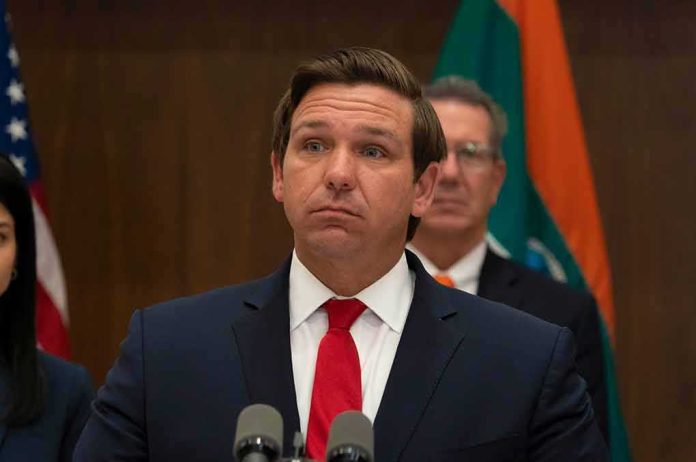
In modern American politics, a serious statewide figure signaling a national comeback often does it with a manuscript, not a microphone; reports that Florida Governor Ron DeSantis is at work on a new book fit that pattern and, by design or effect, keep his 2028 options open.
At a Glance
- Axios reported, citing two sources, that Gov. Ron DeSantis is quietly working on a book.
- Aggregators and political sites echoed the report, linking the project to 2028 speculation.
- DeSantis has published politically inflected books before, consistent with this move.
- He is term-limited and leaves office in January 2027, a natural staging point for national positioning.
What’s been reported, and why it matters
Axios reported that two sources say DeSantis is developing a new book, a project the outlet framed as fueling speculation about a 2028 presidential bid. The claim has since been summarized by Mediaite and Political Wire, which track and amplify political maneuvering across cycles. As of this reporting, DeSantis has not publicly confirmed the project, but the account has held its shape across outlets: a quiet writing effort, no revealed publisher or title, and an implicit link to post-governorship positioning. The significance lies in timing as much as content. DeSantis, term-limited, is expected to leave the Florida governorship in January 2027, and a manuscript landing around or after that transition would offer an agenda-setting platform at precisely the moment national conversation turns to the next presidential cycle.
The report fits DeSantis’s track record. He has previously used books to articulate ideological arguments and a governing brand—first with Dreams from Our Founding Fathers (2011) and more recently with The Courage to Be Free (2023). That history makes a fresh project unsurprising and, if it materializes, likely to be programmatic rather than purely memoiristic. Political books are multipurpose tools: they create media hooks, test policy frames, and introduce (or reintroduce) a candidate’s story in a controlled format. In practice, they are a rehearsal for the stump—on paper.
How candidate books function in presidential politics
Across the last several cycles, the “candidate book” has become a genre unto itself—part autobiography, part manifesto, part campaign brochure. Nearly every serious contender publishes one before or during a run, and two broad types recur. First, the introduction: a personal narrative that answers who I am, calibrated for the broadest possible audience. Second, the manifesto: a set of principles and policy planks that defines what I would do and why. The two often blur; the political marketplace rewards hybrid volumes that can book a Sunday show segment and supply quotable lines to a Fox, CNN, or talk-radio appearance the same week. This rhythm is not new; reporters were noting the “books pave the road to the White House” phenomenon even in the 2008 cycle, and assessments of the genre’s limits and excesses have been a minor literary beat for decades.
For a term-limited governor with national name recognition and existing donor networks, the book functions as a reframe. It supplies a thesis to replace the last news cycle’s defeats or detours, curates accomplishments, and previews contrasts with likely competitors. It also disciplines the author: to ship a book with real argument, the would-be candidate must convert governing records into a coherent narrative, anticipate attacks, and commit ideas to the public record—useful constraints ahead of retail campaigning. The downside is as familiar as the upside: candidate books can read like stitched-together op-eds and move few voters; the bestsellers are outliers, and blandness is endemic when every sentence is lawyered and poll-tested.
The DeSantis timing question and the 2028 inference
Axios’s framing links the book project to 2028 inferences without asserting a campaign decision. That’s fair as far as it goes: modern cycles demand early narrative infrastructure, and a governor exiting office in 2027 would logically build one before donor season and think-tank conference circuits ramp in earnest. Reporting indicates DeSantis has left the door open to a run, saying he would assess the political landscape after leaving office; a book is a classic vehicle for that assessment, and for telegraphing themes to activists, conservative media, and policy allies before formal filings or exploratory committees appear.
Still, a book is necessary but not sufficient. The hard signals of a national bid remain organizational—travel through early states framed as policy speeches, renewed small-dollar list growth, super PAC consultancy hires, polling memos seeded to friendly outlets, and the donor summits that double as talent recruitment. If the book materializes on the schedule suggested by his January 2027 transition, watch for a choreographed sequence: excerpt in a major outlet, a launch on friendly sets, then a run of speeches to governors’ conferences, conservative legal and policy groups, and state party dinners. That’s the measurable bridge from manuscript to movement.
How this report fits the media and publishing marketplace
The news originated with Axios and was echoed by Mediaite and Political Wire—the standard arc for early-cycle maneuvering: a discrete scoop, then aggregation that spreads its strategic implication as much as the underlying fact. On the publishing side, the commercial incentives align. Over the last decade, political cycles have reshaped trade publishing economics, expanding conservative imprints and turning campaign-adjacent titles into predictable list pillars in election run-ups; publishers time these bets to when media oxygen and event calendars are most favorable. A DeSantis book in the 2027–2028 window would enter a crowded but well-understood market segment with built-in television, podcast, and conference demand for the author.
Quality and sales are separate questions. Candidate volumes are often seldom read cover-to-cover; their purpose is agenda-setting, not literary innovation. The rare exceptions—books that shape rather than echo the campaign—combine clear narrative voice with a credible policy spine and a conflict the author can resolve on the page and on the trail. If DeSantis is indeed writing, the test will be whether the book translates Florida’s governance record into a forward-looking program that answers the Republican coalition’s unresolved questions heading into 2028, rather than relitigating prior fights at greater length.
I'm sure it will be riveting.
Florida Gov. Ron DeSantis Is Writing a Book, Sources Say — Fueling 'Speculation' About 2028 – https://t.co/w66aLejnpH #GoogleAlerts— Florida Issues (@FloridaIssues) November 23, 2026
What to watch next
Three tangible markers will separate rumor from runway. First, hard publishing signals: a catalog listing, ISBN registration, or on-record confirmation from a publisher or agent. Second, integration with a political calendar: orchestrated media placements and a launch tour that mirrors early-state roadmaps. Third, personnel and infrastructure: the quiet reassembly of national-policy advisers, digital and data vendors, and PAC-side alignments that precede any formal announcement. If those pieces follow a manuscript into the world, the book will read not as speculation, but as the opening argument of a bid.
Sources:
mediaite.com, politicalwire.com, dailyfoxnews.com, newsbreak.com, 2028tracker.com, esquire.com, politico.com, theatlantic.com, link.springer.com