
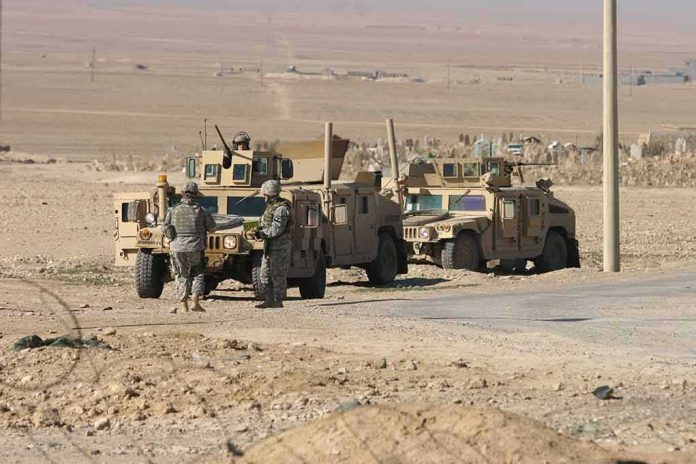
America’s military departure from Iraq is not just a chapter break; it is the formal close of a 23-year U.S. combat-and-advisory cycle and the pivot to a political, diplomatic, and intelligence-centered relationship that will define whether the gains against ISIS endure and whether Iraq can balance sovereignty with security.
At a Glance
- President Trump publicly declared the mission over and said the last American forces were leaving Iraq, framing the exit as an orderly conclusion and a joint U.S.–Iraq win.
- U.S. military officials confirmed the completion of the withdrawal on the same day, ending the coalition’s anti-ISIS mission in Iraq and initiating a bilateral defense relationship.
- The administration presented the exit as consistent with long-held promises to avoid “endless wars,” contrasting it with previous drawdowns and returns.
- This is the second full U.S. departure from Iraq; history suggests withdrawals can be revisited if the security balance tilts and local partners falter.
What happened: a declared end and a matched military exit
President Trump announced that the last American forces were leaving Iraq, describing the decision as overdue and the departure as complete and orderly. He called it a victory for both countries, asserting that the original military purpose — the defeat of the ISIS caliphate — had been accomplished and that the United States was “going home.” The public framing emphasized closure: a costly mission was ending, and equipment and personnel were departing in a controlled manner. The same day, U.S. military reporting affirmed that the withdrawal had been completed, aligning the commander-in-chief’s statement with operational reality and marking the end of the coalition mission in Iraq.
The administration’s rhetoric did more than announce a movement of troops; it narrated a strategic finish. Trump linked the exit to his broader posture against indefinite deployments, and to a handoff from a war footing to a sovereign Iraqi lead. Reporting tied the physical departure to the wrap-up of activity at Erbil and other coalition sites and to the start of a bilateral defense relationship rather than a coalition combat mission.
How the drawdown worked: mission design to retrograde
End-game military logistics are prosaic by design. Once the policy decision to exit is taken, commanders execute a retrograde: consolidate forces, inventory materiel, backhaul equipment, and transfer facilities and responsibilities to host-nation forces. Accounts of the final phase emphasized a deliberate closeout, including the movement of gear out of remaining hubs and the end of U.S. activity at Erbil Air Base — details consistent with standard U.S. practice of leaving minimal signature and minimal recoverable value behind in theaters where relationships remain sensitive and adversaries probe for propaganda wins.
Operationally, the exit also capped Operation Inherent Resolve’s Iraq chapter. The coalition’s tasks — advising Iraqi units, enabling intelligence, surveillance, and reconnaissance, and providing precision airpower against ISIS remnants — have been sunset in-country. The United States signaled a shift to a normal bilateral security dialogue, which typically means continued intelligence cooperation and professional military education opportunities, but no permanent U.S. ground presence or standing combat mission.
How we arrived here: two decades, two withdrawals, one recurring dilemma
This is not the first U.S. departure from Iraq. American forces left in 2011 under a status-of-forces schedule, only to return in 2014 when ISIS overran large swaths of territory and Iraqi units collapsed under pressure. That cycle taught a hard lesson: withdrawal ends a presence, not a problem set. The anti-ISIS campaign rebuilt Iraqi capacity and denied the group its territorial caliphate, but it also entrenched a familiar policy dilemma — how to sustain counterterrorism gains without a long-term garrison that becomes a political liability for Baghdad and a target for militias.
The current exit closes the coalition’s mandate in Iraq and transfers formal responsibility to Iraqi institutions. Analysts have long noted that in similar transitions, the base rate is not permanence but contestability — withdrawals are often politically popular and strategically contingent, revisited when security risks spike or host-nation calculus shifts.
What the administration claimed — and how it compares to the record
Trump cast the announcement in decisive terms: a clear choice to leave, a completed mission against ISIS, and a clean break from an era of costly entanglement. He also contrasted the withdrawal’s orderliness — “we took all of our equipment” — with prior episodes that left gear behind, underscoring command emphasis on a no-drama retrograde. Independent reporting the day of the announcement corroborated the central fact pattern: U.S. troops departed, the mission ended, and the United States and Iraq would proceed into a bilateral defense phase.
The victory framing was not only political theater; it aligns with the operational reality that ISIS no longer holds territory in Iraq and that Iraqi forces are the lead security actors. The decisive question has always been the durability of that arrangement without a U.S. on-the-ground backstop — a question that history urges policymakers to keep front of mind even as they mark the exit as an achievement.
The strategic stakes for Iraq and the region
Iraq now sits at the center of overlapping pressures. Without a U.S. footprint, Baghdad has greater room to assert sovereignty, reduce friction with factions that opposed the coalition presence, and recalibrate ties with neighbors. But the same vacuum can invite intensified competition among domestic armed groups and regional patrons; in previous drawdowns, that competition increased targeting of state institutions and widened security gaps that ISIS exploited.
A successful transition therefore hinges on three practical pillars. First, Iraqi command-and-control must keep coherence across army, police, and counterterrorism units as they absorb missions formerly enabled by U.S. advisors. Second, intelligence fusion — always the sinew of effective counter-ISIS operations — must persist through liaison channels even absent U.S. bases. Third, regional escalation management will matter more, not less, as militias test red lines and as neighbors gauge how far Baghdad can police its own airspace and borders.
Trump Says Over 4,500 US Soldiers Killed In Iraq War
US President Donald Trump has said more than 4,500 American soldiers were killed and about 31,000 wounded during more than two decades of US military involvement in Iraq.
Trump made the remarks as the last American forces… https://t.co/RuoJwAYoee
— frontis (@frontisHQ) September 30, 2026
What to watch next: signals that tell you if the exit is holding
Three indicators will separate rhetoric from reality. One, the tempo and geographic spread of ISIS-claimed attacks: a low, steady trend suggests Iraqi security forces are sustaining pressure; spikes in contested provinces signal stress on the system. Two, the degree of daylight between Baghdad and non-state armed groups in ministries and on the street: creeping normalization of militia coercion would erode the state’s monopoly on force. Three, the cadence and content of U.S.–Iraq defense consultations: robust intelligence exchange and episodic joint training, without mission creep, will reflect a healthy bilateral footing.
Why this exit matters for U.S. strategy
For Washington, the Iraq departure demonstrates an ability to terminate a long war mission on schedule while preserving a pathway for targeted cooperation. It also frees force structure for other theaters and signals to domestic audiences that campaign pledges against endless wars can be executed without chaos. The trade-off is familiar: reduced leverage on the ground in exchange for strategic flexibility. Whether that bargain pays off will depend less on what was said at the podium and more on how Iraqi institutions perform absent a U.S. safety net — and on how quickly both governments can adapt their partnership to deter new threats without recreating the old footprint.
Sources:
washingtontimes.com, npr.org, apnews.com, nbcrightnow.com, rand.org, atlanticcouncil.org, aljazeera.com