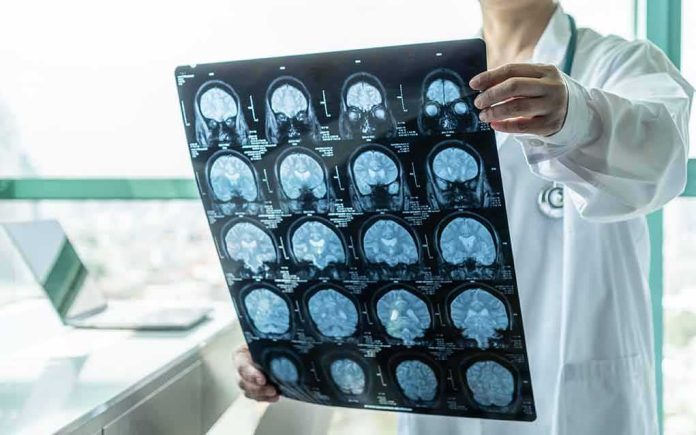
A new carbon dioxide breathing technique claims to wash Alzheimer’s proteins out of the brain, but the same gas is also linked to causing Alzheimer’s disease.
Story Snapshot
- Brief high-dose carbon dioxide sessions can push Alzheimer’s-related proteins from brain to blood in humans.
- Researchers say this may tap the brain’s waste removal system, the glymphatic pathway, without surgery.
- Other studies link elevated carbon dioxide to higher Alzheimer’s risk and damaged brain blood vessels.
- Experts warn against do-it-yourself carbon dioxide devices and stress this is early-stage research.
What the new carbon dioxide research actually shows
Scientists from the United States used short bursts of carbon dioxide mixed into room air to raise carbon dioxide levels in the blood for about thirty minutes. They tested five people with Parkinson’s disease and five healthy older adults, drawing blood before and after the session. After the intermittent carbon dioxide exposure, blood levels of amyloid beta, phosphorylated tau, alpha-synuclein, and other brain proteins increased. The team interpreted this as waste proteins moving from the brain into the bloodstream, driven by stronger vessel pulsations and cerebrospinal fluid flow.
The Nature paper and related summaries say intermittent hypercapnia—brief “on–off” periods of higher carbon dioxide—elicits vasomotion, the rhythmic squeezing of brain blood vessels that can move fluid. Imaging showed more regular waves of cerebrospinal fluid, which the authors linked to activation of the glymphatic system, the brain’s waste clearance network. A news report notes that protein levels in blood rose after the 30‑minute treatment and then dropped back toward baseline about an hour later, suggesting a temporary flushing effect rather than a lasting change.
Why this matters for Alzheimer’s and other brain diseases
Abnormal clusters of amyloid beta and tau are central to Alzheimer’s disease, and alpha-synuclein plays a similar role in Parkinson’s disease. Many labs now see the glymphatic pathway as key for clearing these proteins, especially during deep sleep when brain vessels naturally pulse and fluid flows more strongly. The new work suggests doctors might someday mimic deep sleep’s vascular pumping using controlled carbon dioxide pulses, without drugs or surgery, to move waste out of the brain. This idea appeals to people who want less invasive options than expensive drugs pushed by powerful companies.
For families watching loved ones decline while Washington bickers and drug prices soar, a simple breathing-based treatment sounds almost too good to be true. The technique uses a gas that we already exhale every second, and early trials have not required cutting into the skull. In a country where many feel the health system serves insurers and pharmaceutical giants more than patients, the thought of using air chemistry instead of another patented pill fits a growing desire for lower-cost, more natural tools. A registered clinical trial now aims to test prescribed carbon dioxide for enhancing protein efflux, a stand‑in measure for brain waste clearance.
The other side: when carbon dioxide looks like a threat, not a cure
A major case‑reports study finds that higher arterial carbon dioxide levels are directly proportional to the number of Alzheimer’s disease cases in a population. The authors describe several mechanisms: carbon dioxide‑induced acidosis can disrupt enzymes that clear amyloid beta, promote tau phosphorylation, and activate inflammatory pathways, all of which can push the brain toward Alzheimer’s‑like damage. Animal work cited in that paper shows chronic hypercapnia can increase amyloid precursor protein expression and amyloid beta buildup, and worsen tau changes.
Separate research on people with Alzheimer’s disease shows that cerebrovascular reactivity to carbon dioxide—the ability of brain vessels to widen or narrow when carbon dioxide changes—is often impaired. If vessel responses are blunted, the pumping mechanism that the hypercapnia therapy relies on may not work well in the very patients it aims to help. Preliminary data from one hypercapnia project even suggest that at 2 percent carbon dioxide, glymphatic clearance may slow, which clashes with the idea that more carbon dioxide always speeds waste removal. These conflicting results highlight how fragile the path from lab concept to real‑world treatment can be.
Safety concerns and expert warnings
Carbon dioxide is not a harmless toy; at higher levels it can cause headaches, confusion, and even loss of consciousness, especially in people with lung or heart problems. A fact‑check review quotes medical experts saying there is no proven benefit to consumer carbon dioxide breathing devices and that such products are more likely to cause serious harm than help. They warn that manipulating carbon dioxide without monitoring can worsen obstructive lung diseases and trigger dangerous drops in oxygen.
The United States Food and Drug Administration has issued consumer alerts about “false promises” and “miracle cures” for Alzheimer’s, telling the public to be wary of anything marketed as a breakthrough without strong clinical trial data. Right now, the intermittent hypercapnia approach sits in the early research stage: small human studies, rodent experiments, and one registered trial, but no approved treatment protocol for Alzheimer’s patients. That gap between exciting headlines and proven therapy feeds the shared frustration of both conservatives and liberals who feel the health system, backed by elite interests, keeps dangling hope while real solutions lag.
What we actually know, and what remains unknown
So far, the strongest fact is narrow but important: brief, carefully controlled carbon dioxide pulses can move brain‑derived proteins into blood in older adults and people with Parkinson’s disease. That shows the vascular and fluid systems of the brain are still responsive to rhythmic chemical cues. It does not yet prove that Alzheimer’s patients will clear enough amyloid beta or tau to slow memory loss, or that the long‑term balance between helpful pumping and harmful acidosis will favor benefit over risk.
Future work needs to address several gaps: direct imaging of amyloid and tau in Alzheimer’s brains before and after treatment, dose‑response studies at different carbon dioxide levels, and long‑term safety tracking. Independent teams will also need access to the original imaging and blood data to confirm that the rise in proteins in blood truly reflects brain clearance rather than measurement artifacts. Until those pieces are in place, inhaling high‑dose carbon dioxide remains a promising but unproven idea—one that shows how desperate our society is for new answers, and how important it is to demand solid evidence before trusting any new “fix” from medicine, industry, or government.
Sources:
newscientist.com, yahoo.com, pubmed.ncbi.nlm.nih.gov, mumblestandoori.co.uk, pmc.ncbi.nlm.nih.gov, assets.ctfassets.net, nature.com, abstractscorecard.com, youtube.com, mybrainco.com