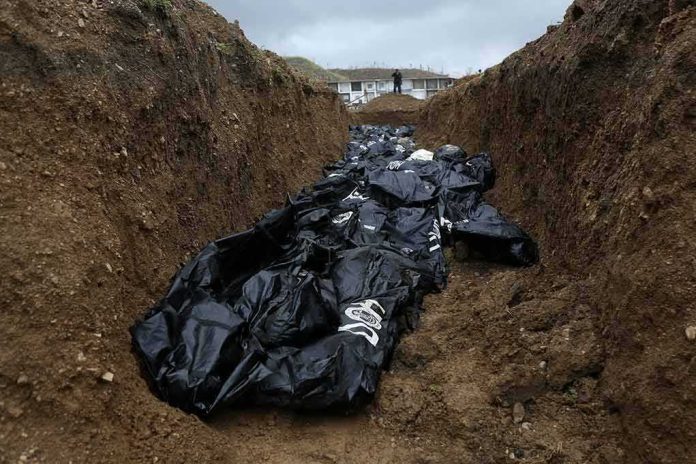
Families in Gaza City buried roughly 100 of their own on Sunday, more than two years after an Israeli strike buried them first under their own homes.
Story Snapshot
- Palestinians held a mass funeral in Gaza City’s Zeitoun neighborhood for about 100 people recovered from rubble.
- The dead came from the Rahim, Balawi, Malaka, Qanbour and Salmi families, killed when Israeli strikes hit residential homes roughly two and a half years ago.
- Middle East Eye reports 62 of the recovered were children.
- Local crews worked with the International Committee of the Red Cross and heavy machinery to pull the remains free.
- Burial followed funeral prayers at Al-Ahli cemetery after public memorial addresses from Gaza’s Civil Defence.
A Funeral Years In The Making
Mourners gathered Sunday in Zeitoun to bury remains pulled from collapsed homes destroyed early in the war. Al Jazeera’s field report describes a funeral procession for 100 people whose bodies had sat beneath rubble since a strike roughly two and a half years earlier. WAFA put the number at around 100 as well, tying the recovery to homes flattened in the war’s early months.
The victims were not strangers pulled from a disaster zone. They belonged to five named families, the Rahim, Balawi, Malaka, Qanbour and Salmi households, according to local authorities cited by Al Jazeera. Middle East Eye’s reporting adds a gutting detail. Of the roughly 100 recovered, 62 were children, meaning entire young generations of these families never made it out from under their collapsed homes.
How The Bodies Came Out Of The Ground
Digging through two years of collapsed concrete is not simple shovel work. WAFA reports local crews partnered with the International Committee of the Red Cross, using excavators, trucks, bulldozers and rubble-removal equipment to reach the remains. Middle East Monitor adds that Civil Defense teams recovered the bodies in recent days as part of a second recovery phase in a project that began back on July 19, aimed at retrieving Palestinians still trapped beneath destroyed buildings.
Before burial, Gaza’s Civil Defence and community representatives delivered memorial addresses, a public acknowledgment of loss before the remains were carried to their final rest, according to TRT World. The bodies were then taken to Al-Ahli cemetery in Zeitoun for funeral prayers and burial, a step confirmed separately by Middle East Monitor’s Anadolu-sourced reporting. WAFA’s account places the burial site at the Martyrs Cemetery in the same neighborhood, a reminder that even basic location details can shift slightly between outlets covering the same somber event.
Why The Numbers Never Quite Match
Readers scanning headlines this week saw 100, 105, and 112 all attached to similar Gaza funeral stories. That is not outlets contradicting each other on the same event. Gaza has held a string of mass funerals in recent weeks as recovery teams work through different collapsed sites, each with its own count and its own families. The scale of the underlying crisis explains why. One Gaza forensic official told reporters his department has no more than 15 staff, including volunteers, to handle a caseload that dwarfs their capacity.
Proper wartime recovery is supposed to follow strict steps, confirming death, establishing identity, and documenting each body before burial, under long-standing rules for handling the dead in conflict. A forensic pathologist described Gaza’s current reality bluntly, calling the identification backlog an international forensic emergency, noting only around 50 bodies had been positively identified through basic markers like height, age, and old injuries. Doctors handling the task say they lack even basic tools, with no DNA lab and no advanced scanning equipment available locally.
What This Says About A War Still Being Counted
A funeral for 100 people, most of them women and children pulled from under their own roofs, is not a statistic conservatives should wave away with geopolitical shorthand. Whatever one’s view of the broader war, burying a child nearly three years after a strike collapsed their home is a human tragedy that deserves plain acknowledgment, not spin from any side. The available reporting does not include an on-record Israeli military statement addressing this specific neighborhood, timeline, or casualty count.
🚨 Mass Funerals Held in Gaza for Over 100 Recovered from Rubble.
Palestinians in Gaza City held mass funeral services today for 105 people whose remains were recovered from buildings destroyed by Israeli airstrikes.
Mourners gathered amid the ongoing conflict, as families laid… pic.twitter.com/fENbzZ0n5R— Headline Theory (@HeadlineTheory) October 2, 2026
Gaza’s recovery effort is expected to continue, with more collapsed buildings still holding remains yet to be pulled free. Each new funeral will likely carry its own slightly different number, its own family names, and its own date range, a pattern rooted less in confusion than in the sheer scale of a city still digging out its dead.
Sources:
youtube.com, aljazeera.com, nbcnews.com, lusa.pt, english.wafa.ps, cbc.ca, bbc.com