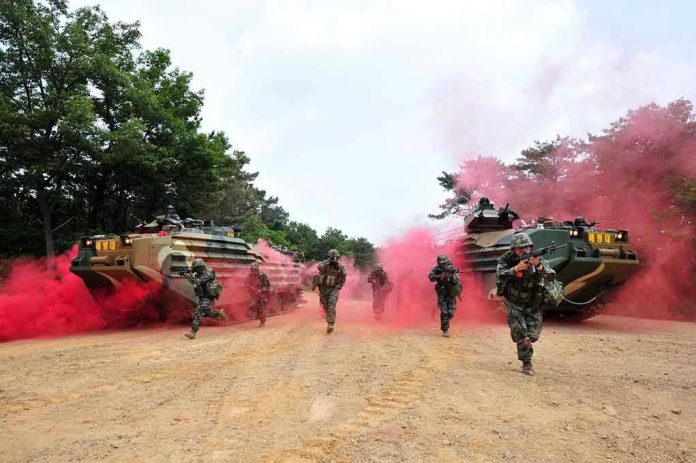
As Taiwan fires U.S.-made HIMARS rockets toward waters facing China, the clash between deterrence and escalation is back on center stage.
Story Snapshot
- Taiwan has fired U.S.-supplied HIMARS rockets in a live drill facing China’s coast.
- Island leaders frame the exercise as defensive training to stop a Chinese invasion.[3]
- Beijing’s media calls the same system a major threat that can hit deep targets on the mainland.[2]
- The United States now has one of its key rocket systems sitting within range of Chinese ports.[3][6]
Taiwan’s HIMARS Drill: What Actually Happened
Taiwan’s army has begun live-fire drills with the U.S.-made High Mobility Artillery Rocket System, known as HIMARS, in coastal areas that face mainland China.[1][2] Reports say this includes the island’s western and central shores, where Chinese forces would likely try to land in a war.[2][3] During one major drill, HIMARS trucks received an order, drove into firing position, and launched rockets toward waters in China’s direction, all on live television.[3] Taiwanese officials say the goal is to test real combat skills and invasion defense.[2][3]
The HIMARS system itself is a long-range, truck-mounted rocket launcher that the United States military first fielded in the late 1990s.[6] It can fire guided rockets and, in some versions, tactical missiles that reach about 300 kilometers, putting Chinese coastal ports in Fujian Province within range from Taiwan.[3][6] Taiwan began receiving HIMARS launchers from the United States in 2024 and has a plan for dozens of systems, which are now being folded into its biggest annual war games.[3][4] That means American-made precision firepower now sits right across from China’s coastline.[3][4]
How Taiwan Frames the Drills: Deterrence and Defense
Taiwan’s military leaders describe these exercises as unscripted drills meant to copy “full combat conditions” against a Chinese attack.[3][4] The Han Kuang drills, which run for about ten days, start with simulated enemy strikes on command and communications, then move into a full invasion scenario that includes beach landings.[3][4] Officials say the purpose is to prove to China, the United States, and the world that Taiwan is determined and prepared to defend itself, not to launch first strikes.[3][4] Coastal live-fire practice also helps troops learn local terrain, weather, and wind for real battles.[2]
U.S. Army analysis backs up that picture of HIMARS as a tool to break a fast, surprise grab by China, rather than to start a war.[4] That study says rocket artillery on Taiwan “frustrates the fait accompli” by making it much harder for the People’s Liberation Army to rush across the strait and lock in gains before outside help arrives.[4] By hitting ship groups, landing forces, and logistics nodes, systems like HIMARS raise the cost of any invasion.[4] For many in Washington and Taipei, that is exactly how deterrence is supposed to work: make the price of aggression too high to be worth it.
How China Spins It: A Major Strike Threat at Its Doorstep
Chinese state outlets tell a different story. China’s state-run China Central Television has highlighted Taiwan’s HIMARS purchase as a major threat, showing drills where Chinese rocket units train to strike it first.[2] One segment quoted soldiers saying that they had confirmed HIMARS targets and were ready to fire long-range rockets right away.[2] Chinese experts in that coverage called HIMARS capable of “deep counterstrikes” against People’s Liberation Army rocket units and supply lines, making it a high-priority target in any conflict.[2]
🚨 Taiwan has conducted its first live-fire HIMARS exercise on the island's western coast, the area widely considered the most likely corridor for a potential PLA amphibious invasion.
During the drill, 32 of 36 planned rockets were successfully launched, while 4 misfires are… pic.twitter.com/Vo31IggYn5
— Global Frontline News (@OmeyLad23) June 10, 2026
Chinese forces have also used their own large-scale exercises around Taiwan to send political signals.[2][4] At the end of 2025, China staged drills in waters and airspace around the island, with live fire on December 30 and moves by Chinese coast guard ships east of Taiwan.[2][4] Analysts say Beijing wanted to stress its claim that the Taiwan Strait is an internal issue, not an international waterway.[4] In this back-and-forth, each side calls its own drills “routine” or “defensive” while painting the other’s moves as dangerous games that raise the risk of war.[1][2][4]
Why This Matters for America-First Conservatives
For Americans who care about strong borders, limited war, and smart use of tax dollars, this story cuts both ways. On one hand, Taiwan buying and training on U.S. systems like HIMARS means a frontline ally is paying to hold the line against Communist China, not begging for American troops on the beach.[3][4] That fits a burden-sharing model many conservatives support: U.S. weapons, local fighters, and no endless nation-building.[4] It also puts real pressure on Beijing, which has grown more aggressive in the region.[4][6]
On the other hand, every new high-tech system moved into a hotspot can drag the United States deeper into far-off risks if things spiral.[4] China now points to American-made rockets in Taiwan as proof that Washington is “arming separatists,” while U.S. leaders insist they are only helping a free people defend themselves.[2][4] The facts on the ground are clear: Taiwan’s first live-fire HIMARS drills were aimed out toward China’s coast, but framed as anti-invasion training.[1][2][3] Whether that is seen as common-sense defense or dangerous provocation depends on which capital you sit in—and how much you trust Communist promises.
Sources:
[1] Web – Taiwan Fires Rockets in China’s Direction from a US-Supplied Mobile …
[2] Web – Taiwan deploys advanced US HIMARS rockets in annual drills
[3] Web – China highlights Taiwan’s HIMARS as major threat in latest military …
[4] YouTube – Taiwan Tests US-Made HIMARS Rockets Ahead Of Drills
[6] Web – Taiwan tests US-made HIMARS ahead of drills – Facebook