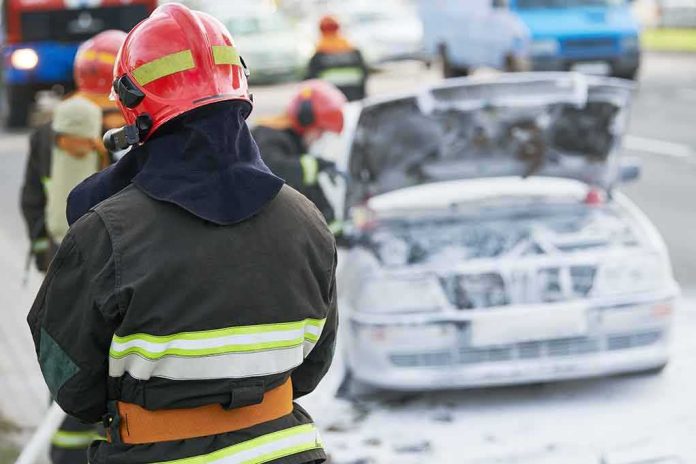
A tanker packed with thousands of gallons of fuel turned a California freeway into a fireball, and once again exposed how fragile our basic safety systems really are.
Story Snapshot
- A tanker truck carrying about 8,600 gallons of fuel crashed near Selma and exploded into a massive highway fireball.
- Both the tanker driver and the box truck driver survived with reported minor injuries, despite the scale of the blast.
- Southbound lanes of Highway 99 were shut down for hours, disrupting travel and commerce across a key Central Valley route.
- Conflicting early reports on what caused the crash highlight how the public is kept in the dark while officials control the story.
What Happened On Highway 99 Near Selma
On a busy Saturday in Fresno County, a fuel tanker truck traveling south on Highway 99 near Selma slammed into a box truck and burst into flames. The tanker was hauling about 8,600 gallons of fuel, enough to feed a towering fireball that drivers could see from miles away. Video from the scene shows black smoke pouring into the sky and flames engulfing the highway, as traffic came to a halt and people scrambled to get clear.
California Highway Patrol officers said the crash happened near the Second Street area, a common stretch for local commuters and truckers moving food and goods through the Central Valley. The impact turned the tanker into a rolling torch, sending burning fuel across lanes and onto the shoulder. Despite the violent explosion, officials reported that both drivers managed to escape, with injuries described as minor, and one driver treated for small burns.
How Officials Described The Cause And Response
Early reports said a box truck had become disabled on the right shoulder with a flat tire and pulled off the roadway before the crash. According to a California Highway Patrol sergeant quoted by local media, the driver waited about ten minutes for help when the tanker barreled into the parked truck, triggering the fire. Fire crews and law enforcement rushed in, battling the blaze and shutting down southbound Highway 99 while traffic was diverted onto nearby streets.
Local outlets reported that the closure stretched for hours, choking a major north–south route that Central Valley workers and small businesses depend on every day. Drivers sat in long backups or were forced onto farm roads and side streets that were never meant to handle that volume. For families already dealing with high fuel prices and long commutes, the shutdown was another reminder that one bad moment on an aging, crowded highway can ripple through thousands of lives in minutes.
Why The Story Around The Crash Keeps Shifting
Soon after the fireball video began spreading online, some posts and reports claimed the crash came from an unsafe lane change, while later accounts focused on the disabled box truck parked on the shoulder. The public has not seen the full California Highway Patrol collision report, which is supposed to spell out the primary collision factor and list the facts that support that finding. That means people are left with partial summaries and shifting theories, even though the fire itself is beyond dispute.
Crash investigation manuals used in California show that what officers say at first is often considered preliminary and can change once they gather more evidence and finish the report. Yet by the time those details are ready, the viral clips and quick headlines have already told millions of people one simple story about who is to blame. Repeating the same short explanation across outlets can make a guess sound like settled fact, even when the real cause is still under review.
What This Says About Safety, Trust, And Everyday Risk
For people on both the right and the left, this kind of event feeds a familiar frustration: government systems seem reactive and opaque, not built to protect ordinary citizens first. Federal and state leaders talk about climate goals and big infrastructure plans, but families still drive on crowded highways where one tanker crash can shut down a region and nearly kill two workers just trying to do their jobs. The Central Valley, which helps feed the country, relies on these routes every hour of every day.
Highway 99 in Selma shut down Saturday after a fuel tanker crashed into a box truck, sparking a massive fire. Both drivers suffered minor injuries. pic.twitter.com/r4zEEMjU1Y
— Breaking911 (@Breaking911) August 9, 2026
Commercial truck crashes are more likely to turn deadly or destructive when fuel or other hazardous cargo is involved, which is why federal transportation researchers stress careful scene work, roadway design, and strong safety rules for large trucks. Yet the public rarely sees that deeper analysis. Instead, people see a giant fireball, hear that officials are “investigating,” and then move on without real answers about whether poor planning, thin enforcement, or corner-cutting by carriers played a role. That gap fuels the sense that powerful players stay protected while regular drivers absorb the risk.
Sources:
thegatewaypundit.com, fresnobee.com, abc7news.com, yahoo.com, kmph.com, x.com, instagram.com, newsbreak.com, nypost.com, nhtsa.gov, ops.fhwa.dot.gov