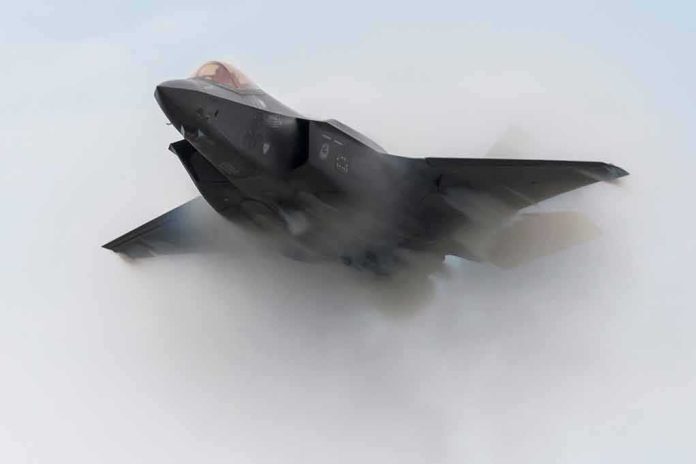
The central military lesson of Operation Epic Fury is not about target lists or sortie counts; it is that sustained, high-intensity air combat against a missile- and drone-enabled adversary has permanently reset how the U.S. Air Force will posture, protect, and prosecute airpower. Those days are over—meaning the era of concentrating aircraft and exquisite systems at a handful of large, predictable bases without layered defenses, dispersion, and autonomous mass.
At a Glance
- Thirty-eight days of major combat revealed vulnerabilities in concentrated basing, munitions resupply, and fleet survivability, accelerating a pivot to dispersed operations and thicker base defense.
- Operational tempo was punishing: Airmen endured over a thousand base-wide attack alarms and repeated runway and UXO recovery cycles under fire.
- Losses and costs were real—tens of billions in munitions and platforms—and the Air Force is moving toward “attritable” and autonomous systems to preserve combat power at scale.
- Senior leaders say the campaign achieved its military objectives and will shape future force design, tactics, and investment priorities.
What Epic Fury Proved About Modern Air Warfare
Epic Fury validated two truths that often sit in tension. First, airpower—stealthy ISR-led targeting, penetrating strikes, and long-range bombers—can rapidly dismantle an adversary’s ability to project force when it is integrated with joint and partner effects. Senior leaders stated plainly that the joint force achieved the President’s defined objectives over 38 days, and they have framed the campaign as a case study in operational scale, precision, and speed. Second, even decisive air campaigns now unfold in an environment of persistent, massed missile and one-way UAV attack that turns every forward base into a combat zone, every day. U.S. Airmen weathered roughly 1,200 “Alarm Red” conditions, executed dozens of runway repairs, and conducted hundreds of UXO sweeps while maintaining flight operations—evidence of how adversary salvos force constant defense, damage control, and rapid recovery as integral parts of airpower, not supporting acts.
That is the new baseline. The Air Force’s conclusion is unambiguous: concentrated, predictable footprints invite attrition; dispersed operations, layered defenses from high-end interceptors down to point-defense and counter-sUAS, and a mix of exquisite and attritable aircraft are the durable answer. Those decisions are not theoretical—they flow directly from combat conditions the force just survived.
From Concentration to Dispersion: How Basing Must Change
Dispersed operations are not a fashion—they are survival math. The logic is simple: adversary reconnaissance-strike complexes cue ballistic, cruise, and UAV salvos against stationary runways, parked aircraft, tankers, command nodes, and fuel. Spreading aircraft across more airfields and ramps, varying operating locations, and hardening or camouflaging critical nodes dilutes the effectiveness of massed fires and raises the adversary’s targeting cost and uncertainty. This trendline matches decades of analysis—from Cold War dispersal of bomber forces to contemporary RAND work on operating in contested environments—which consistently finds that dispersion, deception, and rapid runway repair drive survivability and sortie regeneration under attack.
Epic Fury’s base defense experience reinforces that point. Repeated alarms, cratered pavement, and UXO hunts are not episodic anomalies; they are the ambient conditions of modern forward airpower. Integrating agile combat support teams, prepositioned repair kits, and standardized fly-away security and counter-UAS packages with every deploying unit is now table stakes. Former AFCENT leaders and Air University analyses converge on one prescription: bolster self-defense at the wing level and push layered air and ground defense closer to the flight line so operations can continue through, not after, attacks.
Munitions, Maintenance, and the Industrial Base Strain
Combat validation has a cost curve. Inspector General and related reporting point to a campaign price tag in the tens of billions—dominated by expended precision munitions—alongside notable platform losses and damage, including remotely piloted aircraft attrition and battle damage to high-value enablers. Those figures are not merely accounting; they expose the pace at which a high-end air campaign can drain inventories, and the lag in industrial capacity to replenish interceptors, standoff weapons, and critical spares quickly.
That resupply reality is pushing two design pivots. First, a broader mix of weapons—balancing standoff with “stand-in” GPS-aided, lower-cost effects when air defenses permit—preserves magazine depth while maintaining pressure on time-sensitive targets. Second, “attritable” and autonomous systems that are cheaper to field and acceptable to risk at scale expand the force’s resilience against a thinking adversary. The logic is straightforward: if the enemy can generate mass, so must we—but at price points and production tempos the nation can sustain in a prolonged contest.
Base Defense as a System, Not a Silo
Patriot and THAAD batteries were essential shields during the conflict, but missile defense alone cannot be the plan; it must be nested within an integrated architecture that starts outside the wire and ends at the revetment. Historical and contemporary doctrine converge on three ground-defense imperatives: control the standoff zone, defend the perimeter and entry points, and protect critical assets inside the fence—with counter-sUAS, camouflage, decoys, dispersal, and rapid damage control all treated as primary, not adjunct, missions.
Epic Fury showcased how quickly sustained salvos can tax even excellent interceptor networks and how crucial it is to add depth with point-defense guns, SHORAD, and sUAS swarms for sensing and defeat. Air University work emerging from the conflict explicitly ties catastrophic losses to the need for tighter tactical air defense integration at the unit level, coupled with training and command relationships that cut response times from minutes to seconds.
Bombers, Tankers, and the Reach-Back Problem
Epic Fury also revalidated the bomber-tanker team. Simultaneous employment of B-2, B-1, and B-52 aircraft against hardened, deeply buried, and time-urgent targets underscored why the U.S. invests in stealth penetration, very large conventional payloads, and persistent strike capacity. But long, global sorties stitched together by delicate aerial refueling chains are not free: the force paid in crew fatigue, tanker vulnerability, and maintenance intensity. The lesson is twofold—keep the penetrating edge sharp, and shorten lines where feasible through regional dispersion and coalition access, while hardening the tanker enterprise that makes any of it possible.
Senior leaders have highlighted that the campaign’s operational intensity will anchor future training and force-presentation models. Expect more emphasis on mission command for maintainers and defenders, autonomous data integration for targeting, and tactics that swap exquisite munitions for cheaper effects when the air picture allows—all to keep pressure on adversary launch cycles without outrunning magazines or crews.
Travel Pool Report # 26 – More quotes from POTUS/GCC meeting
More quotes from POTUS & GCC meeting:
"Operation Epic Fury crippled Iran's Navy. It eliminated it. Actually, they have 159 ships. Every one of them is right now at the bottom of the sea. Eliminated its air force. They…
— White House Press Pool Reports (@WHPressPool) September 22, 2026
What Changes Next—and Why It Lasts
The through-line from Epic Fury to future Air Force design is clear and durable. Disperse force presentation to complicate enemy targeting and speed recovery. Thicken base defense from the perimeter to the parking spot with layered, integrated, and unit-owned capabilities. Broaden the weapons mix and scale production so commanders can choose “good-enough” effects more often. Build in autonomous and attritable mass to preserve exquisite platforms for the missions only they can do. And drive training and leadership for a world in which alarm klaxons, crater fills, and UXO sweeps are not interruptions to airpower but its operating context.
Officials have been explicit that Epic Fury achieved its military aims and that its lessons are already being written into doctrine, acquisition, and posture decisions. The strategic payoff of those choices will not be measured by the next strike video but by whether, in the first hours of the next high-end fight, U.S. airpower generates sorties, protects its people, and sustains pressure faster than a missile-saturated adversary can adapt. After this war, the Air Force is designing to win that race.
Sources:
19fortyfive.com, airuniversity.af.edu, airandspaceforces.com, aa.com.tr, cbc.ca, dronexl.co, justsecurity.org, economictimes.indiatimes.com, atlasinstitute.org