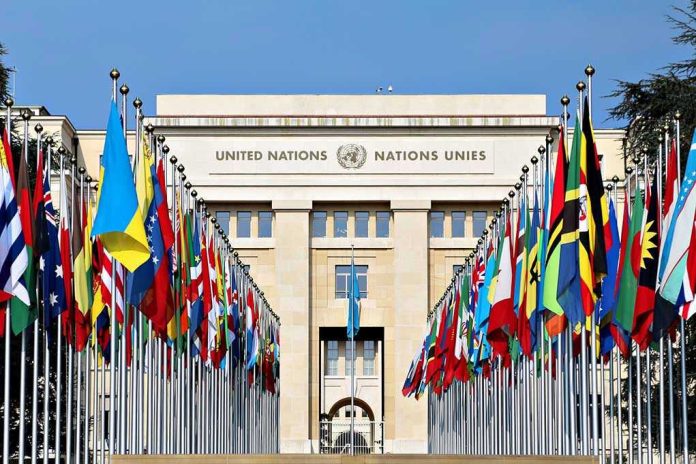
Every year Benjamin Netanyahu stands at the UN General Assembly podium, he delivers two speeches at once — one aimed at the delegates in the hall, who mostly stopped listening years ago, and one aimed squarely at audiences back home and in Washington. This year’s version broke from the usual script by naming a sitting New York City official as a target, turning what is normally a set piece about Iran and Hamas into a direct confrontation with America’s own domestic politics.
Key Points
- Netanyahu used his September 24, 2026 UN address to accuse NYC Mayor Zohran Mamdani of associating with Hamas sympathizers and failing to condemn antisemitic rhetoric, including from his own wife’s social media activity
- He publicly thanked President Trump as Israel’s “greatest partner” in what he called a “battle against the barbarians,” tying the praise to the June strikes on Iran’s nuclear program
- Netanyahu rejected genocide accusations against Israel’s Gaza campaign, citing a West Point scholar and humanitarian aid figures as counter-evidence
- The speech triggered one of the largest walkouts in recent General Assembly memory, continuing a pattern from his 2024 and 2025 UN appearances
A Direct Attack on a Sitting American Mayor
The most unusual element of Netanyahu’s address was its target: not a foreign adversary but Zohran Mamdani, New York City’s mayor. Netanyahu accused Mamdani of praising individuals convicted in connection with Hamas, of associating with people who said “America deserved 9/11,” and of hosting a Palestinian journalist who had allegedly filmed Hamas torturing Israeli hostages but withheld the footage. He went further, claiming Mamdani’s wife had liked social media posts celebrating the October 7 massacre and denying Tel Aviv’s right to exist — and that Mamdani himself had tried to obstruct the UN speech and silence him. “You can’t silence me,” Netanyahu told the chamber. “You can’t silence the truth.”
These are serious, specific allegations leveled from an international stage against an elected American official, and they landed amid an already tense relationship between Israel’s government and progressive municipal leadership in New York. Whatever one makes of the underlying claims, the choice to escalate a foreign policy speech into a personal indictment of a city mayor marks a departure even for a leader known for combative UN appearances — and it guaranteed the remarks would dominate American coverage regardless of how the rest of the speech was received abroad.
The Trump Alliance as Centerpiece
Netanyahu paired the attack on Mamdani with effusive praise for President Trump, calling him Israel’s indispensable partner. “In this battle against the barbarians, we’ve had no greater partner than President Trump. I thank him,” Netanyahu told delegates, crediting Trump’s “bold leadership” for confronting what he described as an existential Iranian threat. He characterized the June strikes on Iran’s nuclear facilities as one of the easiest calls of his premiership, arguing that inaction would have left Israel exposed to annihilation. The framing echoed a line he first drew fourteen years earlier warning against a nuclear-armed Iran, now presented as vindicated by direct military action taken jointly with Washington.
This was not incidental flattery. Netanyahu structured much of the address around a “seven-front war” narrative — Hamas, Hezbollah, Houthi forces, Iranian proxies, and Iran itself — and positioned Trump as the one head of state who had matched Israel’s urgency with force rather than diplomatic caution. He anchored the argument in the October 7 attacks, telling delegates that Hamas “slaughtered 1,200 Israelis that day”, a figure he used repeatedly to justify both the military campaign in Gaza and the strikes on Iran as proportionate responses to an ongoing existential threat rather than isolated retaliations.
Answering the Genocide Charge
A substantial portion of the speech was devoted to rebutting accusations, now common at international bodies and among a number of Western governments, that Israel’s Gaza campaign constitutes genocide. Netanyahu called the charge “the greatest lie of the century” and cited Colonel John Spencer, a West Point urban warfare scholar, who he said concluded that Israel “has done more to prevent civilian casualties in war than any other military in history.” He pointed to specific humanitarian figures — a million polio vaccinations administered and roughly two million tons of food allowed into Gaza — as evidence contradicting genocidal intent, and accused Hamas of using hospitals, schools, and mosques as command posts while forcing civilians to remain in combat zones.
He also drew a comparison to the 1967 Six-Day War, noting Israel occupies roughly a third of one percent of the Arab world’s landmass, to push back against accusations of colonial expansion. And he invoked his late brother Yoni, killed leading the 1976 Entebbe hostage rescue, closing with Yoni’s own words: “We’re going to win. We have no other choice.” The rhetorical throughline was consistent — existential threat, moral clarity, historical resilience — the same architecture he has used at the UN podium for more than a decade.
A Familiar Pattern, an Unfamiliar Reception
None of this occurred in a vacuum. Netanyahu’s UN speeches in 2014, 2024, and 2025 followed nearly identical structural beats: civilizational framing of Israel’s conflicts, sharp denunciations of both adversaries and Western critics, and a chamber response defined by walkouts from delegates and applause from a shrinking circle of allies. This year’s exodus — described by multiple outlets as among the largest in recent memory — fit that pattern precisely, with delegates from Arab, Muslim, African, and several European states leaving before he finished speaking. What changed was the addition of an American municipal official as a named target, and the explicit, personal gratitude extended to a sitting U.S. president rather than the more diplomatically hedged language previous administrations received.
Dozens of delegates walked out of the Aassembly hall as Israeli PM Benjamin Netanyahu began his UN General Assembly address. Bibi’s speech came as Israel faced growing criticism from world leaders at this year’s assembly over its genocidal war in Gaza.🇵🇸🇮🇱 pic.twitter.com/0elXwHRd6K https://t.co/VGtTbqeby7
— 惣電通・停波・アホカ・ハングレー@THE LORDS OF THE RINGS 🍉 (@FuckTokyo2021) September 25, 2026
What the Speech Signals Going Forward
Netanyahu’s UN address functions as a barometer of where Israeli diplomacy stands relative to both its adversaries and its allies, and this year’s reading is unambiguous: closer alignment with the Trump administration, sharper confrontation with domestic American critics, and continued isolation within the UN’s broader membership. That combination is unlikely to be a one-year anomaly. As long as the Gaza war’s political and humanitarian fallout remains contested internationally, and as long as American municipal politics keeps producing officials willing to publicly criticize Israeli policy, expect the UN podium to keep serving Netanyahu as a stage for exactly this kind of dual-audience messaging — reassurance to Jerusalem’s closest partner in Washington, confrontation with critics wherever he finds them, including, now, in New York’s city hall.