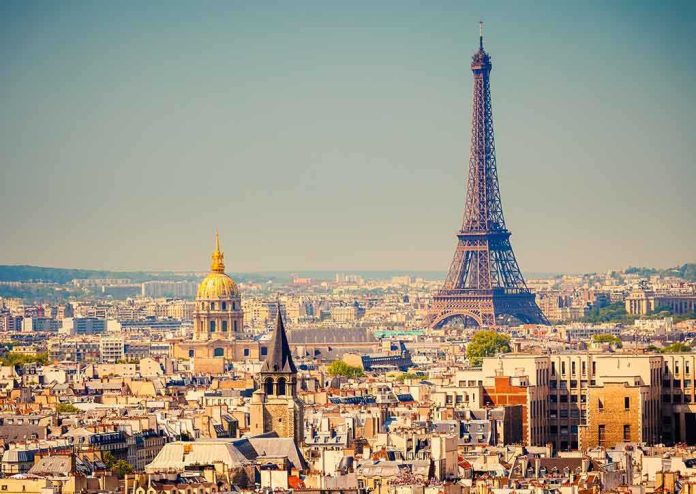
A single afternoon on the Champs-Élysées made visible a truth that numbers alone only hint at: in a country often described as secular and post-Christian, a papal Mass still has the power to summon a vast, disciplined public into the heart of Paris — and to hold it in prayerful silence.
At a Glance
- Pope Leo XIV celebrated an open-air Mass at Place de la Concorde with crowds stretching along the Champs-Élysées.
- The Vatican estimated roughly 700,000 in attendance; close to 600,000 had registered in advance through the Diocese of Paris.
- The liturgy capped a high-profile stop in Paris during the Pope’s apostolic journey to France, formally scheduled by the Holy See.
- The event’s scale underscores both enduring Catholic presence and the logistical calculus behind major public worship in a secular republic.
What Happened: A Mass that turned central Paris into a cathedral nave
On Saturday, September 26, 2026, Pope Leo XIV presided over Holy Mass at Place de la Concorde — a first for the storied square — with devotional throngs flowing down the Champs-Élysées. The Holy See’s official program listed the liturgy for 15:00 as a centerpiece of the apostolic journey, which also included meetings with pastoral and civic communities across France. Organizers with the Diocese of Paris had closed online registration days earlier after tallying nearly 600,000 sign-ups, anticipating spillover zones around the Place de l’Étoile and Avenue de la Grande-Armée to accommodate latecomers. The Vatican’s post-event estimate placed the turnout near 700,000, a figure echoed across international outlets that covered the scene on the ground.
That scale was visible in more than headcounts. Security and crowd-control perimeters stretched across central arrondissements, with liturgical logistics — thousands of trained volunteers, distributed communion points, and broadcast audio — stitched into the city’s historic fabric. The visual was as deliberate as the rite: a papal altar set against neoclassical facades and the obelisk’s silhouette, signaling a Catholic ceremony staged unembarrassed in the public square, not sequestered behind sanctuary walls.
How we got here: Programmed to be big — and built to work
Major papal liturgies are not spontaneous assemblies; they are engineered pilgrimages. The Vatican’s advance notice, the French Church’s mobilization, and the state’s public-order apparatus converged to turn a civic landmark into a temporary ecclesial precinct. The Holy See’s travel program fixed the liturgy at Concorde weeks in advance, and French media and diocesan communications made plain that the Church was planning for extraordinary demand: hundreds of thousands registered, prompting the diocese to close its portal and design overflow avenues with eucharistic logistics scaled to the terrain. Government estimates ahead of time, widely cited in European outlets, likewise anticipated a crowd in the high hundreds of thousands and prepared accordingly.
At Mass itself, the Pope preached in continuity with his Paris homilies and addresses: Christianity’s promise of living water for a spiritually thirsty culture. That theme, foregrounded in broadcast coverage of the liturgy and in the Paris stop’s wider catechetical arc, framed the event not as a one-off spectacle but as evangelical theater — worship arranged to be seen and, in being seen, to teach.
What the numbers mean — and why obsessing over precision misses the point
Crowd counting at open-air religious gatherings is inherently approximate. The Church’s figure around 700,000 rested on a base of nearly 600,000 registered participants, combined with on-site inflows that spill beyond cordoned zones — the familiar arithmetic of papal events. Independent analysts have long cautioned that non-ticketed crowd sizes are difficult to verify precisely without rigorous aerial imagery and density mapping, methods that newsrooms and civic planners employ inconsistently. The technique is straightforward in principle — segment space by density, calculate square footage, apply per-square-foot occupancy, then sum — yet results pivot on assumptions about how tightly people stand and how far fringe areas actually fill.
This is a known pattern with papal travel. Large claims attract scrutiny; some past Vatican-linked tallies have proven optimistic when subjected to post-hoc geospatial analysis. But the structural incentives also explain why headline figures swell: organizers and host cities benefit from signaling success, and faith communities read outsized turnouts as signs of vitality. The Paris Mass sits comfortably within that tradition. The credible core is firm — registrations near 600,000; crowds visibly occupying Concorde and the avenue; post-event estimates at roughly 700,000 — and the precise last decimal is less important than the civic, liturgical, and cultural fact that central Paris became a congregation.
Paris as stage and symbol: The setting sharpened the message
Place de la Concorde is not a neutral plaza. It is where the French Revolution turned on throne and altar; it is also the ceremonial hinge between the Tuileries and the Champs-Élysées. To set a papal altar here, with the axis of French statehood as a processional aisle, is to write a claim in stone and sky about memory and meaning in a laïcité republic. The French state, custodian of Notre-Dame and guarantor of public order, enabled the Church to sacralize the public square for an afternoon, an accommodation built into France’s particular church-state settlement. The event thus functioned as both pastoral encounter and civic pageant — a reminder that France’s “eldest daughter of the Church” moniker is not merely antiquarian but still yields modern moments where religious practice shapes public space.
The optics also mattered internally to Catholic life. A massed laity; clergy and consecrated persons robed and ordered; a papal homily contextualized by French saints and social witness — these elements signal an ecclesial body confident enough to claim visibility and to invite an ambivalent culture to look and listen. For many attendees, the liturgy was not a referendum on demography; it was a sacrament received in the open air, a shared act of faith in a city where cathedrals and cafés coexist.
Pope Leo XIV drew a record ~800,000 to a historic Paris Mass Saturday, the first papal visit to France in 18 years. He told young Catholics in French they are "today's church." Overflow sites opened as crowds packed the Champs-Élysées. #BreakingNews #PopeLeoXIV #France pic.twitter.com/p7k7s7xfPY
— Trending Updates Folders International (@trendingsources) September 26, 2026
Operational lessons: Why these gatherings work — and what they require
Practical competence is the unglamorous secret behind successful mega-liturgies. Paris had it. Registration systems allowed planners to scale volunteer recruitment and communion stations; security coordination with municipal authorities managed ingress and egress; broadcast partnerships carried the liturgy to those beyond visual range. Such events are case studies in crowd science as much as pastoral outreach: flow modeling, density tolerances, and clear wayfinding make the difference between prayerful order and dangerous bottlenecks. Best practice, well documented by engineers and public safety experts, relies on segmented zones, conservative density caps, and multiple redundancies — principles that translate from pilgrimages to stadiums and civic marches alike.
What endures after the banners are folded
The Paris Mass will be remembered for its image: a sea of people, a city remapped into a sanctuary, a Pope preaching living water at a place once marked by the Reign of Terror. But its more durable legacy may be institutional muscle memory. The Church in France demonstrated that it can still convene and care for a vast public; the state demonstrated that it can host that public in safety; the city remembered that sacred and civic life can rhyme without erasing their differences. Whether measured at 600,000 or 700,000, the crowd size simply names what the pictures already show. The Church’s influence in France is not exhausted. It can still fill the great avenue — and hold it, quietly, in prayer.
Sources:
humanevents.com, apnews.com, thetablet.co.uk, vatican.va, france24.com, connexionfrance.com, afp.com, fullfact.org, ijnet.org