When a former cable news analyst admits Republicans were right about real weaknesses in our election systems, it exposes how long Americans across the political spectrum were kept in the dark about risks that Washington quietly knew were there.
Story Snapshot
- A former mainstream analyst now agrees some Republican election-integrity concerns about system vulnerabilities were valid.
- Declassified federal reports and new White House actions admit internet-connected election systems carry real security risks.
- Research still finds widespread voter fraud is very rare and has not changed recent national results.
- The real problem is a system that is technically fragile, poorly explained to voters, and managed by elites who appear more focused on power than trust.
Election Security Concerns Move From Fringe To Official Record
For years, many liberal commentators dismissed Republican claims about election vulnerabilities as conspiracy theories or “denial” of results. At the same time, frustrated voters on both the right and left watched faith in the system fall as each close election brought new accusations. That picture shifted when federal records and a White House directive openly admitted what many citizens suspected: parts of our voting system are tied to the internet and can be attacked by hackers or foreign governments.
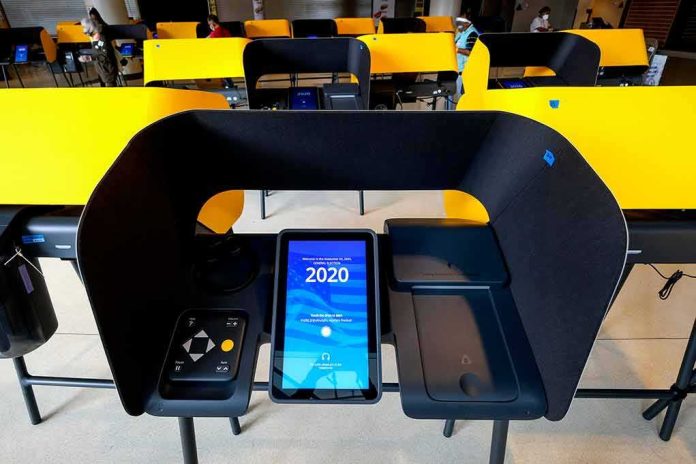
The March 2025 presidential action titled “Preserving and Protecting the Integrity of American Elections” ordered the Department of Homeland Security to review “all electronic systems used in the voter registration and voting process,” including those connected to the internet. That order tells experts to assess risks from malicious software and unauthorized access. It is a formal, written recognition that election systems are not magically safe simply because officials say so. It also confirms that Republicans were not wrong to demand answers about technical vulnerabilities in voting equipment.
What Experts Say About Fraud And Technical Weakness
Independent research still shows a clear line between **technical vulnerabilities** and **proven fraud**. A major report on the 2020 election found that experts “overwhelmingly rejected claims of widespread fraud” in their states. Another legal review of dozens of post-2020 lawsuits concluded judges, including many appointed by Republicans, found no evidence of large-scale illegal voting that changed outcomes. That means the large national elections most people focus on were not “stolen,” even if local errors or small illegal cases did happen.
At the same time, respected scientific bodies warn that certain voting setups remain open to serious disruption. The National Academies of Sciences state that all forms of internet voting are vulnerable to denial-of-service attacks, where an attacker can block access or crash systems at key moments. Declassified intelligence assessments released by the White House say Americans were “blatantly lied to” for years about the security of election infrastructure, including voting machines and ballot-counting devices. Together, these documents back up a core Republican claim: our election technology can be targeted, and officials were slow and secretive in admitting that risk.
Former Analyst’s Admission And The Trust Gap
That is why a former MSNBC-style analyst changing tune matters. When someone who built a career defending the system now concedes that Republicans were right about some vulnerabilities, it sends a signal that the old talking points were not the full truth. It also mirrors a deeper research pattern. Studies show voter fraud, especially impersonation at the polls, is “vanishingly rare.” But those same studies confirm that isolated fraud cases, administrative mistakes, and technical weaknesses do exist, especially in mail voting and local races.
Many Americans look at this mix of facts and feel squeezed. Conservatives see elites denying obvious risks in machines and mail ballots. Liberals see elites shrugging at gerrymandering, money in politics, and the growing gap between the rich and everyone else. Both sides increasingly agree on one thing: the federal government and its expert class talk more about protecting their own power than about rebuilding public trust. The gap between what insiders knew and what they told voters about election security feeds anger at what many call the “deep state.”
Rare Fraud, Real Vulnerabilities, And A Failing System
Research from the Brennan Center, Brookings, and others finds only a tiny number of proven fraud cases compared with hundreds of millions of votes cast. Most of those cases are local, not national, and did not flip major races. So claims that every recent election was rigged are not supported by facts. Yet the same research warns that systems must be better protected, audited, and explained. When the government quietly admits security holes while loudly insisting everything is fine, it deepens the sense that officials care more about calming anger than fixing problems.
The key takeaway from this moment is simple and troubling. Republicans were right that our election systems have real technical vulnerabilities and deserve tougher protection and transparency. Democrats and many experts were right that widespread, outcome-changing fraud has not been proven in recent national races. What almost nobody in power wants to admit is the full picture: a complex system that is mostly accurate, sometimes sloppy, technically exposed, and overseen by leaders who often put party advantage ahead of honest, clear communication. That is the failure that more and more Americans, left and right, are now calling out.
Sources:
heritage.org, brennancenter.org, whitehouse.gov, campaignlegal.org, pmc.ncbi.nlm.nih.gov, nationalacademies.org, pbs.org, brookings.edu