Taiwan’s status has become the kind of “small” issue—names on office doors, warship transits, political visits—that can drag two nuclear powers into a crisis neither side claims to want.
At a Glance
- Taiwan sits at the center of a sovereignty dispute where Beijing demands “reunification,” while Taiwan functions as a self-governing democracy and Washington maintains robust, unofficial support.
- U.S. policy relies on the Taiwan Relations Act—arming Taiwan and maintaining capacity to resist coercion—while stopping short of a formal defense treaty.
- China’s intensified air and naval activity around Taiwan raises the risk of accidents or miscalculation, especially as “gray-zone” pressure becomes routine.
- Taiwan’s location in the first island chain and its outsized role in advanced semiconductors turn a regional dispute into a global economic and security concern.
Why Taiwan Sits at the Center of U.S.–China Rivalry
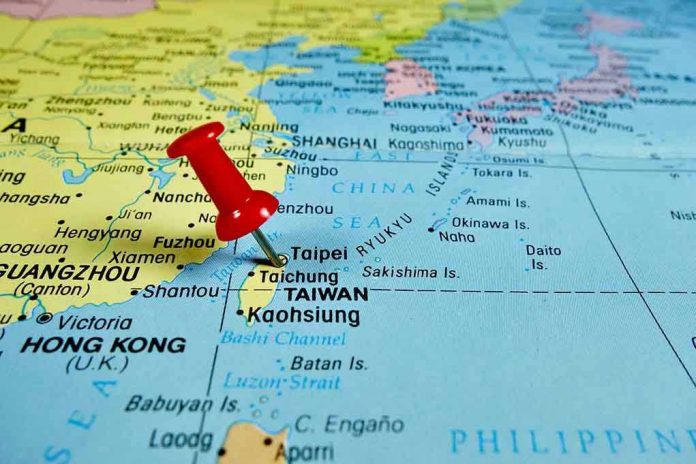
Taiwan is a self-governing democracy roughly 80–110 miles off China’s coast, but Beijing treats the island as a core sovereignty issue tied to national identity and Communist Party legitimacy. The U.S., while formally operating under a “One China” policy, has built a dense web of unofficial ties, arms sales, and political support that aims to deter coercion. That mix—high stakes, conflicting legal interpretations, and constant signaling—makes Taiwan the likeliest trigger for a direct U.S.–China confrontation.
Washington’s approach is shaped by history. After the Chinese civil war produced two rival governments in 1949, Taiwan became part of Cold War containment. U.S. involvement sharpened during early Taiwan Strait crises in the 1950s, when brinkmanship made clear that limited clashes could escalate quickly. Today’s environment echoes that lesson: a “localized” standoff can become a test of credibility, and credibility is often what powers defend when they feel the world is watching.
The Legal Framework: “One China,” the TRA, and Strategic Ambiguity
The U.S. recognizes the People’s Republic of China as the legal government of China while maintaining unofficial relations with Taiwan through mechanisms designed to keep ties functional without formal recognition. The Taiwan Relations Act commits the U.S. to provide defensive arms and maintain capacity to resist coercion that threatens the security or social and economic system of Taiwan. It does not promise automatic intervention, creating “strategic ambiguity” that is meant to deter aggression and discourage unilateral moves.
Beijing’s position runs in the opposite direction: it insists there is one China and that Taiwan is part of it, and it reserves the option of using non-peaceful means if it judges that peaceful outcomes are no longer possible. Those competing frameworks help explain why symbolic changes can matter so much. When policymakers treat names, titles, and diplomatic language as signals of sovereignty, even procedural shifts can be interpreted as a strategic provocation—sometimes by design, sometimes by domestic political pressure.
Military Pressure and the Problem of “Normalizing” Risk
China’s increased military activity—more aircraft and ships operating around Taiwan and more frequent crossings of informal lines—has the practical effect of compressing decision time in a crisis. Regular operations can condition commanders to treat close encounters as routine, which can lower caution at exactly the wrong moment. U.S. Navy transits and freedom of navigation operations are intended to contest excessive maritime claims and reassure partners, but they also create more opportunities for miscalculation in crowded air and sea lanes.
Economics and Semiconductors: A Global Shock Built into the Map
Taiwan’s role in advanced semiconductor manufacturing is one reason the island’s security now affects far more than regional politics. Supply chains for high-end chips are specialized, expensive, and slow to replicate at scale, so markets watch cross-strait tensions for any sign that shipping routes or production could be disrupted. Taiwan also sits along heavily traveled waterways, meaning a conflict could ripple into energy prices, consumer goods, and industrial production well beyond Asia—exactly the kind of inflationary shock voters still remember from earlier disruptions.
The 2025–2026 Flashpoint: Politics, Naming Fights, and Credibility Tests
Recent friction has included proposals in Washington to rename Taiwan’s de facto representative office and replace “Chinese Taipei” with “Taiwan” across U.S. federal agencies, a move sponsors framed as matching reality and supporting democratic Taiwan. Beijing condemned such steps as violating its core principle and interfering in internal affairs. In practical terms, naming disputes can become proxy battles over sovereignty, forcing leaders to prove resolve to domestic audiences—an outcome that can make compromise politically costly even when it is strategically prudent.
Why Taiwan is a major flashpoint between the U.S. and China as Trump meets with Xihttps://t.co/bll8qqcoqw
— newstabs (@newstabs_online) May 14, 2026
For Americans, the tension highlights a broader frustration shared across party lines: major decisions can be driven by elite signaling and bureaucratic momentum rather than transparent debate about costs, risks, and goals. Conservatives tend to focus on deterrence, hard power, and protecting U.S. strategic position in the Pacific; liberals often emphasize democracy and human rights. The overlap is the public’s demand for competence and honesty—because miscalculation in the Taiwan Strait would not stay overseas, and ordinary families would bear the economic and security consequences.
Sources:
Taiwan: The Dangerous U.S.–China Flashpoint
Taiwan: A Flashpoint Between the US and China
Margalla Papers article download (244/163/431)
Renaming Taiwan: New US-China Flashpoint