
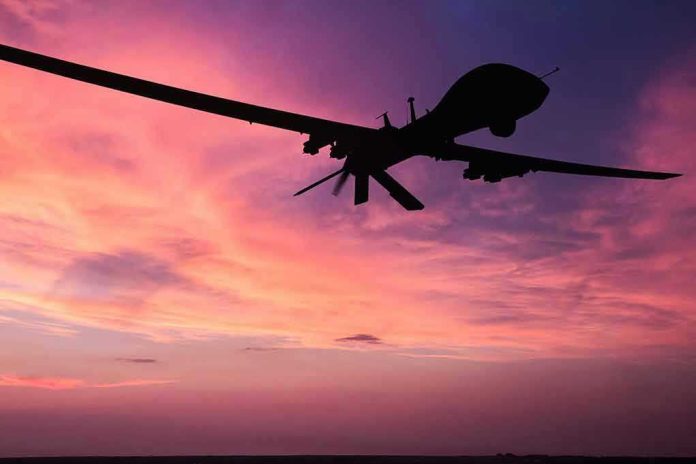
A stray Ukrainian sea drone detonated inside Romania’s Constanța port, forcing evacuations and reviving fears that Europe’s war could spill deeper into North Atlantic Treaty Organization territory.
Story Snapshot
- Romanian officials said a maritime drone self-detonated in Constanța after the area was secured; no casualties were reported [11].
- Ukraine-linked sources attributed the drift to Russian electronic jamming, with Romania’s president calling it a consequence of Russia’s war on Ukraine [1][15].
- The incident fits a broader pattern of Black Sea spillover where attribution and intent remain contested in early hours [1].
- Response protocols and port security were tested as authorities isolated the area amid live broadcasts and public alarm [3][5].
What Happened Inside Romania’s Largest Black Sea Port
Romanian authorities reported that a maritime drone discovered in Constanța Civil Port self-detonated around 10:30 a.m. local time after the area had been isolated and secured, causing no injuries and limited visible damage, according to the national news agency Agerpres [11]. European media and local broadcasts documented a powerful blast and live evacuations near the waterfront, underscoring how quickly a battlefield technology can create panic far from frontline trenches [3][5]. Officials emphasized there was no deliberate attack on Romania.
Ukraine-focused outlets and regional observers identified the device as a Ukrainian sea drone that veered off course, likely after Russian electronic warfare interference, which disabled remote control and navigation [1]. Romanian President Nicușor Dan publicly framed the event as a direct consequence of Russia’s war against Ukraine, signaling that Bucharest sees the episode as wartime spillover rather than an intrusion aimed at a North Atlantic Treaty Organization member [15]. Commercial maritime alerts earlier noted a Sea Baby-type drone drifting east of Constanța, consistent with later reports [4].
Why This Matters For NATO Security And U.S. Interests
Constanța is a vital logistics hub for grain, fuel, and military transit across the Black Sea, so any blast inside its perimeter raises hard questions about port protection, maritime screening, and cross-border deconfliction during active conflict [5]. Romanian officials’ quick isolation of the area and controlled detonation narrative point to improved protocols since prior Black Sea incidents, where attribution and response lagged behind public alarm [11]. For American readers, this tests allied readiness while avoiding escalation that could drag the United States into direct confrontation.
The event matches a recurring Black Sea pattern: military objects drift, wash up, or cross borders, and political actors contest intent, authorship, and risk in the first hours after discovery [1]. Early statements from Bucharest and Kyiv converged on a spillover explanation tied to Russia’s aggression, while declining to claim that Romania was targeted [1][15]. That framing limits immediate pressure on the North Atlantic Treaty Organization’s collective defense provisions, while still demanding vigilance against electronic warfare effects that can push unmanned systems off course.
Public Anxiety, Media Footage, And The Push For Clarity
Live television segments captured the shock as a reporter ran from the blast area, a vivid illustration of how wartime tools unsettle civilian spaces and challenge crisis communication in real time [3]. Regional outlets described a powerful explosion, evacuations, and a rapid security perimeter, confirming that local authorities treated the device seriously from discovery to detonation [5]. While video drew global attention, the official message stayed consistent: the device self-detonated after isolation, and there were no casualties [11].
Open-source maritime monitoring flagged a drifting sea drone hours earlier, reinforcing the likelihood of a strayed system rather than a targeted strike on Romanian infrastructure [4]. Ukraine-linked reporting tied the loss of control to Russian jamming, a technique repeatedly observed across the theater to disrupt unmanned platforms’ guidance and command links [1]. Romania’s head of state echoed that causal chain by labeling the event a consequence of the war, not an attack on Romania or the North Atlantic Treaty Organization [15].
What Conservatives Should Watch Next
Romania’s secure-and-detonate approach, paired with transparent public updates, suggests allies are strengthening layered defenses without rushing into escalation that burdens American taxpayers or troops. The core risks now revolve around port hardening, detection of unmanned devices before they reach quays, and counter-jamming resilience along busy commercial routes. If electronic warfare keeps pushing wayward systems into allied waters, Washington should press for tighter maritime screening protocols and rapid attribution to prevent panic and protect energy and grain flows that affect household costs back home [11][15].
Sources:
[1] YouTube – Ukraine maritime drone explodes at a Black Sea port in Romania
[3] YouTube – Maritime drone exploded in the Port of Constanta. Evacuations in …
[4] Web – Video. Romania: TV reporter flees live on air after drone explosion in …
[5] Web – OSINT: Maritime drone spotted off Constanta – Clearwater Dynamics
[11] YouTube – A naval drone exploded in the Port of Constanta. Red Intervention …
[15] Web – OSINT: Maritime drone spotted off Constanta – Clearwater Dynamics