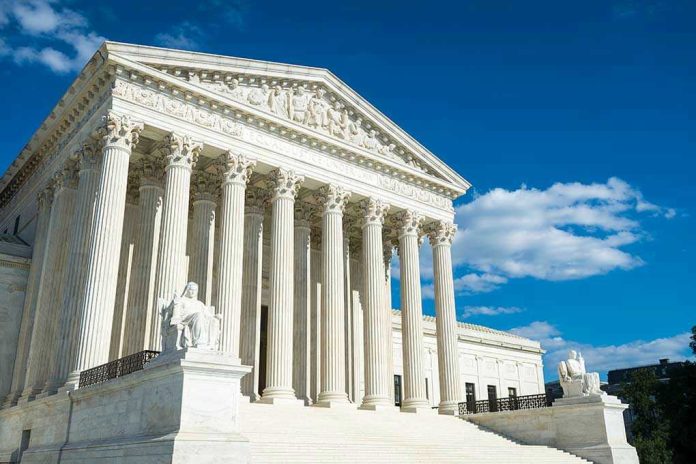
The Supreme Court signaled this week it may finally impose a uniform Election Day across America, rejecting fourteen states’ attempts to count mail-in ballots arriving days after voting ends.
Quick Take
- The Supreme Court heard oral arguments Monday in Watson v. Republican National Committee, challenging whether states can count ballots postmarked by Election Day but arriving afterward
- Conservative justices appeared skeptical of state grace periods, with Justice Alito comparing Election Day to fixed holidays like Labor Day and Independence Day
- Fourteen states currently allow five-business-day counting windows; a ruling against them would eliminate these grace periods before the 2026 midterm elections
- The decision will clarify whether federal Election Day statutes preempt state ballot deadline extensions, reshaping mail-in voting nationwide
- The Court’s decision is expected before November 2026 midterms, with conservative justices signaling support for a single-day Election Day standard
What Election Day Actually Means
For over 150 years, federal law has defined Election Day as “the Tuesday next after the 1st Monday in November” for congressional and presidential contests. Yet this seemingly clear definition has become contested terrain. All fifty states require ballots to be marked by Election Day, but fourteen states—including Illinois and Mississippi—permit ballots postmarked by Election Day to arrive and be counted up to five business days later. This grace period system has created a fundamental constitutional question: does federal Election Day statute mean a single day when voting concludes, or does it merely designate when voting begins?
Conservative Justices Signal Their Position
During oral arguments on March 24, Justice Samuel Alito pressed the case directly. He compared Election Day to other single-day federal holidays—Labor Day, Independence Day—suggesting these terms refer to specific calendar dates, not extended periods. Justice Clarence Thomas questioned how early voting fits within a fixed Election Day framework. Their skepticism indicates the conservative majority likely views federal Election Day statutes as preempting state grace periods. Paul Clement, arguing for the Republican National Committee challengers, framed Election Day as “the date where the election is consummated,” distinguishing early voting as permissible through different historical precedent.
The Liberal Justices’ Defense of State Authority
Justice Elena Kagan pressed Republican attorneys about voter qualification concerns, while Justice Kentanji Brown Jackson offered a counterargument rooted in congressional intent. Jackson noted that federal statutes acknowledge post-Election Day deadlines in certain circumstances—particularly military and overseas voting—suggesting Congress implicitly permitted state flexibility. This distinction matters: if Congress knew about grace periods and incorporated them for military voters, did it implicitly authorize states to extend deadlines more broadly? The liberal justices’ skepticism of uniform federal mandates reflects federalism concerns about state election administration authority.
Real Consequences for Real Voters
A Supreme Court ruling against grace periods would immediately affect the 2026 midterm elections. Mail-in voters whose ballots arrive late through postal delays—not voter negligence—could face disenfranchisement. Election officials in fourteen states would need to revise counting procedures and voter communication. Military and overseas voters, who already receive special post-Election Day counting protections, would face questions about whether those exceptions survive a uniform Election Day ruling. The decision establishes precedent for decades of election administration, fundamentally reshaping how mail-in ballots are processed nationwide.
Why the Court Cares Now
This case directly addresses substantive constitutional questions that the earlier Bost v. Illinois State Board of Elections decision avoided by ruling only on standing. The Supreme Court has demonstrated consistent skepticism toward state voting law changes close to elections. Recent decisions cut early voting in Ohio, ended same-day registration in North Carolina, and blocked Wisconsin’s voter ID implementation—all overturning lower court decisions made near election cycles. Justices have shown “low tolerance for lower courts making changes to voting laws close to an election,” suggesting the Court may prioritize election stability and uniform federal standards.
The Supreme Court Seems Ready to Make ELECTION DAY Great Again. Thank God. https://t.co/o3gsQrJc1u
— Fearless45 (@Fearless45Trump) March 24, 2026
The Biden Administration’s amicus brief supported the Republican National Committee’s position, arguing that post-Election Day ballot counting “undermines” federal election integrity. This unusual alignment reflects broader constitutional concerns about federal authority over elections, transcending typical partisan divisions. The Court’s decision, expected before November 2026, will determine whether federal Election Day statutes mean what conservative justices believe they mean: a single day when voting ends, not an extended counting period states can unilaterally expand.
Sources:
Supreme Court Considers Laws Allowing Mail-In Votes to Be Counted After Election Day
Supreme Court Hears Arguments in Case About Mail-In Ballots Arriving After Election Day
What Does Election Day Mean? The Supreme Court Is Being Asked to Decide This Consequential Question
Supreme Court Stays Busy Ruling on State Voting Laws