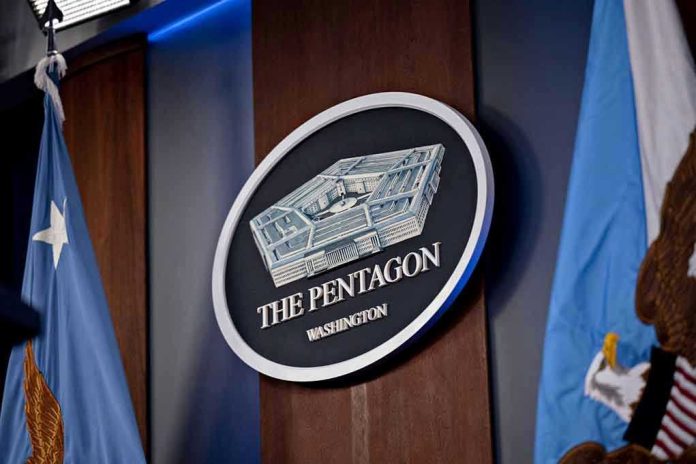
The Pentagon has quietly turned its own press office into a classified zone and kicked out reporters, raising serious questions about transparency, constitutional rights, and what the brass does not want the American people to see.
Story Snapshot
- The Pentagon has redesignated its press office as a classified area and barred journalists from the space.
- Officials claim the change is needed because speechwriters and staff “routinely handle classified material” there.
- For decades, the press office functioned as an open, unclassified hub where reporters met sources and gathered news.
- The move comes on the heels of court fights and walkouts over press rules critics say violate First Amendment protections.
Pentagon Turns Press Office Into Classified Zone
Pentagon leaders have formally redesignated the Pentagon Press Office as a classified space, blocking journalists from entering the very office intended to serve as the nerve center for public information about the United States military. Defense officials say the change was driven by the presence of speechwriters who “routinely handle classified material,” arguing that tighter access is necessary to protect sensitive information from inadvertent exposure.[2] The new designation effectively converts a long-standing media workspace into an off-limits government enclave.
Reporters who once used the press office as a routine stop to ask follow-up questions, clarify briefings, and arrange interviews are now barred by security rules that treat the area like a secure intelligence facility. For years, Pentagon guidance recognized that press access would be controlled but still allowed accredited journalists to move unescorted through limited, non-classified areas of the building. That balance has now shifted sharply toward restriction, with the press office itself no longer accessible for everyday news gathering.
Decades Of Access Rolled Back In A Single Policy Shift
Historical practice at the Pentagon shows that press access has always been structured but not shut down, with credentialed reporters operating inside the building through Democratic and Republican administrations.[4] Commentary from former defense officials notes that while media access was tightly controlled when the building opened, it gradually evolved into a system where registered journalists had a regular presence and direct contact with senior leaders.[4] That presence supported a two-way relationship: the military explained its missions, and citizens could scrutinize policy through independent reporting.[4]
Under recently adopted press rules, that relationship has come under strain as reporters describe a pattern of new limits dressed up as security measures.[1][4] An official Pentagon summary of updated physical control measures shows how press movement is now confined to specific floors and rings, tightly bounding unescorted journalist access to non-classified spaces. Against that backdrop, reclassifying the press office itself as off-limits looks to many observers like another step toward consolidating message control inside the building.[4]
Court Battles, Walkouts, And Fears Of Government Gatekeeping
The fight over the press office comes after a broader legal and political battle over Pentagon press rules that began when new restraints were rolled out in 2025.[1] Those rules, issued by Secretary of War Pete Hegseth, included a detailed 21-page framework that sharply limited what credentialed journalists could do inside the building compared with earlier, shorter guidelines.[1][3] A Washington, D.C. federal district judge later found key portions of the restrictions unconstitutional, ruling they violated the First and Fifth Amendments and amounted to viewpoint discrimination and censorship.[1]
Reporters were also asked to sign a pledge effectively promising not to gather or solicit information that had not been pre-approved for release, a requirement media organizations said directly targeted core newsgathering activity.[1][3] Journalists warned that treating independent questions as “improper solicitation” could chill whistleblowers and punish reporters for uncovering inconvenient truths about defense policy.[3] Several major outlets responded by rejecting the rules and, at one point, turning in their badges in a coordinated walkout over what they described as unprecedented interference with press freedom at the Pentagon.[2][3]
Security Justifications Versus Public Right To Know
Pentagon officials continue to frame the redesignation of the press office as a straightforward security update designed to prevent accidental exposure of classified material handled by speechwriters and staff.[2] They point out that mishandling classified information is a crime and stress the need to protect service members by avoiding leaks that could compromise operations.[2] That argument echoes a long-running pattern in national security debates, where executive-branch officials cite operational security while press advocates warn about creeping secrecy.[2][4]
The Pentagon Press Office has been designated a classified space in the complex, with journalists being evicted from the area to make room for a new classified speechwriter area.
“The Pentagon Press Office has been redesignated as a Sensitive Compartmented Information Facility… pic.twitter.com/SnUuPmBvx9
— The Epoch Times (@EpochTimes) June 2, 2026
Press freedom groups counter that the press office was never used to discuss classified information and functioned for decades as an unclassified space where questions, not secrets, were traded.[1] Legal briefs filed against the Pentagon’s new rules argue that any restriction on access should be narrowly tailored, rather than broadly excluding journalists from spaces built to facilitate public communication.[1] They warn that, combined with prior unconstitutional rules and pledges, converting the press office into a classified zone pushes the department closer to controlling what Americans are allowed to hear about their own military.[1]
Sources:
[1] Web – Pentagon defends banning reporters from press office by turning it …
[2] Web – Pentagon Rules for the Press, 2025 | The First Amendment …
[3] YouTube – Pentagon journalists turn in access badges after rejecting …
[4] YouTube – Pentagon press policy: Media outlets reject new access pledge