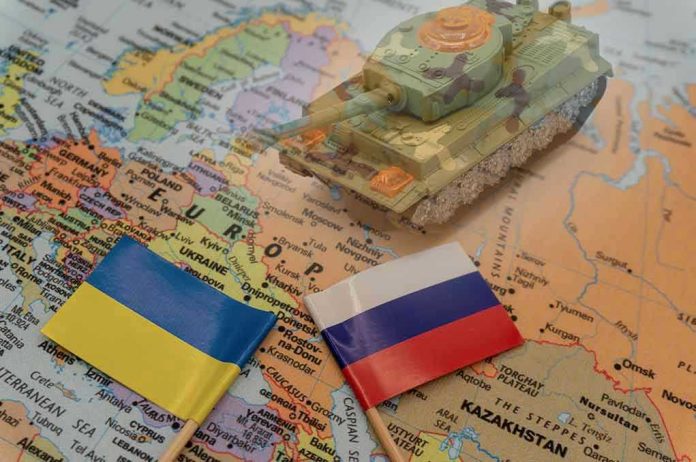
A U.S.-brokered “pause” meant to showcase American leverage is already being swamped by competing claims of more than 1,000 violations and fresh civilian casualties.
Quick Take
- Russia’s Defense Ministry said Ukraine committed over 1,000 ceasefire violations during a three-day truce tied to Victory Day commemorations.
- Ukrainian officials reported at least one civilian killed and multiple injuries from Russian drone and artillery strikes in several regions, including Kharkiv.
- President Donald Trump confirmed the truce began May 9 and was set to run through May 11, positioning it as a test of U.S. diplomatic muscle.
- The dueling narratives highlight how hard it is to enforce short ceasefires without trusted verification, even when Washington brokers the deal.
What the Trump-brokered three-day truce was designed to accomplish
President Donald Trump confirmed a U.S.-brokered three-day truce starting Saturday, May 9, and running through Monday, May 11, timed to Russia’s Victory Day commemorations. The stated goal was de-escalation—an achievable, limited objective compared with a full peace settlement. The truce also served as a measurable test: could Washington pressure both Moscow and Kyiv to reduce strikes, even temporarily, and prove that U.S. engagement can still move events on the ground?
Early reporting suggests the answer is murky. Russia and Ukraine quickly traded blame, and neither side publicly presented independent verification that would settle who violated what, where, and when. That gap matters because ceasefires without enforceable monitoring can turn into propaganda contests, not humanitarian relief. For Americans watching from afar, this is the central tension: the U.S. can help bring parties to the table, but it cannot easily police a sprawling front line with drones, artillery, and local commanders making fast decisions.
Russia claims 1,000+ violations as Ukraine reports new casualties
Russia’s Ministry of Defense accused Ukraine of committing more than 1,000 ceasefire violations, including alleged attacks on civilian targets in Russian regions and on military positions along the front. Ukraine, meanwhile, reported casualties from Russian strikes in Kherson, Zaporizhzhia, and Kharkiv regions. One widely cited incident involved a Russian drone hitting an apartment block in Kharkiv late Saturday, injuring five people. Russia said it “responded in kind,” keeping the truce nominally intact while justifying continued fire.
Because these claims come from warring governments and local authorities under extreme stress, the numbers and attributions remain difficult to verify independently in real time. Russia’s tally of “over 1,000” alleged violations is especially hard to confirm without third-party monitoring, and Ukraine did not frame its own casualty reports as a formal accusation of “truce violations” in the same manner. That imbalance leaves outside observers with a familiar problem: the public narrative moves faster than the facts, and each side’s messaging is tailored for domestic and international audiences.
Victory Day politics and the propaganda value of a “fragile” ceasefire
Victory Day brings heightened symbolism for Moscow, with public ceremonies that emphasize national endurance and military power. In that context, Russia has incentives to depict Ukraine as the aggressor while presenting Russian strikes as restrained or retaliatory. Ukraine, facing sustained attacks and a grinding war, has incentives to spotlight civilian harm and demonstrate that Russian fire continues even during announced pauses. When a ceasefire is framed around a holiday and national pride, the information battle can become as important as the battlefield battle.
Why short ceasefires keep failing—and what that means for U.S. leverage
The latest truce follows a pattern of short-lived pauses tied to holidays or infrastructure goals, including a U.S.-linked push earlier in 2026 focused on energy targets. The recurring outcome is familiar: both sides accuse the other of violating commitments, and the ceasefire becomes a temporary headline rather than a durable shift. For a U.S. administration trying to demonstrate competence after years of public distrust in institutions, that’s a challenge. Americans frustrated with “deep state” dysfunction want results, but war-zone enforcement is brutally technical, not rhetorical.
Russia accuses Ukraine of violating U.S.-brokered three-day truce https://t.co/l7D1JtadIx
— The Washington Times (@WashTimes) May 10, 2026
For now, the three-day truce appears to be holding only on paper, with violence continuing and both sides claiming the other is to blame. The key limitation is structural: without credible monitoring, clear definitions of prohibited actions, and consequences for violations, a ceasefire can devolve into a messaging tool. Trump’s team can still treat this as a data point—identifying what each side will accept and where enforcement breaks down—but the events of May 9–10 show how quickly a “pause” can become another contested narrative.
Sources:
Russia and Ukraine trade blame as fragile US-brokered ceasefire rocked by deadly drone strikes
Russia accuses Ukraine of violating U.S.-brokered three-day truce