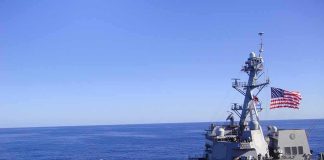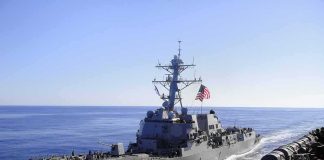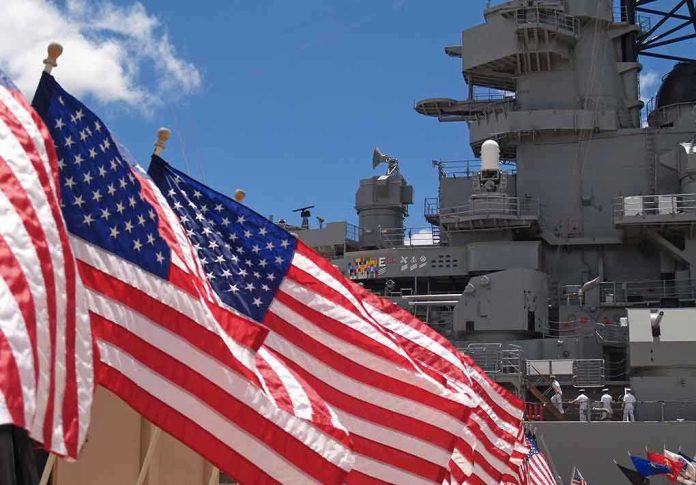
The USS Nimitz did not sail into the Caribbean as a mystery; it arrived carrying both steel and a message.
Quick Take
- U.S. Southern Command described the carrier strike group’s arrival as proof of readiness and presence [1].
- The Navy had already framed USS Nimitz as part of the planned Southern Seas 2026 deployment [2].
- The move landed as the United States unsealed murder charges against Raúl Castro tied to the 1996 Brothers to the Rescue shoot-down [1].
- The public evidence points to a real operational deployment, but also to deliberate signaling [1][2].
A Carrier Built for More Than Transit
USS Nimitz entered the U.S. Southern Command area of responsibility as part of a larger regional mission, not as a sudden improvisation [2]. The Navy said Southern Seas 2026 would include passing exercises and operations with partner nations while the ship circumnavigated South America [2]. That matters because it undercuts the easy assumption that every carrier movement near Cuba signals an emergency. Sometimes a deployment is exactly what the Navy says it is: planned, visible, and meant to be seen.
The force package itself looked serious because it was serious. The Nimitz Carrier Strike Group includes the carrier, its escort ships, and Carrier Air Wing 17, which gives commanders a wide menu of options if they need surveillance, air defense, or maritime presence [1][2]. That does not prove a combat mission against Cuba. It does prove the United States was not sending a token patrol boat. A supercarrier in the Caribbean is never just scenery.
The Timing Turned Routine Deployment Into a Political Signal
The same day the carrier’s arrival became public, the United States unsealed murder charges against former Cuban leader Raúl Castro over the 1996 shoot-down of two civilian aircraft operated by Brothers to the Rescue [1]. That timing gave the deployment a sharper edge than a standard exercise announcement. Even if the sailing was preplanned, the news cycle attached it to Cuba’s most sensitive historical wound. That is how deterrence works: not only through movement, but through timing, context, and memory.
U.S. officials told reporters the strike group would remain in the Caribbean for several days and that no immediate combat operation was planned [1]. That detail matters. It supports a reading that the deployment functioned as presence and pressure, not as a precursor to war. The public record does not show a named Cuban military threat that required this specific carrier group. So the strongest case is not “invasion preparation.” It is a carefully calibrated show of force, which is less dramatic but far more believable [1][2].
Why the Conservative Read Is Deterrence, Not Theater
American conservatives tend to trust strength when strength is clear and necessary, but they also distrust noise dressed up as strategy. On the available facts, the Nimitz deployment fits a deterrence model better than a crisis-response model. The Navy had a preexisting mission, the force package was substantial, and the administration used the moment to send a message to Havana [1][2]. That is legitimate statecraft when the goal is to remind adversaries that the United States still controls the tempo.
The weakness in the public case is just as important as the strength. The reporting available here does not include a threat memo, operational order, or intelligence assessment showing why this carrier had to be there at that moment [1][2]. Without that, outside observers cannot prove necessity in the narrow military sense. They can only judge the posture. And the posture was unmistakable: the United States wanted Cuba, the region, and its own domestic audience to notice that Nimitz was in the neighborhood [1].
US carrier arrival to Caribbean raises fears of military action against Cuba
Raúl Castro indictment, USS Nimitz deployment and intensified surveillance flights raise tensions around the island, while Havana warns any US interventio…https://t.co/VMCCxFrkFo pic.twitter.com/KoOuFSCQQt
— Ynet Global (@ynetnews) May 23, 2026
That is the deeper story. The carrier did not merely arrive in Caribbean waters; it entered a political theater already lit by sanctions, legal action, and old grievances. If you want the cleanest interpretation, use the one the evidence supports. The deployment was real, preplanned, and operationally meaningful [2]. It was also a signal, because Washington knew exactly what Havana would hear. In the Caribbean, those two things are often the same thing.
Sources:
[1] Web – USS Nimitz enters Caribbean as pressure on Cuba intensifies
[2] Web – U.S. 4th Fleet Announces Southern Seas 2026 Deployment – Navy.mil