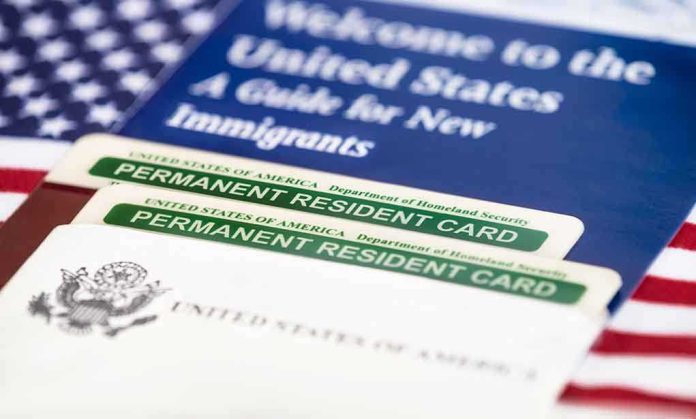
A sweeping new immigration policy quietly pushed through the bureaucracy now tells many would-be green card holders: pack your bags, go home, and hope Washington lets you back in later.
Story Snapshot
- New guidance directs most temporary visa holders to leave the United States and apply for green cards from abroad, ending a long-used in-country path.[1][3]
- U.S. Citizenship and Immigration Services (USCIS) now says green card “adjustment of status” inside the country is a rare discretionary favor, limited to “extraordinary circumstances.”[1][3][4]
- The agency claims it is closing loopholes and restoring Congress’s intent, but has not clearly published the legal and data backbone behind that claim.[1][3][4]
- Critics warn of confusion, family disruption, and arbitrary case-by-case exceptions, while supporters see a long-overdue reset toward consular processing in home countries.[1][3]
What Exactly Just Changed In The Green Card Process?
Under policy long described on official government pages, many people already in the United States on temporary visas could remain here and apply for a green card through a process called “adjustment of status.” New guidance from U.S. Citizenship and Immigration Services now flips that default. Most applicants are “expected to leave the United States” and pursue their application at a consulate in their home country, a process called consular processing.[1][3] USCIS describes this as restoring how the law was meant to work.
Legal summaries of the memo explain that officers are being told adjustment inside the country is no longer a routine track for otherwise eligible applicants but an “extraordinary” form of relief.[1][3] The Carnegie Mellon University advisory notes that adjustment decisions on Form I‑485 are explicitly framed as discretionary, not guaranteed, and not meant to replace consular processing as the regular path.[2] That means the traditional in-country path remains on paper but will be much harder to secure in practice.
USCIS Rationale: Closing Loopholes Or Quietly Rewriting The Rules?
USCIS officials argue the change is about ending incentives to game the system and ensuring the immigration laws operate as originally written.[1][4] A spokesperson is quoted saying the new approach allows the immigration system to function “as the law intended” instead of “incentivizing loopholes,” echoing long-standing language that adjustment is an act of administrative discretion.[1][3] Agency summaries also say shifting most applicants to consular processing will free resources for other priorities, including visas for crime and trafficking victims and naturalization cases.[1]
Despite this framing, the public record so far does not show the detailed legal analysis behind the shift. None of the available summaries reproduce the memo’s full statutory citations or walk through how the Immigration and Nationality Act’s adjustment provision is being reinterpreted.[1][2][3][4] Commentaries from immigration firms describe the move as a significant departure from prior practice, not a minor clarification, which raises questions about whether more formal rulemaking should have occurred before such a broad operational change.[1][2][3] Those are the kinds of questions likely to surface in court challenges.
Who Must Leave, And Who Gets To Stay Under “Extraordinary Circumstances”?
For many foreign workers, students, and family members who are in the country legally today, the practical message is simple and blunt: if you want a green card, plan on departing and applying from your home country’s consulate.[1][3] Reports describe this as a “major change” from prior practice, and some news coverage highlights that those who remain while applying could be deemed out of status and at risk.[1][4] That prospect is driving fear and confusion among families and employers trying to plan their future in the United States.
No, because
1) Indians already suffer the effects of green card country caps that amount to a de facto Indian Exclusion Act,
2) People seem to hate us even when we don’t exist.
Eg there are all of 6000 Indians in Taiwan, they are law-abiding, politically powerless…
— Hugh (@HMBrough_) May 27, 2026
At the same time, USCIS insists it has preserved discretion to approve in-country adjustment in “extraordinary circumstances” on a case-by-case basis.[1] Guidance and press reporting mention potential exceptions for applicants whose presence provides economic benefits or serves the national interest, signaling a limited safety valve for cases that clearly help the country.[4] However, the criteria for “extraordinary circumstances” or “national interest” have not been spelled out publicly, raising worries that similar cases could receive very different results depending on the officer and field office involved.[1][3][4]
How This Fits The Bigger Immigration Fight And What Conservatives Should Watch
This battle sits inside a long-running tug-of-war over whether consular processing abroad should be the default and whether agencies can tighten discretionary benefits without rewriting the statute itself.[1][2][3][4] For years, official United States websites told nonimmigrants in plain language that they “may be able to stay and apply for adjustment of status,” which shaped expectations for families and employers. By contrast, the new memo is described as steering almost everyone back through home-country consulates while insisting that adjustment technically remains available.[1][3]
Immigration lawyers interviewed in reporting say they expect litigation, arguing that such a sweeping shift through policy guidance alone risks instability and perceived overreach.[1][3][4] They also caution that vague exception standards can fuel accusations of arbitrary enforcement if detailed criteria and training materials are not released.[1][3][4] For conservatives who support both the rule of law and a predictable legal immigration system, the key questions now are whether USCIS publishes its legal reasoning, clarifies how officers should apply exceptions, and releases data showing how many cases are actually denied, approved, or pushed to consulates under this new framework.[1][2][3][4]
Sources:
[1] YouTube – Green card application process now forces immigrants to return home | …
[2] Web – Top 5 Things to Know about the New USCIS Adjustment of Status …
[3] Web – USCIS Policy Guidance on Adjustment of Status
[4] Web – USCIS Issues Policy Memo Requiring Adjustment of Status …