When a superstar walks onstage wearing two words, the arena becomes more than a venue; it becomes a forum about who gets to speak on private stages and how cultural power collides with property power. Zach Bryan’s “Free Palestine” shirt at Gillette Stadium was one of those moments.
At a Glance
- Zach Bryan performed at Robert Kraft’s Gillette Stadium wearing a shirt reading “Free Palestine,” with additional wording reported on some footage.
- Multiple outlets documented the shirt onstage and in circulating concert video; some band members wore similar shirts.
- The timing followed weeks of controversy around Macklemore’s removal from Ed Sheeran’s stadium shows after pro-Palestinian remarks, with Kraft publicly weighing in.
- The episode fits a long pattern: artists using the stage for political expression inside privately controlled venues where owners set the boundaries.
What Happened Onstage
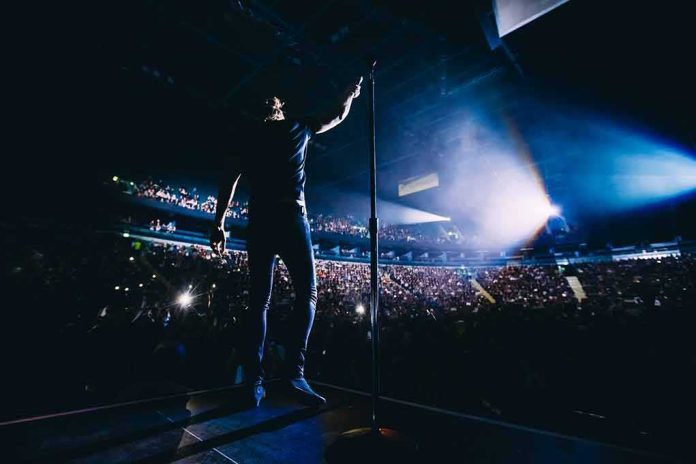
During the first of two shows at Gillette Stadium in Foxborough, Massachusetts, Zach Bryan performed while wearing a black cutoff T-shirt with the words “Free Palestine” visible in white letters. Multiple independent reports described the text and pointed to concert footage circulating on social platforms that showed the slogan clearly; local broadcast coverage also captured the appearance. Some reporting noted additional wording on the shirt—“An Appeal to Heaven,” accompanied by a pine tree emblem—indicating the garment carried more than a single slogan line, but “Free Palestine” was the front-of-stage message audiences saw and filmed.
The date and setting are undisputed: Friday night at Gillette Stadium, owned by New England Patriots owner Robert Kraft. Bryan’s bandmates, according to several accounts, wore similar shirts—an indicator of a coordinated, onstage statement rather than an incidental wardrobe choice. Bryan did not address the shirt’s message from the stage, and at the time of the coverage referenced here, he had not issued a public explanation of his intent; nonetheless, the visual fact of the shirt—and the venue context—anchored how the moment was understood.
Why This Venue, Why This Night
The gesture resonated because it arrived against the backdrop of a distinct recent controversy at the same stadium. In the weeks prior, Macklemore was removed from Ed Sheeran’s stadium shows after making pro-Palestinian remarks; Kraft publicly argued that Macklemore’s planned appearance would cross a line for his venue, citing a commitment to a “welcoming environment” and opposition to what he framed as hate speech. Reporting tied Kraft’s stance directly to the decision-making that reshaped Sheeran’s tour lineup and Gillette’s bookings.
That history set the interpretive frame for Bryan’s shirt. Entertainment and local outlets described his wardrobe choice as a political statement and—by virtue of time and place—an apparent rejoinder to the venue’s owner, even as they acknowledged the absence of a spoken explanation from Bryan. In other words, the symbolism was constructed by the stage itself: a high-visibility act in the house of the person who had, weeks earlier, asserted the prerogative to police the bounds of political speech from that same platform.
How Stages Become Speech Battlegrounds
Concerts are not town squares. They are commercial productions inside privately controlled spaces, governed by contracts, production riders, and venue policies. That architecture matters. In First Amendment terms, a privately owned stadium is generally not obligated to host any particular speech; owners and promoters can set content guidelines and choose which artists appear, subject to anti-discrimination and contract law. Legal analyses following the Macklemore episode underscored this point: constitutional free-speech guarantees restrict government, not private venue owners, and the case law on private property as a forum has consistently favored owners’ control over expressive use.
Because the law grants that control, artists who want to express political messages on those stages often rely on surprise and symbolism—visual cues, wardrobe, brief remarks—rather than negotiated approval. The result is a recurring flashpoint: the artist asserts cultural authority in front of tens of thousands; the owner exercises property authority in the background. Bryan’s shirt belongs squarely in that pattern, where a two-word garment can force a conversation about who decides what ideas appear on a privately run stage.
The Message, The Medium, The Audience
“Free Palestine” functions as a compact political signifier that audiences decode through their own priors. For supporters, it signals solidarity with Palestinian self-determination and humanitarian concern; for critics, it can read as an erasure of Israeli security or worse. That semiotic volatility is precisely why large venues and tour promoters seek to manage political messaging—they are in the business of reducing risk to audience satisfaction and sponsor relationships. Studies of stadium speech and recent commentary after the Macklemore dispute made the same point in plainer terms: private venues curate, and curation is a form of power.
Country music complicates the picture. The genre’s mainstream audience is often stereotyped as culturally conservative, yet its history includes outspoken artists who step into political terrain when they judge the moral stakes to be high. Bryan, a Navy veteran whose songwriting foregrounds working-class life, commands a broad coalition of listeners; that breadth made the shirt a more consequential signal because it crossed multiple audience segments at once, not a niche subculture already aligned with the message.
Comparing the Macklemore Episode and Bryan’s Night
The Macklemore sequence unfolded through pre-show pressure and public statements: after his pro-Palestinian remarks, he was, by his account and by corroborating tour-side explanations, removed from the stadium slate, with Kraft’s stance factoring into venue access. ESPN and BBC reporting captured the crux: the team behind Sheeran’s tour concluded that some venues—including Gillette—would not proceed if Macklemore remained, creating an operational impasse.
Bryan’s case inverted the chronology. There was no pre-event censorship to navigate; he took the stage and wore the message. That difference highlights the leverage points in modern touring: when owners act ex ante, they shape lineups; when artists act in the moment, they shape headlines and public meaning. Both routes are expressions of control—one over who enters, the other over what is said once inside.
Zach Bryan wore a “Free Palestine” shirt during his concert at Gillette Stadium in Massachusetts, with members of his band also wearing Palestine themed clothing.
Attn.@palestine @IsraelArabic @netanyahu @Israel @gidonsaar @IDF @KnessetIL @Isaac_Herzog @IsraeliPM @IsraeliPM_heb pic.twitter.com/ZnAVw3n8gq— George Chamoun (@georgechamoun45) October 4, 2026
What To Watch Next
Two questions tend to decide the long tail of episodes like this. First, do artists and their teams institutionalize the message—merchandise, recurring stage elements, explicit statements—or keep it as a situational flash? Institutionalization increases friction with venues and sponsors but also signals durable conviction. Second, do venue owners escalate policy language after a high-profile moment, tightening contractual controls on political expression? In recent controversies, owners have emphasized “welcoming environment” standards and anti-hate provisions to justify discretion; those clauses can be drafted broadly, giving wide latitude to decline or condition performances.
None of that changes what happened at Gillette: Bryan wore a “Free Palestine” shirt in a stadium whose owner had recently moved to limit a different artist’s pro-Palestinian speech. The image traveled because the stage amplifies symbols, and private control of that stage makes the symbols matter even more. That is the enduring lesson of this moment—less about one artist’s wardrobe than about how American entertainment now arbitrates expression inside its biggest rooms.
Sources:
facebook.com, nbcnews.com, edition.cnn.com, aljazeera.com, bostonglobe.com, thewrap.com, cbsnews.com, ca.news.yahoo.com