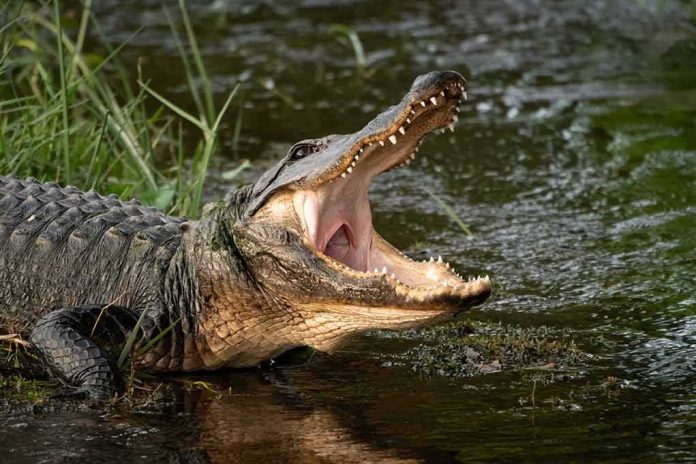
Record-size wildlife stories aren’t really about spectacle; they’re about documentation—how a state measures and ranks an animal, and how one extraordinary catch threads through a management system built to keep both people and alligators safe.
At a Glance
- An 844-pound alligator nicknamed “Snaggletooth” was captured from Lake Moultrie, South Carolina, around 11 p.m. on Sept. 28, after a multi-year pursuit by a guiding team.
- At roughly 14 feet, the animal ranks among the largest harvested gators recorded in South Carolina and has been widely reported as the state’s second-largest on record.
- The pursuit and capture were led by Renegade Bowfishing guide Cole Poplin with team members and a permitted tag holder; the measurement and weight claims have been consistent across outlets.
- South Carolina’s harvest program and reporting rules explain why such claims matter—and why precise, measured (not estimated) data underpin record talk.
What Happened at Lake Moultrie
On the night of September 28, a team guided by Renegade Bowfishing captured an American alligator from Lake Moultrie that weighed a documented 844 pounds and measured approximately 14 feet. The hunt ended a years-long effort by guide Cole Poplin and collaborators, who had tracked the animal—known locally as “Snaggletooth”—across seasons and sightings before finally closing the distance late that evening. The Charleston Post and Courier reported the time, place, and measurements, and framed the animal as the second-largest ever caught in South Carolina—a claim echoed by national outlets that cited the same core facts and the same source.
From a fieldcraft perspective, bagging a gator of that mass is a test of logistics as much as marksmanship. Rigging, winches, and boat handling strain under loads that rival a grand piano; each step from retrieval to transport must preserve the carcass’s integrity for weighing and measurement. Poplin’s team, by their own accounts and press reports, executed those fundamentals cleanly, producing a set of figures—844 pounds and roughly 14 feet—that traveled quickly through the state’s tight-knit hunting community and national press.
How South Carolina Measures and Ranks Giant Gators
South Carolina’s alligator program is built around permits, defined season windows, and reporting requirements that make big claims traceable to standardized measures. The Department of Natural Resources (DNR) defines total length precisely—tip of snout to end of tail—and instructs hunters to report carcass length in feet and inches on the public harvest form. Crucially, the form requires that any weight entered be an actual scale measurement, not an estimate. That single rule is why certain numbers in high-profile cases carry weight; they come from a measured figure on a carcass that’s been secured and transported, not a guess made boatside under a spotlight.
Unlike some trophy programs with a single consolidated “record book,” South Carolina’s public outputs are season reports and guidance documents that highlight maximums for that year or management unit, not an always-on master list. Even so, the state’s published materials and long-running guidance on measurement—supplemented by perennial season summaries showing how rare 13-foot-plus animals are—provide a common yardstick. In the 2023 public season, for example, the largest reported gator measured 13 feet 6 inches, with an average of 8.9 feet; numbers like 14 feet and 844 pounds therefore sit well outside the mean, which is why they immediately gain attention.
Why This Catch Resonates: Rarity, Effort, and Management
Size and rarity alone do not make a fish or reptile story endure; it’s the combination of a verifiable outlier and a narrative of persistence that does. Poplin’s pursuit of Snaggletooth spanned years, with repeated sightings and near-misses that hardened into a methodical search pattern. When an animal this large finally comes to hand, it validates not just the hunter but also the state’s framework: controlled permitting, clear season dates, and a requirement to log measured data rather than lore. Media attention gravitates to the superlatives—second-largest, near-14 feet—but the backbone is procedural. The claim’s credibility rests on how South Carolina codifies a harvest and how a guiding team moves a massive carcass from water to scale to form.
Context matters. South Carolina shifted from tightly limited private-lands harvests in the 1990s to a broader public hunt regime, with a contemporary season that yields several hundred animals annually. In recent years, public harvests have risen into the 300–400 range statewide, with management units distributing pressure and outcomes. Within that volume, 13-foot-plus animals remain rare; most harvested gators cluster under 10 feet. That rarity is the statistical frame around Snaggletooth’s dimensions and why a single verified specimen can redefine the upper bound in the public imagination.
The Mechanics of Big Numbers: Length, Weight, and “Second-Largest”
Length and weight tell different biological stories, and neither is trivial to pin down on an animal with a muscular, flexible tail and a mass that challenges roadside equipment. Length tends to compress during transport and cooling; tail curvature can shorten a tape measurement, while careful straightening on a flat surface can restore it. Weight, by contrast, is binary: a calibrated scale reading is either recorded or it isn’t. South Carolina’s reporting form is explicit—enter a weight only if measured on a scale—which is why figures like 844 pounds carry analytic value beyond the boat ramp.
“Second-largest” is a media-friendly label for an outlier. In practice, it distills multiple dimensions—length, weight, sometimes girth—into a single rank. Because South Carolina emphasizes standardized length and measured weight in its reporting, the strongest “second-largest” claims rest on those criteria as documented by the harvest team and corroborated by reputable reporting. The Post and Courier’s framing, repeated by national outlets, sits on that foundation: a measured 844-pound animal approximately 14 feet long, captured within the rules of the public season and aligned with the state’s measurement norms.
What It Means for Hunters, Managers, and the Public
For hunters and guides, Snaggletooth is both benchmark and motivation. It validates years of scouting and the value of disciplined process—lights, lines, handling, and quick transitions to measurement and reporting. For wildlife managers, it’s a case study in how a public harvest program accommodates apex specimens without distorting the population’s age structure: one enormous individual taken cleanly within a season that otherwise removes primarily mid-size animals. For the public, the story refreshes a perennial truth about living with alligators in the Lowcountry: they are long-lived, territorial, and—managed with discipline—compatible with human communities and recreation.
One final point underscores the health of the system: the numbers that anchor this story are not rumors. They are the outputs of a regulated hunt, logged against a form that demands measured data. That is why an 844-pound, roughly 14-foot alligator from Lake Moultrie can be described with confidence—and why, the next time a giant surfaces, we will know how to judge the claim.
Sources:
youtube.com, usatoday.com, people.com, wjcl.com, internewscast.com, us.headtopics.com