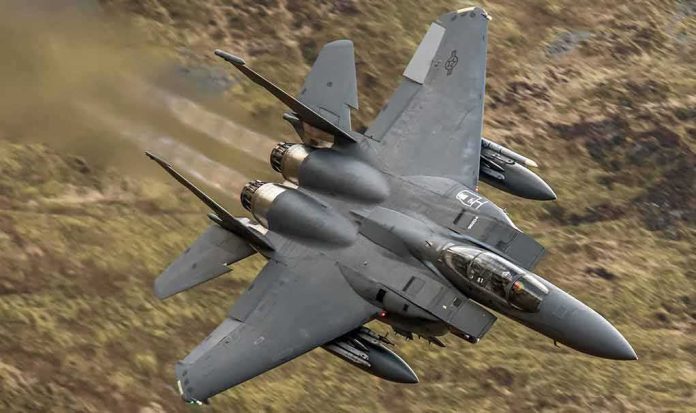
A downed U.S. F‑15E pilot’s report of a “jellyfish” drone swarm over Iran is exposing how little Washington is telling the American people about a new kind of high‑tech threat.
Story Snapshot
- A U.S. F‑15E was shot down over western Iran on April 3, 2026; both crew members were rescued in a complex special operations mission.
- The pilot later told intelligence officers he saw a coordinated “jellyfish” swarm of Iranian drones moving as one unit just before ejecting.
- Officials and media are split on whether the jet fell to a drone swarm or a shoulder‑fired missile, and the Pentagon has not released hard proof either way.
- The dispute highlights how rapidly drone swarms are changing warfare while Washington keeps key facts classified and leaves citizens in the dark.
What We Know About The F‑15E Shootdown Over Iran
On April 3, 2026, an American F‑15E Strike Eagle using the call sign “Dude 44” was shot down over western Iran, in what was reported as the first U.S. fighter lost in the conflict.[6] The jet went down in rugged terrain, and a joint force of American special operators rescued both the pilot and the Weapon Systems Officer about seven hours later in what has been described as a textbook combat search and rescue mission.[1] That part of the story is clear and backed by official reporting.
Less clear is exactly what brought the jet down and what kind of enemy systems were in the air that night. Major media reports, citing unnamed U.S. officials, say early assessments pointed to a likely hit from a shoulder‑fired missile, possibly of Chinese origin, fired from the ground.[3] Iranian state media quickly pushed that same missile story, which fits their long‑standing goal of showing they can knock down advanced American jets with simple weapons rather than admitting to new, secret technology in their arsenal.[16]
Inside The Pilot’s “Jellyfish” Drone Swarm Account
Several weeks after the crash, a report from CNN described what the rescued pilot allegedly told intelligence officers during his debrief.[13] According to four unnamed sources, the pilot said he saw multiple Iranian drones in the sky moving together “in a formation that resembled a jellyfish” just before he and his crew member ejected.[13] Larger drones appeared to form the “body” while smaller drones hung below like tentacles or legs, all linked and moving as one system rather than as separate aircraft.[10]
One source relayed the pilot’s own words as calling it “real alien” technology, a phrase that has spread quickly online and in foreign media.[4] Another source said the pilot described the air ahead as a “minefield of drones,” suggesting a thick, layered threat meant to trap or herd incoming jets.[4] Aviation analysts say this kind of layout fits what experts call “one‑to‑many meshed networking,” where a single control node or a few leaders coordinate many smaller drones at once in a true swarm.[4] If this was real, it would mark a major leap forward in Iranian unmanned warfare.
Why The Story Is Being Questioned And What Is Still Missing
Despite how striking the pilot’s account is, the Pentagon has not released radar logs, cockpit video, or flight‑data recordings to confirm the swarm.[13] Public reports say the official cause of the shootdown is still under review, and the government has not stated that a drone swarm either fired on the jet or directly caused its loss.[13] An in‑depth analysis by The War Zone notes there is “no publicly available evidence” yet that proves a swarm directly took part in bringing the aircraft down, even though the pilot’s sighting could still be accurate.[10]
U.S. intelligence officials quoted in the same CNN piece have also raised doubts about how clearly the pilot could see and process what happened.[13] They point out that he had already been shot down once before in a friendly‑fire incident over Kuwait just weeks earlier and suffered a concussion in the Iran crash, factors that can affect memory and perception.[5] At the same time, those critics have not provided their own hard data, such as missile fragments or sensor tracks, that would fully disprove his “jellyfish” description and settle the debate.[16]
Drone Swarms, Great‑Power Tech, And What It Means For America
Whatever the final answer in this case, the bigger trend should concern every American who cares about national defense and limited but effective government. Military researchers have been warning that armed, fully autonomous drone swarms can behave like weapons of mass destruction because they can strike many targets at once and cannot easily tell soldiers from civilians.[19] Other experts note how swarms, guided by artificial intelligence, can change speed, height, and direction in seconds, making them extremely hard to track and defend against with older radar and missile systems.[20]
Downed U.S. F-15E Pilot Reportedly Observed Unusual Iranian Drone Swarm Moving In ‘Jellyfish’ Formation
A jellyfish formation of drones. Is a curious reported report of a Pilot downed over Iran.
When you see drone shows and other things a floating moving minefield of drones is…
— Titch Ashen (@titchashen) June 24, 2026
China and Russia are already moving fast in this area. Chinese researchers have shown a “mothership” aircraft launching over one hundred small drones that then coordinate flight paths and share data in real time, proving the basic building blocks of swarm warfare are here today.[21] Open studies of Chinese military writings also say Beijing wants drone swarms that are hard to detect and can carry out more and tougher missions than manned aircraft, which would directly challenge American air power if fielded in combat.[22]
Why Transparency And Strategy Matter For U.S. Patriots
For Americans, especially conservatives who value a strong but accountable military, the real issue is not chasing “alien” stories but demanding clear facts and smart planning. Washington has asked for tens of billions of dollars to counter rising missile and drone threats, yet we still do not have a public, honest accounting of whether a cheap enemy drone network helped bring down a front‑line U.S. fighter.[19] Keeping key records classified for long stretches feeds confusion and makes it harder for citizens to judge if the money is fixing the right problems.
At the same time, this dispute shows how easily foreign regimes and some media voices can shape the narrative after an attack. Iran benefits from claiming a simple shoulder‑fired missile victory, while others hype the most dramatic “alien” spin to chase clicks and views.[7] Somewhere between those extremes lies the truth about what our pilots are facing overseas. Until more data is released, Americans will have to keep pressing leaders for transparency, real oversight, and a clear plan to handle drone swarms before they show up not just over Iran, but anywhere our forces fly.[24]
Sources:
[1] Web – The “Jellyfish-Like” Drone Swarm The Downed F-15E Over Iran
[3] YouTube – How a US F-15 Jet Was Shot Down & it’s Pilot Rescued
[4] Web – U.S. fighter jet downed over Iran, one pilot rescued, official says
[5] Web – A US F-15 pilot who ejected from his aircraft over Iran … – Facebook
[6] Web – F-15E pilot downed over Iran had been shot down a month prior
[7] Web – Accident Boeing F-15E Strike Eagle , Friday 3 April 2026
[10] Web – F-15E pilot downed over Iran had been shot down a month prior
[13] Web – Was Iran’s ‘jellyfish’ drone swarm behind US F-15E jet crash?
[16] X – A US F-15 pilot shot down over Iran in April told intelligence …
[19] YouTube – Did an Iranian “JELLYFISH” Drone Swarm Actually Take Down a US F-15E? …
[20] Web – Swarms of Mass Destruction: The Case for Declaring Armed and …
[21] Web – Military drones are swarming the skies of Ukraine and other conflict …
[22] YouTube – Top 3 Military Drone Swarms in Development Now
[24] Web – Drone swarm attacks. : r/CredibleDefense – Reddit