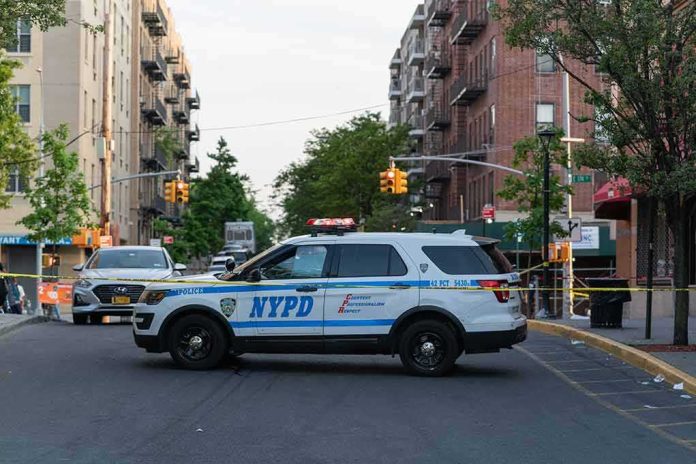
A federal immigration officer fired multiple shots during a Bronx arrest attempt while a 5-year-old sat in the car, and New York erupted within hours.
Story Highlights
- Homeland Security confirmed an Immigration and Customs Enforcement officer shot a man during a Bronx operation; the case is under investigation.
- Local officials said a child was in the vehicle at the time; reports say the child was not physically hurt.
- Protesters clashed with police near the scene and hospital, leading to arrests and traffic blockages.
- Officials stressed the man was the target of a “targeted enforcement” tied to prior crimes; key use-of-force details remain unclear.
Confirmed Facts From Officials and Reporters
The Department of Homeland Security said Immigration and Customs Enforcement officers were conducting a “targeted enforcement operation” in the Bronx when one officer discharged his weapon, injuring a man who was then taken to a hospital alive. The New York Police Department said it was not involved and was not on scene during the shooting. Reporters and the city’s mayor said a five-year-old child was inside the car when shots were fired; coverage indicated the child was unharmed. The incident remains under investigation, and no use-of-force video has been released so far.
Homeland Security described the man as a Dominican Republic national with a prior grand larceny conviction and several arrests, saying agents moved to arrest him as part of the targeted action. The agency stated officers rendered aid after the shooting. These details aim to explain why agents acted that day, but they do not answer the central question of what prompted the officer to fire. Officials have not stated if a perceived weapon, a vehicle movement, or another immediate threat triggered the gunfire.
What Sparked Protests and Why Tensions Rose
Protests began within hours in the Marble Hill area and near the hospital treating the man. Crowds chanted against Immigration and Customs Enforcement and demanded transparency about the shooting. Demonstrators blocked vehicles, and police made arrests as tensions rose into the night. A local mayor said early accounts indicated agents “surrounded” the man and a child before “firing multiple rounds,” calling for accountability and the release of evidence. That claim amplified public anger, especially because a child was present, even though the child was not physically harmed.
Witness descriptions added to the shock. One account reported hearing three or four shots and seeing men in face coverings and Department of Homeland Security vests, with at least one long gun visible after city officers later arrived on scene. Such mixed attire can confuse bystanders and fuel claims of secretive tactics. Similar confusion has marked other immigration operations in public places, where fast-moving arrests, plainclothes elements, and crowd reactions can quickly spiral into chaos before facts are settled.
Known Gaps and Why They Matter
Key facts remain missing. Officials have not released body-worn camera video, dash camera footage, or a full timeline of commands and actions. The public does not have a clear account of the exact moment the officer decided to fire, including distance, line of fire, and any threat cues. Without that record, people are left to choose a narrative: necessary force during a dangerous arrest, or reckless force that put a child at risk. The absence of hard evidence invites speculation that deepens the divide.
An ICE agent shot and wounded a 28-year-old man in the Bronx on Thursday afternoon while his 5-year-old child was inside the car, NYPD confirmed.
The shooting occurred around 4:20 PM near Marble Hill Ave when federal agents attempted a targeted arrest. The man was struck in the… pic.twitter.com/PnusXLW00v— Khabrain Digital (@daily_khabrain) October 9, 2026
Broader reporting shows these incidents are no longer rare. Newsrooms and researchers have tracked a rise in confrontations tied to immigration enforcement in everyday spaces, often followed by protests and dueling statements from authorities and activists. One national outlet noted that Immigration and Customs Enforcement and Customs and Border Protection say they teach minimum force, but they also report more assaults on officers and more chaotic scenes in cities. This cycle erodes trust across the spectrum.
Why Both Sides See a System Failure
People who back tough enforcement say dangerous suspects cannot get a free pass, and they point to prior convictions and arrests as proof that agents face real threats. People focused on civil rights ask why agents fired near a young child and why details stay sealed while anger grows. Both groups share a core complaint: a government that often withholds timely facts, then asks the public for patience while streets boil. That pattern feeds the belief that the system protects itself first.
What To Watch Next
Watch for release of video, radio traffic, and the internal use-of-force review. Look for a clear timeline: when agents approached, what they saw, what commands they gave, and why the trigger was pulled. Track whether New York Police Department or federal investigators issue a scene reconstruction with bullet paths and shell casing locations. If that evidence comes out fast, public trust can recover. If it drips out late, expect more protests and deeper doubt on both left and right.
Sources:
yahoo.com, bronx.news12.com, katv.com, aljazeera.com, straitstimes.com, turnto10.com