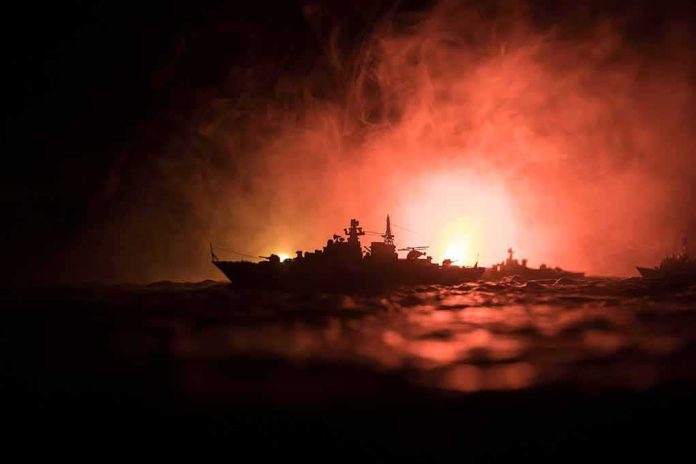
A missile and drone assault on tankers near the Strait of Hormuz has again turned one of the world’s key trade routes into a shooting range for rival governments and their elites.
Story Snapshot
- Iranian forces are accused of hitting three commercial ships with missiles and a drone near the Strait of Hormuz, badly damaging Qatari and Saudi tankers.
- British monitors first reported a tanker fire caused by an “unknown projectile,” showing that front-line crews often face danger before politicians even start talking.
- The United States answered with “powerful” airstrikes on Iran and moved to clamp down again on Iranian oil sales, tying security moves to energy politics.
- Iran hints at responsibility through state media yet avoids a clear admission, leaving regular people stuck between competing stories from distant capitals.
What Happened To The Tankers Near Hormuz
Late Monday, a tanker sailing near Limah, off the coast of Oman, reported being hit on its left side by an unknown projectile, which started a fire in the engine area. The United Kingdom Maritime Trade Operations, a British navy-run watch center, relayed the report and noted no deaths or spill, but raised alarms about safety in the strait. Soon after, United States officials said Iran’s Islamic Revolutionary Guard Corps had fired at least two missiles at commercial ships in the same area, heavily damaging two vessels.
The damaged ships included a Qatari liquefied natural gas tanker and a Saudi crude oil tanker that were transiting close to Omani waters when they were struck. Qatar’s Foreign Ministry named its ship as the Al Rekayyat and called the attack a “serious and clear violation of international law,” holding Iran fully responsible and summoning an Iranian diplomat to protest. Saudi Arabia reported its tanker Wedyan was hit east of the Emirati port of Khorfakkan and likewise said Iran “bears full responsibility” for endangering global energy flows.
Missiles, Drones, And A Growing Pattern Of Attacks
United States and allied reports say these latest hits were not a one-off but part of a string of at least thirteen attacks on commercial ships since late February. A senior United States official told reporters that Iran’s Revolutionary Guard used missiles against two vessels and a drone against a third, matching earlier incidents where Iran mixed different weapons to scare ships away from routes it dislikes. Since March, Iranian officials have claimed the right to “close” the strait and warn or strike ships that avoid its preferred northern passage, which pushes more traffic under Tehran’s watch.
For crews, insurers, and cargo owners, this pattern turns every voyage through Hormuz into a high-stakes gamble shaped by decisions far above their heads. Ship-tracking data shows at least four oil and gas tankers turned back after the latest attacks, once authorities raised the risk level for the strait to “severe.” The United Nations’ shipping agency had already slowed or paused some evacuation plans there, fearing that one misstep could create a major spill or mass casualty event. These changes ripple through energy markets, pushing up prices that everyday Americans and others eventually pay at the pump.
How The U.S. And Iran Are Using The Crisis
Hours after confirming the ship attacks, United States Central Command announced “powerful strikes” on multiple Iranian targets, saying it wanted to “impose heavy costs” for hitting civilian-crewed vessels in international waters. At roughly the same time, Washington revoked a waiver that had allowed limited sales of Iranian oil under an interim peace deal, tying security claims to renewed economic pressure. Pentagon statements called Iran’s actions “unprovoked” and a clear breach of the cease-fire, effectively framing the tanker incidents as proof that diplomatic promises from Tehran cannot be trusted.
Iran’s leaders, for their part, are walking a careful line between showing strength and avoiding formal blame. Iranian state television said a Qatari tanker was attacked only after ignoring warnings, but stopped short of an official admission, and no ministry has released hard evidence to support that story. Tehran’s Foreign Ministry instead blames the United States for violating the memorandum of understanding and paints its own actions as defense of Iranian rights in the strait. This leaves outside observers trying to piece together truth from anonymous claims, unnamed officials, and competing political agendas.
Why This Matters For Ordinary People On Both Sides
Every missile or drone strike against a tanker near Hormuz hits more than steel; it hits working families who depend on stable energy and honest government. Higher risk in the strait means higher shipping costs, tighter supply, and more price spikes, which hurt Americans already strained by inflation and people in the Gulf who rely on trade for jobs. Meanwhile, leaders in Washington and Tehran trade blows and statements, each insisting they are defending law and security, even as many citizens feel they are defending their own power above all.
The Strait of Hormuz was quiet the way a rattlesnake is quiet. Then Iran moved.
By Francis Gauthier
Three commercial vessels tied to Qatar, Saudi Arabia, and the United Arab Emirates were targeted near the narrow waterway that carries a major share of the world’s oil traffic.… pic.twitter.com/NktjfPR88g— Faith Gonzales (@faith3155) July 9, 2026
For conservatives tired of global chaos and liberals angry about unchecked militarism, this episode looks like another case where regular folks absorb the costs of elite decisions. There is still no public forensic report tying specific missile debris to a known Iranian model, and no clear, on-the-record Iranian admission or denial, so people must trust the same institutions they suspect of spin. Until shipping is safe and facts are shared openly, the Strait of Hormuz will remain a symbol of how distant power struggles can choke the everyday quest for a fair shot at the American Dream.
Sources:
insiderpaper.com, cnn.com, npr.org, upr.org, youtube.com, pbs.org, apnews.com, instagram.com, facebook.com, thehill.com, en.wikipedia.org, crisisgroup.org