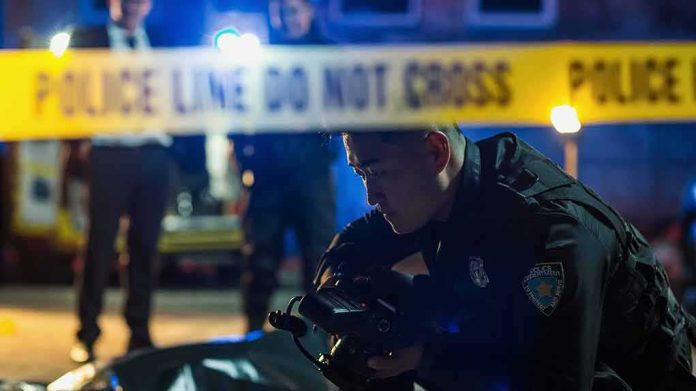
Los Angeles police shot and killed a man who advanced on officers with a long, bladed tree trimmer after repeated commands to drop it, according to police.
Story Snapshot
- LAPD says the man ignored commands to drop a bladed pruning pole and kept advancing.
- Officers tried to create distance before one officer fired in Boyle Heights.
- Police collected the pruning pole as evidence; no bystanders or officers were hurt.
- The case is under active review, including body-camera footage, per LAPD.
What Police Say Happened on Gillette and Bridge
Los Angeles Police Department officers responded around mid-morning on September 7 to reports of a man with a pipe in Boyle Heights. Police say they found a man holding a long pruning pole with a serrated blade attached. Officers ordered him to drop the weapon. Police say he refused and kept moving toward them on Gillette Street near Bridge Street. An officer then fired, striking the man, who later died.
Reporters described the tool as eight to ten feet long, with a ten to twelve inch serrated blade. Police took the pruning pole into evidence after the shooting. Authorities said no officers or bystanders were injured. The initial 911 call referenced a man with a metal pipe, which police later clarified as a bladed tree trimmer after the scene was secured and the item was recovered.
Commands, Movement, and Officer Positioning
Police say the man ignored clear commands to drop the pole and continued to advance. Officers tried to reposition to increase distance, according to their account. When the man closed space while armed with the bladed tool, one officer fired. That sequence is central to the department’s framing of a defensive use of force during a fast, close threat on a public street with homes and shops nearby.
Los Angeles Fire Department crews responded after the shooting. Media reports said the suspect was taken to a hospital, where he died. Police did not release the man’s name, and the identities of the officers were also not released in initial reports. The New York Post reported that no one else was hurt, which matches local broadcast accounts from the scene in Boyle Heights.
Active Investigation and What Comes Next
The Los Angeles Police Department said its Force Investigation Division is reviewing body-worn camera video, other footage, and officer and witness interviews. The Los Angeles County District Attorney’s Office typically reviews fatal police shootings, and similar language appeared in early coverage of this case. That process sets the timeline for any public release of video and a fuller report on the use of force.
Early descriptions often shift as more facts are confirmed. Here, the dispatch call mentioned a pipe, while the recovered item was a long pruning pole with a serrated blade. That type of change is common when a scene is still active and details are moving fast. Police say the item was booked as evidence, which helps anchor the later description in physical proof from the scene.
Why This Matters for Public Safety and Trust
Los Angeles has seen a rise in police shootings in recent years, with several cases involving sharp or bladed objects and people reported to be in crisis. A Los Angeles Times review found that edged-weapon encounters have made up a notable share of police shootings since 2018, and many ended in death. That backdrop shapes how communities and officials look at training, de-escalation tools, and mental health response models in the city.
#BREAKING: LA Fire says a suspect was transported to the hospital with a gunshot wound after the LAPD responded to reports of a man armed with a pipe in Boyle Heights Monday morning. https://t.co/bX0OmaLKms pic.twitter.com/P8YD08T4UV
— KTLA (@KTLA) September 7, 2026
City data and local reports show that officer-involved shootings have spiked in some recent periods, even as other crime measures fell. Police leaders have cited expanding less-lethal tools, but firearms still decide many of these split-second street encounters. This case will add to that debate once body-camera video and investigative files are released, showing the commands, distance, and timing that guided the officer’s decision to fire.
Sources:
nypost.com, ktla.com, abc7.com, mynewsla.com, cbsnews.com