
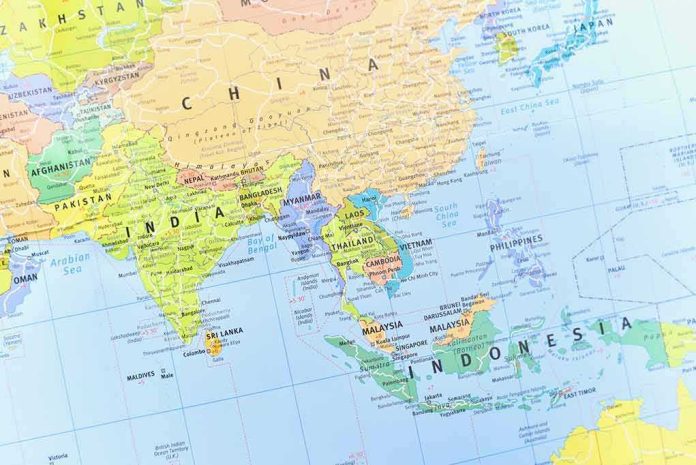
New satellite images show floodwaters across most of Thailand, with more than 4 million people affected and vast cropland under water.
Story Highlights
- Flooding since mid-September has hit about 50 provinces, affecting over 4 million people.
- Bangkok and dozens of provinces saw heavy rain warnings and government relief operations.
- Official tallies report roughly 260,000 to 270,000 hectares of farmland damaged.
- At least 31 deaths were reported as of early October, with impacts still widespread.
Nationwide Flood Scope Confirmed by Satellite and State Reports
NASA’s Earth Observatory reported that floods since mid-September spread across about 50 provinces, affecting more than 4 million people and damaging about 270,000 hectares of farmland. Thailand’s Department of Disaster Prevention and Mitigation reported severe flooding in Bangkok and 27 provinces on September 28. Those figures expanded to 29 provinces plus Bangkok, with more than 2.6 million people affected, by September 29 as waters moved through river basins and cities. The scale stayed large into October, with many areas still waterlogged.
Thai government releases described impacts across hundreds of districts and villages and detailed relief measures, including evacuations, food delivery, and pumps to clear standing water. Officials also began recovery tasks as rain eased in some zones, while still warning urban residents about clogged drains and rising canals in Greater Bangkok. The rapid change in province counts reflects how the crisis evolved day by day. Each bulletin captured a moving footprint rather than a fixed map.
What Drove the Flooding and Where It Hit Hardest
The Thai Meteorological Department warned on September 25 of heavy to very heavy rain through September 27. The United States Embassy alert on September 26 pointed to a strengthening low-pressure system and southwest monsoon as the drivers of the downpours. Reuters also reported local emergency status in Bangkok during the peak rain. These alerts match the field reports from the capital and from central and northern provinces where rivers swelled and drainage struggled to keep up.
Agriculture losses have been severe, especially in low-lying rice areas. An agriculture ministry figure cited by wire reporting counted about 1.64 million rai of cropland affected, which equals roughly 263,000 hectares across 42 provinces. That aligns with the NASA estimate of about 270,000 hectares, showing broad agreement on the scale, even if exact numbers vary by date and source. The difference shows how tallies shift as fields drain or new areas flood.
Human Toll, Urban Strain, and Why the Numbers Move
By October 5, at least 31 people had died in the floods across eight provinces, including several in Bangkok, according to international wire reporting. Earlier official counts focused on households and districts under water, which climbed quickly as storms moved across regions. As conditions changed, so did reported totals of people affected. Later snapshots captured a larger national picture, pushing the tally beyond 4 million in NASA’s summary. This is not a contradiction; it reflects a live disaster timeline.
GISTDA Records 4.21 Million Rai Flooded During October 3–9, 2026
GISTDA’s flood-monitoring dashboard recorded 4.2 million rai of flooded land during October 3–9, 2026. Nakhon Sawan had the largest flooded area among the provinces displayed, at 642,236 rai.
Ayutthaya followed… pic.twitter.com/bVuBlMM00W
— Thai Enquirer (@ThaiEnquirer) October 9, 2026
The floods again expose stress points that many countries face: rapid urban growth, aging drainage, flat floodplains, and heavy rain bursts. Thai agencies moved pumps and gear into hard-hit neighborhoods and tried to keep airports and transport running. The near-term goal is clear: drain water, protect lives, and shore up power, food, and health access. The longer-term task is tougher: reduce exposure in cities and farms when extreme rain turns from a weather event into a national test.
Sources:
science.nasa.gov, thailand.prd.go.th, thailand.go.th, jen.jiji.com, abcnews.com, reuters.com