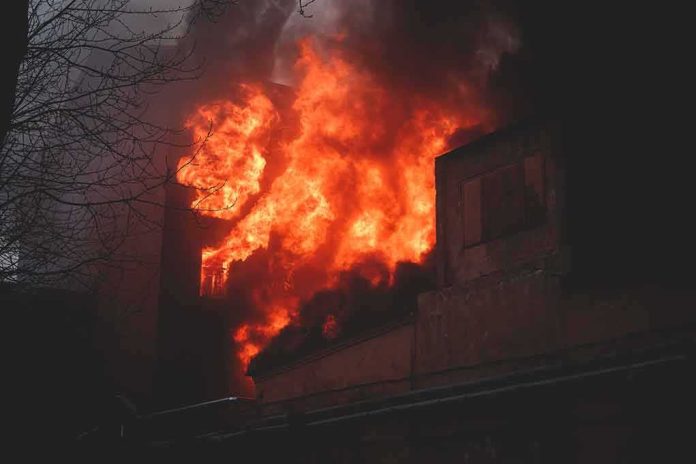
A thousand-year-old Christian monastery in Kyiv went up in flames after a massive Russian missile and drone barrage, raising hard questions about what kind of war Putin is really waging.
Story Snapshot
- A historic UNESCO-listed monastery in Kyiv caught fire after a large Russian missile and drone attack.
- Ukraine says Russia launched about 70 missiles and over 600 drones in one coordinated overnight assault.[3]
- Ukrainian leaders call the strike a crime against faith and heritage, while Moscow denies targeting civilians.[3]
- The attack fits a growing pattern of cultural and energy sites coming under fire in Russia’s war on Ukraine.[1]
Ancient Christian Site in Flames After Overnight Barrage
Ukrainian officials say Russia hammered Kyiv and other cities overnight with one of the heaviest air assaults in weeks, lighting up the sky with missiles and drones and leaving a centuries-old monastery burning.[3] The Kyiv Pechersk Lavra complex, founded in the eleventh century and sacred to millions of Orthodox Christians, saw its Dormition Cathedral catch fire as blasts rocked the capital for nearly five hours.[1][3] Video from the scene showed flames and thick smoke pouring from the cathedral’s roof.[3]
Ukraine’s air force reported that Russia launched about seventy missiles and six hundred eleven drones, a level of firepower that suggests this was a planned, large-scale operation, not a random skirmish.[3] Ukrainian defenses shot down most of them but not all, and the ones that slipped through still caused deadly damage and widespread fires.[3] Kyiv officials said people watched from bomb shelters as live feeds showed the monastery roof burning in real time.[1]
Why the Kyiv-Pechersk Lavra Matters to Faith and Freedom
The Kyiv Pechersk Lavra is not just another old church on a hill; it is one of the holiest sites in Eastern Christianity and has been listed by the United Nations Educational, Scientific and Cultural Organization (UNESCO) as a World Heritage Site since 1990.[3] Monks have prayed there for almost a thousand years, over catacombs that hold the remains of early Christian believers from the region.[1] For both Ukrainians and Russians, this monastery has long been a core symbol of faith and identity.[1]
That deep meaning is why Ukrainian religious and political leaders reacted so strongly. Prime Minister Yulia Svyrydenko called the fire “a brutal assault on our people and our heritage” and shared footage of the flames climbing across the cathedral’s upper walls.[3] Metropolitan Epiphanius, head of the Orthodox Church of Ukraine, condemned the strike as another crime by Moscow against history and Christianity itself.[3] Kyiv’s mayor, Vitali Klitschko, said Russia is trying to “erase everything Ukrainian,” pointing to the pattern of damage to cultural and civilian sites.[1]
Casualties, Blackouts, and a Familiar Russian Denial
The attack did not just scar stone and icons; it cost lives and shut down basic services for many families. Initial reports said at least several people were killed in Kyiv and dozens wounded, as explosions hit multiple districts and sparked fires in homes and streets.[3] Power lines were shredded in the wider strike package, leaving around one hundred forty thousand residents without electricity and forcing emergency crews to race from site to site. In Kharkiv, rescue workers were reported killed while fighting blazes from related attacks.
Moscow, for its part, stuck to a familiar script. Russian officials have long claimed they do not target civilians, and state outlets framed this round of strikes as aimed at Ukrainian infrastructure and military assets, not churches.[3] They also pointed to reported deaths from a Ukrainian drone attack inside Russia to argue they were responding to Kyiv’s actions.[3] So far, there is no public proof from inside the Russian military showing they ordered a direct hit on the monastery itself, and no independent body has released a final forensic report on intent.[3][1]
Targeted Heritage or Collateral Damage? What We Know So Far
The fight over what this strike means goes beyond the blast crater. Ukrainian sources stress the “precise strike” on the Lavra grounds and the scale of the broader bombardment as signs that Russia is willing to hit cultural and religious sites to break morale. Some Western coverage notes that this is the first time since the Second World War that the monastery has taken this level of wartime damage, which underlines how serious the incident is for Europe’s Christian heritage. Religious leaders and diplomats have urged the world not to look away.
"The Dormition Cathedral—a church with a history dating back to the 11th century—caught fire following a Russian strike on the Kyiv-Pechersk Lavra," Volodymyr Zelenskyy said, commenting on Russia's overnight attack on Kyiv. pic.twitter.com/lrYm1VsZUQ
— Adalet Türkoglu (@RustamovAd44243) June 15, 2026
At the same time, experts caution that, in modern urban war, physical damage is often clear long before anyone can prove, beyond doubt, whether a specific building was the main target or caught in a wider strike zone. That gap has opened space for Russia to deny and for Ukraine to warn that this is part of a bigger pattern of cultural pressure.[3] For Americans watching from afar, the images of a thousand-year-old church roof on fire are a fresh reminder of what is really at stake when authoritarian regimes wage war with little regard for faith, history, or the lives of ordinary people.
Sources:
[1] YouTube – Fire engulfs historic Kyiv monastery after Russian strike
[3] YouTube – Kyiv Burns As Russia Unleashes 611 Drones, 70 …