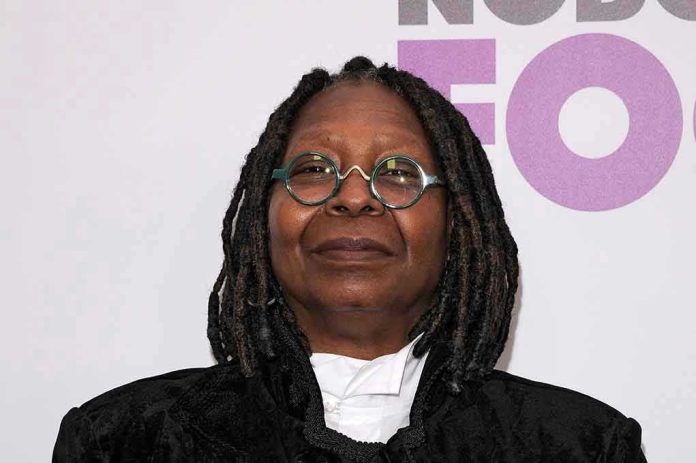
Whoopi Goldberg finds herself in hot water after an on-air clarification for misstatements about Donald Trump ignites controversy.
Story Overview
- Whoopi Goldberg issues an on-air apology for inaccurate statements about Trump.
- Goldberg’s comments linked Trump to a “Brown” shooting and Rob Reiner’s death.
- Conservative outlets demand apology, framing Goldberg’s comments as lies.
- Debate intensifies around media accountability and Trump’s rhetoric.
Whoopi Goldberg’s Controversial Comments
During a discussion on *The View*, Whoopi Goldberg criticized Donald Trump for his remarks following the death of film director Rob Reiner. Goldberg claimed that Trump’s comments contributed to a toxic environment surrounding Reiner’s passing. She also referenced a “Brown” shooting, suggesting Trump’s rhetoric incited violence. However, the specifics of the “Brown” case were not clearly identified, leading to claims that Goldberg’s comments were inaccurate.
Conservative media quickly seized on Goldberg’s statements, labeling them as “lies” and demanding an apology. They accused Goldberg of misrepresenting Trump’s words and linking him to incidents without sufficient evidence. The pressure from these outlets prompted Goldberg to issue a correction and apology on a subsequent episode of *The View*.
Goldberg’s On-Air Apology
In her apology, Goldberg acknowledged that she had overstated or mischaracterized Trump’s comments regarding the “Brown” shooting and Reiner’s death. While she reaffirmed her criticism of Trump’s rhetoric in general, she admitted her specific claims were not entirely accurate. This apology was circulated primarily by conservative media, who framed it as further evidence of liberal media’s dishonesty about Trump.
The incident highlights a recurring theme in partisan media: allegations of mainstream outlets misrepresenting Trump, followed by demands for corrections or retractions. This cycle has been seen in previous controversies, where minor errors are magnified into major scandals, often without altering the core narrative.
The Broader Context and Impact
Goldberg’s comments and subsequent apology occur within a broader context of ongoing media polarization. Trump’s remarks about Rob Reiner, which attributed Reiner’s death to “Trump Derangement Syndrome,” were condemned by Hollywood and discussed on *The View*. This set the stage for Goldberg’s controversial segment, which right-leaning media outlets leveraged to criticize perceived liberal media bias.
In the short term, the incident may cause a reputational hit for Goldberg among conservative critics, but it is unlikely to affect her standing with her primary audience. For Trump, the episode reinforces his supporters’ belief that he is frequently misrepresented by mainstream media. The Brown case, meanwhile, risks being overshadowed by partisan debate rather than receiving focused attention on its own merits.
Media Accountability and Public Perception
This incident illustrates the challenges of maintaining media accountability in a highly partisan environment. Corrections, especially when brief and minimally highlighted, can be seized upon as evidence of systemic bias without altering audience beliefs. For conservative audiences, Goldberg’s apology confirms their suspicions about media dishonesty, while liberal viewers may see it as a minor issue in the context of Trump’s rhetoric.
Daytime talk shows like *The View* face increasing pressure to enhance fact-checking measures, particularly for politically charged segments. The incident contributes to ongoing discussions about media trust and the role of infotainment in shaping public perception.