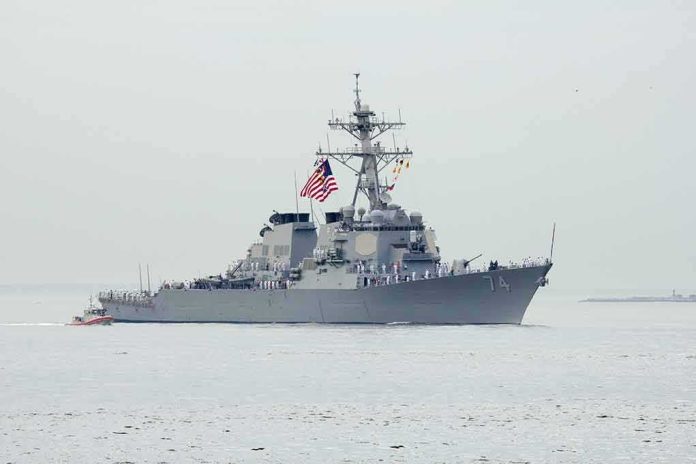
A front-line U.S. destroyer went dark for four days in the South China Sea after a generator failure, forcing a tow to port and raising fresh questions about fleet readiness.
Story Highlights
- The USS Benfold lost power on July 24 due to a generator-related engineering failure, officials said.
- Crew endured days without toilets, galley services, or air conditioning in severe heat; no injuries were reported.
- The ship was towed on July 28 to Subic Bay, Philippines, where power was restored July 30 and repairs finished August 7.
- The incident aligns with documented Navy maintenance strains that reduce ship availability and readiness.
Confirmed Timeline: From Blackout To Return To Sea
U.S. Seventh Fleet officials said the Arleigh Burke-class destroyer USS Benfold experienced a generator-related engineering casualty on July 24 while operating with the USS George Washington Carrier Strike Group in the Indo-Pacific. The loss of power stopped critical shipboard services, including toilets, galley operations, and air conditioning, during sweltering conditions. Navy officials credited the crew for steady response and reported no injuries. The episode ended after a tow to the Philippines and shoreside repair support restored power and systems.
Reporting places the tow on July 28 and the arrival at Subic Bay soon after. Power returned on July 30, with repairs completed on August 7. The destroyer departed Subic Bay the next day and later reached Yokosuka, Japan, marking a full return to movement and scheduled duties. Officials have not publicly detailed the specific failed parts inside the generator systems or the precise sequence of onboard restoration steps used during repair.
Conditions Onboard: Heat, Hygiene, And Food Service
Seventh Fleet’s account said sailors endured several days without basic services that depend on ship power, including toilets and food preparation spaces. Loss of air conditioning increased heat stress, which is a known risk in steel warships in tropical climates. Potable water systems also faced effects during the outage, according to coverage that summarized the Navy’s statements. Navy leaders emphasized that no crew members were injured, and they praised the team’s resilience under difficult conditions in the South China Sea.
Crew hardship claims reached the public through secondary reporting, including family accounts, which adds vivid detail but lacks the weight of official logs. The Navy has not released the ship’s engineering logs or a root-cause report to the public. That limits outside clarity on the exact failure mode, such as whether a fuel, cooling, electrical distribution, or maintenance issue triggered the blackout. The known facts remain the duration, the lost services, the tow, and the repair timeline.
Repair Chain And Support In Subic Bay
Coverage identifies the Ship Repair Facility, Japan Regional Maintenance Center as a key player in restoring Benfold at Subic Bay, suggesting a rapid tasking of regional support to a forward port. The staged timeline—tow, restore power, finish repairs, and depart—matches standard practice when a destroyer needs shoreside help. While reports confirm dates, they do not list which components were replaced or tested before the ship returned to duty, a common gap when only top-line statements are public.
U.S. Destroyer USS Benfold Stranded in South China Sea for 4 Days Due to Power Outage — The U.S. Seventh Fleet confirmed the incident. pic.twitter.com/r49gaHOTSa
— Far East Post (@FarEastPos3t) August 18, 2026
Moving a disabled destroyer in contested waters carries operational risk and geopolitical visibility. The South China Sea is crowded with foreign ships, surveillance, and propaganda. A dark, adrift American warship invites attention. Getting Benfold under tow within days and back to sea within two weeks reduced that window. Still, the incident became a symbol online, where short clips and hot takes often outpace official briefings and detailed maintenance records.
Why This Matters: Readiness And A Pattern Of Strain
The Benfold outage fits a larger pattern: the U.S. Navy has struggled with maintenance backlogs and delays across surface fleets. The Congressional Budget Office reports that large conventional ships, including destroyers, face chronic maintenance delays that reduce time at sea and strain schedules. The Government Accountability Office has tracked rising casualty reports and fewer steaming hours for multiple ship classes over the past decade. This backdrop makes each casualty carry broader weight for deterrence and morale.
What We Know And What Comes Next
We know the what, when, and how the Navy responded: a generator failure on July 24, loss of power and key services, a tow to Subic Bay on July 28, power restored July 30, repairs finished August 7, and departure August 8. We do not yet have a public root-cause analysis that explains the exact failure inside the generator system. Until the Navy releases more technical detail, the event stands as a clear operational disruption within a well-documented readiness challenge.
Sources:
zerohedge.com, theguardian.com, opex360.com, reddit.com, cbo.gov