Los Angeles County’s 2026 West Nile virus surge was not a fluke of headlines but a textbook convergence of ecology and weather: more infected mosquitoes lived long enough to bite more people, and the human toll followed.
At a Glance
- By late September 2026, Los Angeles County had reported 100 human West Nile infections and five deaths — the highest early-season tally in nearly a decade.
- Subsequent county reporting showed the season ultimately climbed well beyond that early mark, exceeding recent five-year averages.
- Vector and wildlife surveillance corroborated elevated transmission: far more West Nile–positive mosquito pools and infected dead birds than the prior year.
- Extreme heat and unusually humid conditions coincided with the surge; higher humidity lengthens mosquito lifespan, extending transmission windows.
The 2026 signal: human illness, infected vectors, and dead birds moved in tandem
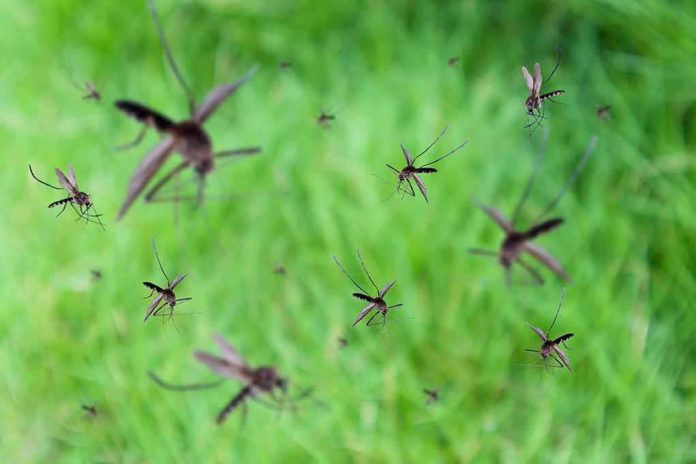
Public health surveillance rarely hands you a single, unambiguous gauge; strong signals arise when multiple indicators align. In 2026, Los Angeles County registered 100 human West Nile virus (WNV) cases and five deaths by September 21, the county’s highest early-season count in almost a decade. In the ensuing weeks, cumulative reporting rose further, and the county’s arbovirus report explicitly stated that 2026 infections exceeded the five-year average for the same point in the season — a critical benchmark that filters out simple calendar effects. Parallel ecological indicators told the same story: by late September, a local vector control district had detected 384 WNV-positive mosquito samples and 78 infected dead birds, compared with 104 positive mosquito pools and two infected birds at the same time in 2025. When human cases, infected vectors, and avian deaths all track upward together, the inference is robust: transmission intensity was genuinely elevated.
The season’s early public numbers, such as the widely cited 100-case milestone in September, later gave way to higher totals as investigations closed and delayed reports posted — a routine feature of communicable-disease surveillance rather than a contradiction of the early snapshot. For risk communication, two truths can coexist: the early count captured an unusually hot start to the season; the reconciled total captured its full scale.
Mechanism: how heat and humidity amplify West Nile risk
West Nile transmission is a multi-host, temperature-sensitive system. Culex mosquitoes acquire the virus from infected birds; after an “extrinsic incubation” period in the mosquito — which shortens at higher temperatures — they can pass it to new avian or human hosts. Humidity matters for a different, decisive reason: it prolongs adult mosquito survival. Each additional day an infected mosquito lives is another opportunity to bite and transmit. Vector-control officials in Southern California described the relationship plainly: increased humidity extends mosquito lifespan, increasing the probability that infected mosquitoes live long enough to spread virus to people. In 2026, extreme heat paired with record or near-record humidity, conditions that media and local officials linked to El Niño–driven moisture, aligned with the transmission surge.
These weather effects interact with urban microecology. Small artificial containers, irrigation runoff, and neglected pools can produce dense Culex populations in otherwise dry climates; warm nights accelerate larval development; and humid air reduces desiccation stress on adults, effectively lengthening the biting season. Surveillance guidelines reflect these dynamics: jurisdictions that track infection prevalence in mosquito pools and sentinel hosts can often detect rising human risk two to four weeks before clinical cases present, offering a window for intensified control.
What the surveillance can and cannot tell you
Two boundaries are crucial for a clear reading. First, the 2026 spike was a West Nile transmission event, not a blanket claim that “mosquitoes took over” uniformly across a county of ten million residents. Surveillance captured infected Culex pools and dead birds in far greater numbers than the prior year, and human infections rose accordingly; that is evidence of elevated WNV risk, not a census of every mosquito species or neighborhood. Second, while heat and humidity coincided with the surge — and the biological logic linking humidity to longer-lived, more infectious mosquitoes is well established — no single, public model apportioned the 2026 increase among weather, land use, mosquito-control operations, or chance year-to-year variability. The inference is sound at the level of mechanism and timing; the exact causal shares remain unquantified.
Context matters for interpretation. West Nile seasons in California typically build from summer through fall, sometimes extending into November, and the state has seen abrupt, localized outbreaks before. That is why practitioners prefer comparisons anchored to timing, geography, and effort — for example, mid-September 2026 versus the same week across recent years, adjusted for trap counts and testing — rather than raw season totals alone. In 2026, even with these cautions, the county’s own five-year comparison flagged higher-than-usual infections for the period.
Implications for public health practice and personal risk management
For agencies, the 2026 pattern validates an all-hazards vector posture calibrated to weather. Warm, humid anomalies — whether tied to El Niño or late-season tropical moisture — should trigger pre-planned escalations: more traps in high-risk microhabitats, accelerated testing of mosquito pools, early larvicide runs where breeding habitat expands, and targeted adulticide operations where infection indices cross risk thresholds. When surveillance indicators move in concert — rising minimum temperatures, persistent humidity, more WNV-positive pools, and infected birds — public messaging should shift from generic summer reminders to concrete, neighborhood-specific calls to action, synchronized with operations on the ground.
For residents, the risk calculus is straightforward and actionable. Most WNV infections are asymptomatic, but a small fraction progress to neuroinvasive disease with serious consequences. Because there is no human vaccine or curative therapy, prevention is behavioral and environmental: remove standing water weekly, repair window and door screens, use repellents with proven actives (such as DEET or picaridin) when outdoors at dawn and dusk, and report mosquito problems to local vector control. These measures are not theatrical; they directly target the steps in the transmission chain that weather cannot by itself complete.
Why the 2026 surge is a durable lesson, not a one-off
As climate variability and urban water practices reshape local humidity and heat profiles, years like 2026 will recur. The durable lesson is not that Los Angeles is perennially doomed to “living hell” summers, but that West Nile risk is legible — and manageable — when we read the system correctly. Align vector and wildlife surveillance with weather anomalies; act early when longevity and infection indices rise; communicate risk with precision, not panic. In 2026, the data streams that matter most pointed in the same direction: more infected mosquitoes, more infected birds, and more human cases — earlier and in higher numbers than recent baselines. That alignment is the signal to plan for, and to meet with discipline.
Los Angeles is facing a significant public health challenge as West Nile virus cases surpass 180. Officials report that record-breaking heat and environmental conditions have created a breeding ground for a surge in Aedes mosquito populations across the pic.twitter.com/PdtWWunW5J
— Azat TV (@azattelevision) October 11, 2026
Sources:
feedpress.me, lacounty.gov, latimes.com, mynewsla.com