The most powerful law‑and‑order story in America right now is not at the border, but on a South Minneapolis street where a federal bullet met a local conscience.
Story Snapshot
- A fatal ICE shooting in Minneapolis has ignited thousands of protests across multiple U.S. cities.
- Federal officials insist on self‑defense and “absolute immunity,” while state prosecutors say they have jurisdiction.
- Democrats frame the clash as an accountability crisis; Republicans stress officer safety and law‑and‑order.
- The outcome will quietly redefine how far federal power can go inside American neighborhoods.
A Minneapolis shooting that refused to stay local
On January 7, 2026, a 37‑year‑old woman named Renée Nicole Good was fatally shot by an Immigration and Customs Enforcement officer during a confrontation involving her car in a Minneapolis neighborhood. Federal officials say she tried to run over officers, justifying lethal force as self‑defense. Local officials immediately challenged both the narrative and the message from Washington when Vice President J.D. Vance asserted that the officer enjoyed “absolute immunity” from prosecution.
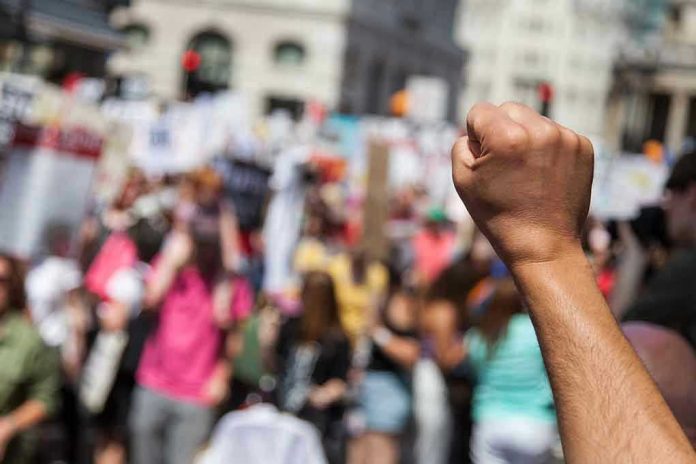
By the weekend, thousands of residents marched to the shooting site in south Minneapolis, turning a disputed use‑of‑force incident into a mass rejection of an aggressive federal presence. Protests remained largely peaceful, with some arrests, and the mayor publicly praised demonstrators for keeping order. Smaller but symbolically potent marches appeared in New York City and Washington, D.C., echoing calls to curb ICE’s footprint in American cities.
When federal power collides with local authority
The fault line now runs between Washington’s control of the case and Minnesota’s demand to investigate on its own terms. The FBI leads the primary investigation and holds key evidence, including Good’s vehicle. Hennepin County Attorney Mary Moriarty counters that her office has jurisdiction and that the ICE officer does not enjoy blanket immunity under state criminal law. Minnesota Attorney General Keith Ellison backs that position and warns no honest conclusion is possible yet because state investigators lack access to federal evidence and personnel.
That imbalance of access prompted Moriarty and Ellison to do something unusual: ask ordinary citizens to send in cellphone video and any information through a county website. State officials describe having “really none” access to federal officers and critical materials, which forces them to build a parallel evidence trail. For conservatives who value federalism, this is an uncomfortable picture: a central government asserting dominance while state and local authorities publicly complain they are being sidelined in a shooting that happened on their streets.
Immigration enforcement, politics, and the protest spotlight
This confrontation does not appear in a vacuum. Since early December, the Trump administration has surged thousands of federal law enforcement officers, including ICE, into Minnesota in the name of combating migrant‑related crime and tightening interior enforcement. Minneapolis, with its large immigrant communities and the lingering shadow of George Floyd’s killing, was already on edge as agents “swarmed” certain neighborhoods. The shooting of Good became the spark for anger about that broader deployment rather than just one tragic encounter.
On national talk shows, the divide fell along familiar lines. Democrats portrayed the shooting and the closed nature of the investigation as part of a pattern of overreach and opacity by ICE and its political overseers. Republicans such as Sen. Markwayne Mullin defended the right of officers to use lethal force if they feel threatened, aligning with the Department of Homeland Security’s self‑defense description. From a conservative common‑sense lens, defending law enforcement’s right to go home alive is non‑negotiable, but so is the expectation that when a citizen dies, an accountable and transparent process, not a pre‑emptive immunity declaration. tests the facts.
Civil liberties, crowd control, and the National Guard shadow
As crowds grew, Minnesota Governor Tim Walz issued a warning order to prepare the National Guard for possible deployment if protests spiraled. For now, demonstrations have remained overwhelmingly peaceful, and the Guard has functioned more as a contingency plan than an occupying force. Local and neighboring Democratic officials, such as Illinois Governor J.B. Pritzker, urged protesters not to hand Washington a pretext for harsher crackdowns by turning peaceful marches into confrontations.
Inside the federal system, Politico reports quiet concern that locking down information and leaning on immunity language could damage public trust in both ICE and the broader enforcement mission over the long term. Congressional Democrats have already clashed with the administration over transparency, with three House members denied entry to a Minneapolis immigration facility after new restrictions on visits. That kind of secrecy feeds the narrative that the government polices itself behind closed doors, a narrative that undercuts respect for lawful authority more than any chant in a protest line.
Sources:
Minneapolis ICE shooting deepens partisan divide over federal enforcement (Politico)